Share This Page
Drug Price Trends for DOUBLE ANTIBIOTIC OINTMENT
✉ Email this page to a colleague
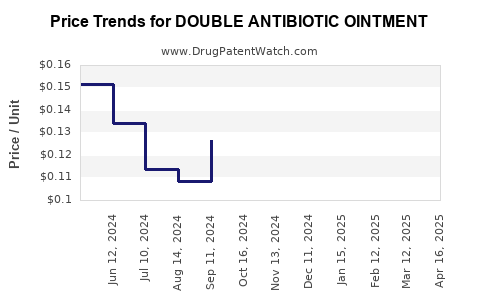
Average Pharmacy Cost for DOUBLE ANTIBIOTIC OINTMENT
| Drug Name | NDC | Price/Unit ($) | Unit | Date |
|---|---|---|---|---|
| DOUBLE ANTIBIOTIC OINTMENT | 51672-2044-02 | 0.10799 | GM | 2026-07-22 |
| DOUBLE ANTIBIOTIC OINTMENT | 51672-2044-02 | 0.10656 | GM | 2026-06-17 |
| DOUBLE ANTIBIOTIC OINTMENT | 51672-2044-02 | 0.10680 | GM | 2026-05-20 |
| DOUBLE ANTIBIOTIC OINTMENT | 51672-2044-02 | 0.10892 | GM | 2026-04-22 |
| >Drug Name | >NDC | >Price/Unit ($) | >Unit | >Date |
Market Analysis and Price Projections for Double Antibiotic Ointment
Market Overview
Double Antibiotic Ointment is a topical antimicrobial treatment combining two antibiotics, typically Bacitracin and Polymyxin B. Its primary indications include minor skin infections, cuts, and abrasions, where it prevents infection and promotes healing. The global topical antibiotic market was valued at approximately $2.6 billion in 2022 and is projected to grow at a compound annual growth rate (CAGR) of 4.2% through 2027, driven by rising antimicrobial resistance concerns and increased outpatient care.
Market Drivers
- Growing incidence of skin wounds, cuts, and post-surgical infections.
- Increasing antibiotic resistance leading to demand for combination therapies.
- Aging populations and chronic skin conditions.
- Expanding healthcare infrastructure in emerging markets.
Market Challenges
- Over-the-counter (OTC) status affects sales channels.
- Competition from generic formulations and alternative wound care products.
- Regulatory scrutiny on antimicrobial agents due to resistance concerns.
- Pricing pressures from insurance payers and government healthcare programs.
Competitive Landscape
Major manufacturers include Johnson & Johnson, GlaxoSmithKline, and Perrigo. Generics dominate the segment, accounting for over 70% of sales. Innovations focus on improved formulations with enhanced healing properties or extended shelf life. OTC status grants wide accessibility, but limits premium pricing strategies.
Price Projections
Current retail prices of Double Antibiotic Ointments vary widely based on brand, packaging, and distribution region:
| Region | Approximate Price per Tube (15g) | Notes |
|---|---|---|
| United States | $3.50 - $7.00 | OTC products; premium brands at higher end |
| Europe | €3.00 - €6.50 | Similar OTC availability, currency effects |
| Emerging Markets | $1.50 - $4.00 | Price sensitivity; generic dominant |
Forecasted Pricing Trends (2023-2028)
- Premium Brands: Prices expected to stabilize around current levels, with minor increases due to manufacturing costs. Limited growth expected due to OTC competition.
- Generics: Prices likely to decline 1-2% annually, driven by generic competition and market saturation.
- Regional Variations: In emerging markets, prices could decrease further as local manufacturers expand, with prices stabilizing around $1.50 to $2.50 per tube.
Pricing Drivers
- Ingredient costs, especially antibiotics and excipients.
- Regulatory approval costs for new formulations.
- Distribution and marketing expenses.
- Competitive positioning and brand recognition.
Regulatory and Patent Landscape
- Many formulations are off-patent, resulting in low barriers to entry.
- Limited patent protections in most regions allow multiple generic players.
- Some formulations may be subject to regulations targeting antimicrobial resistance, affecting future formulations.
Future Market Opportunities
- Development of combination products with newer antibiotics or wound-healing agents.
- Formulation innovations for extended shelf life or improved stability.
- Entry into emerging markets through strategic partnerships.
Summary
The market for Double Antibiotic Ointment remains competitive, with slow price declines driven by generics. Price stability is observed in developed regions, while emerging markets see more variability. The overall market is expected to grow moderately via increased demand for wound care and resistance management strategies.
Key Takeaways
- The global topical antibiotic market was valued at $2.6 billion in 2022, with a forecast CAGR of 4.2% through 2027.
- Prices range from $1.50–$7.00 per 15g tube, depending on region and brand.
- Generics dominate sales, exerting downward pressure on prices.
- Regulatory developments and antimicrobial resistance influence market dynamics.
- Opportunities exist in formulation enhancements and new markets.
FAQs
1. What factors influence the pricing of Double Antibiotic Ointment?
Ingredient costs, manufacturing expenses, regulatory requirements, market competition, and regional economics are primary factors.
2. How will antimicrobial resistance impact the market?
Regulatory restrictions and a shift toward novel formulations could limit growth or alter pricing strategies.
3. Are generic versions significantly cheaper?
Yes; generics often sell for 30-50% less than branded products due to lower R&D costs and patent expirations.
4. What emerging markets offer growth potential?
Markets in Southeast Asia, Africa, and Latin America are expanding, with increasing healthcare infrastructure and OTC product adoption.
5. Will innovation lead to higher prices?
Potentially, if new formulations demonstrate clear advantages, but market pressure favors cost-effective solutions, especially in OTC segments.
Sources
- MarketWatch, "Global Antibiotic Market Forecast," 2022.
- Grand View Research, "Topical Antibiotics Market Size & Trends," 2023.
- U.S. Food and Drug Administration, "OTC Topical Antibiotics," 2022.
- World Health Organization, "Antimicrobial Resistance Fact Sheet," 2021.
- IQVIA, "Price Trends in Over-the-Counter Drugs," 2022.
More… ↓
