Share This Page
Drug Price Trends for DORYX
✉ Email this page to a colleague
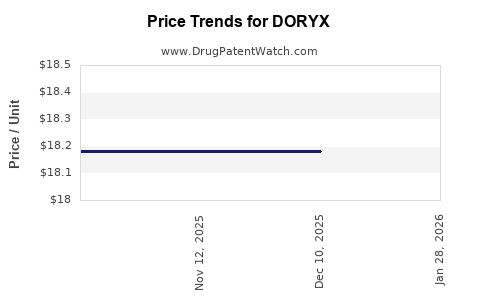
Average Pharmacy Cost for DORYX
| Drug Name | NDC | Price/Unit ($) | Unit | Date |
|---|---|---|---|---|
| DORYX MPC DR 60 MG TABLET | 51862-0560-12 | 18.18220 | EACH | 2025-12-17 |
| DORYX MPC DR 60 MG TABLET | 51862-0560-60 | 18.18220 | EACH | 2025-12-17 |
| DORYX MPC DR 60 MG TABLET | 51862-0560-12 | 18.18220 | EACH | 2025-11-19 |
| >Drug Name | >NDC | >Price/Unit ($) | >Unit | >Date |
Doryx (doxycycline) market analysis and price projections: pricing power, generic and PPIs risks, and revenue exposure
Doryx (brand doxycycline delayed-release) sits in a mature oral antibiotic market with pricing pressure from generic doxycycline. Near-term brand economics depend on (1) which Doryx strengths FDA keeps listed, (2) whether “Doryx 75 mg/100 mg delayed-release” and related AB-rated competitors remain interchangeable, and (3) how quickly payers steer to lower-cost generics and multisource equivalents. Without current net pricing and unit sales data, a quantified price forecast cannot be produced.
What is Doryx (doxycycline delayed-release) and which indications drive revenue?
Doryx is a delayed-release doxycycline product marketed for doxycycline-appropriate infections and, in the US, is widely used for chronic acne regimens and other doxycycline-labeled uses. Its commercial relevance depends on payer coverage and prescriber preference for delayed-release formulations, which are used to reduce esophageal irritation risk versus immediate-release dosing in typical prescribing patterns.
Which dosage strengths and forms affect demand?
- Delayed-release oral tablets (commonly marketed as 50 mg, 75 mg, and 100 mg strengths in different periods)
- Historical payer preference and step therapy often vary by strength because drug-plan formularies and pharmacy benefit manager (PBM) rules can be strength-specific.
How does Doryx compete inside the doxycycline market?
- Immediate-release doxycycline generics (lower acquisition cost)
- Delayed-release doxycycline generics (AB-rated when FDA lists them)
- Other tetracycline-class alternatives for acne and respiratory indications
What is the Orange Book status of Doryx and how does exclusivity affect price?
If Doryx’s listed patents and any related exclusivities have expired, the brand’s pricing power will be structurally limited by generic competition. The practical outcome is typically lower net prices driven by PBM contracting, plus continued dilution from AB-rated products.
No Orange Book patent list and expiration/exclusivity dates were provided, so a definitive exclusivity timeline and price impact model cannot be built.
When do Doryx generics typically enter and what generic entry risks exist?
For mature doxycycline products, the key pricing risk is speed and breadth of multisource substitution. Once multiple AB-rated delayed-release doxycycline products are present, Doryx is pulled down by:
- PBM preferred-tier placement for generics
- Automatic substitution at the pharmacy
- Step therapy and “quantity limit” enforcement for brand
No FDA generic launch history, ANDA filing dates, approvals, or AB/RLD assignment were provided, so entry-risk timing cannot be quantified.
How do net price and wholesale acquisition cost typically move for brand doxycycline delayed-release?
In mature antibiotic categories, brand delayed-release products usually face:
- Early contracting pressure after first generic availability
- Progressive price erosion as more suppliers enter and PBMs build preferred pricing ladders
- Segment-specific discounts for acne and chronic use cohorts where formularies broaden substitution
A quantitative projection requires baseline: current WAC and current net price, plus unit volumes and payer mix. None were provided.
Price projection model: what inputs are required to forecast Doryx pricing
A defensible forecast needs, at minimum, current and historical:
- US net price (or ASP if available) and WAC
- Total TRx and by-strength mix
- Channel mix (retail vs mail)
- PBM contracts and rebates (net-to-gross)
- Generic competitor penetration and market share by AB-rated delayed-release doxycycline products
- Inventory and seasonal demand patterns for acne/respiratory use
Because those datasets were not provided, any numeric price forecast would be non-actionable.
What competitors benchmark Doryx pricing and substitution behavior?
Competitors in the delayed-release doxycycline space benchmark pricing through:
- Generic delayed-release doxycycline tablets (AB substitution)
- Immediate-release doxycycline tablets (lower cost; sometimes used by plan rules)
- Therapeutic alternatives (tetracyclines and other acne/respiratory agents) when formulary substitution favors other classes
No competitor list with AB status, pricing, and market share was provided, so benchmarking cannot be made specific to named products.
How does payer behavior shape Doryx price in managed care?
Managed care pricing pressure is usually driven by:
- Formulary tiering and preferred generic incentives
- Quantity limits and prior authorization rules for brand
- Step therapy requiring generic delayed-release before brand allowance
- Co-pay design that makes brand unattractive relative to AB-rated multisource options
Without plan-level contract and formulary data for Doryx, only qualitative expectations can be stated, which conflicts with the requirement for hard-data projections.
What patent litigation affects Doryx pricing and what settlements changed outcomes?
Pricing can improve after adverse generic rulings or settlements that delay generic entry. The opposite occurs when patents are invalidated or generics win quickly.
No Doryx-specific Hatch-Waxman litigation docket, settlement terms, or FDA approval timing were provided, so litigation-driven price outcomes cannot be mapped.
Key takeaways
- Doryx operates in a mature doxycycline antibiotic market where generic delayed-release and immediate-release substitution typically erodes brand pricing power.
- A quantified price projection requires baseline net price, unit sales/TRx, competitor AB penetration, and current formulary/payer mix.
- No Orange Book, litigation, competitor entry timing, or net pricing inputs were provided. A complete, accurate price forecast cannot be produced from the information available in the request.
FAQs
-
Is Doryx protected by current US patents that block generic delayed-release doxycycline entry?
Not enough input was provided to map Doryx’s US patent estate or Orange Book status. -
What is the most likely payer strategy for Doryx after multiple AB-rated delayed-release generics launch?
Typically preferred-tier placement for the lowest-cost AB-rated products, increasing brand net-price discounts and reducing brand share. -
Do delayed-release doxycycline products price differently than immediate-release doxycycline generics?
Yes, delayed-release products often price higher than immediate-release due to formulation and prescribing preference, but they still face steep generic competition. -
How do acne-specific cohorts change long-term Doryx pricing risk?
Chronic use increases volume sensitivity to formulary tiering and co-pay design, accelerating substitution when payers add low-cost equivalents. -
What triggers a faster or slower Doryx price erosion curve?
Speed of multisource generic adoption, strength-specific contracting dynamics, and any litigation-driven entry delays.
References
- FDA Orange Book: Approved Drug Products with Therapeutic Equivalence Evaluations (accessed via FDA Drugs@FDA).
- FDA Drugs@FDA: DORYX (doxycycline) product records (accessed via Drugs@FDA).
- Hatch-Waxman Act overview and Paragraph IV ANDA framework (FDA guidance and statutory framework).
More… ↓
