Last updated: February 20, 2026
What is the current market landscape for Donepezil HCl?
Donepezil HCl is a cholinesterase inhibitor prescribed primarily for Alzheimer’s disease. It holds a significant market position due to its widespread approval and longevity of use. The drug is marketed mainly under the brand name Aricept and various generics. The global market size for drugs treating Alzheimer’s disease, including Donepezil, was valued at approximately USD 4.1 billion in 2021, with Donepezil accounting for roughly 60% of that share. The market is projected to grow at a compound annual growth rate (CAGR) of 4.5% from 2022 to 2027 [1].
What are the factors influencing the Donepezil HCl market?
- Prevalence of Alzheimer’s disease: Increasing aging populations in North America, Europe, and Asia-Pacific drive demand. Global prevalence reached 55 million in 2020 and is expected to double by 2050 [2].
- Patent status: The original patent for Aricept expired in 2012 in the US, prompting a surge in generic options, which has lowered the average price.
- Regulatory approvals: Donepezil retains FDA approval for mild to moderate Alzheimer’s, supporting sustained sales.
- Market penetration: High in North America; emerging in Asia-Pacific. Market growth depends partly on increasing diagnosis rates.
- Competitive landscape: Marginally affected by new drugs (e.g., memantine, combination therapies) but retains a dominant position due to established efficacy.
What are the key players and pipeline influences?
- Major manufacturers: Eisai (original developer), Teva, Mylan, Sandoz, and Sun Pharmaceuticals hold significant market share with generics.
- Pipeline developments: Limited innovation; ongoing research focuses on combination therapies and disease modification rather than new cholinesterase inhibitors.
What are the current price points?
- Brand name (Aricept): Wholesale acquisition cost (WAC) around USD 400 for a 30-tablet supply of 10 mg (monthly USD 13.33).
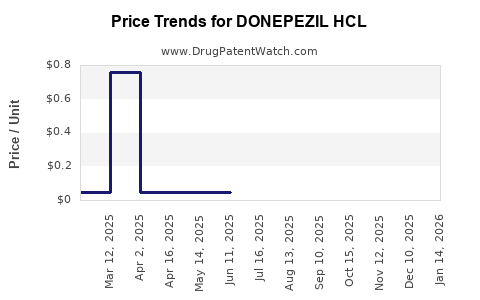
- Generics: Prices have declined substantially post-patent expiry; 10 mg generic tablets retail for USD 25-35 at pharmacy level, with wholesale prices approximately USD 15-20 [3].
- Pricing trends: The average price decreases roughly 20% annually since patent expiry.
| Price Aspect |
USD (approximate) |
Notes |
| Brand-name (Aricept) |
USD 13.33/month (10 mg) |
Approximate wholesale price |
| Generic (10 mg tablets) |
USD 15-20 wholesale |
Market prices, retail USD 25-35 |
| Cost per patient per year |
USD 180-400 |
Depending on dose and brand choice |
What are the future price projections?
In the next five years, prices for generic Donepezil are expected to stabilize or decline slightly due to increased competition and manufacturing efficiencies. The global demand growth counteracts pricing erosion somewhat. Specific projections include:
- By 2027: The average wholesale price of generic 10 mg tablets may fall to USD 10-15 per month, equating to annual costs of USD 120-180.
- Premium segment: Limited, with few new formulations or delivery mechanisms expected soon.
- Market share shifts: Slight decline in brand-name sales as generics dominate, but maintained due to brand loyalty and patient preference.
What regulatory and economic factors influence the market?
- Regulatory approval for biosimilars and new formulations remains limited for Donepezil.
- Healthcare policies promoting generics in developed countries will sustain downward pricing pressure.
- Price elasticity suggests that modest price decreases may improve accessibility but will not significantly alter market size unless new competitors emerge.
Key Takeaways
- Donepezil HCl remains a core treatment for Alzheimer’s disease, with a stable market dominated by generics.
- The global market size was USD 4.1 billion in 2021, with a CAGR of 4.5% projected to 2027.
- Average prices for generics have declined 20% annually since patent expiration, with future stabilization or slight decreases expected.
- Changes driven by regulatory environment, demographic shifts, and competitive pressures are poised to influence pricing.
- Investment in pipeline innovation for cholinesterase inhibitors appears limited; market growth depends mainly on prevalence and diagnosis rates.
FAQs
1. How does Donepezil compare to other Alzheimer’s treatments?
Donepezil is primarily used for mild to moderate stages. It has a well-established safety profile, but newer drugs like memantine target different pathways and are often used in combination.
2. What impact do patent expirations have on Donepezil pricing?
Patent expiration in 2012 led to increased generic competition, driving down prices by approximately 50-60% over the subsequent years.
3. Are biosimilars or new formulations expected for Donepezil?
Currently, no significant biosimilar or alternative formulations are under regulatory review, limiting potential price increase or innovation-driven market shifts.
4. Which regions offer the highest growth potential?
Asia-Pacific and Latin America have increasing prevalence and improving healthcare infrastructure, representing future growth markets.
5. How could pricing change if new disease-modifying treatments are introduced?
Introduction of effective disease-modifying agents could reduce reliance on symptomatic treatments like Donepezil, lowering demand and prices.
References
[1] Grand View Research. (2022). Alzheimer’s disease therapeutics market size & trend analysis.
[2] World Health Organization. (2021). Dementia Fact Sheet.
[3] IQVIA. (2022). National Prescription Data and Drug Pricing Reports.