Last updated: February 12, 2026
What Is the Market Size and Demand for Docusate Sodium?
Docusate sodium is a widely used stool softener primarily for constipation relief. The global demand remains stable due to its over-the-counter availability and widespread use in hospitals, clinics, and home care settings.
Market Size
The global laxative market, which includes docusate sodium, was valued at approximately $3.8 billion in 2022. Docusate sodium holds an estimated 20-25% market share within the laxatives segment.
Demand Drivers
- Increasing prevalence of chronic constipation linked to aging populations.
- Rising awareness of digestive health.
- Growing use in hospital and post-operative care.
Regional demand indicates North America accounts for about 45% of the global market, with Europe at around 25%, and Asia-Pacific trailing at roughly 20%. The remaining 10% is distributed among Latin America, the Middle East, and Africa.
How Competitive Is the Market for Docusate Sodium?
Multiple generic manufacturers produce docusate sodium, resulting in a highly commoditized market. Major pharmaceutical companies with established OTC portfolios include:
- Pfizer
- Mylan (now part of Viatris)
- Teva Pharmaceuticals
- Sun Pharmaceutical
Brand-name products such as Colace (Bayer) are less dominant due to generic competition, with generics accounting for over 80% of sales.
What Are the Price Trends and Projections?
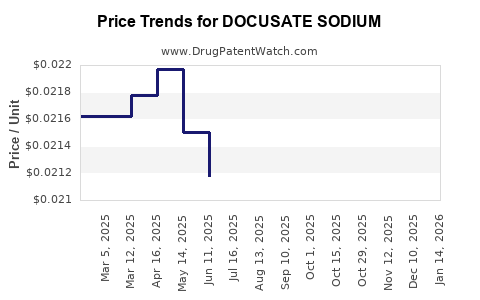
Current Pricing Dynamics
- The typical retail price for a 100-capsule pack of docusate sodium ranges from $4 to $8.
- Wholesale prices for generics hover around $0.05 to $0.15 per capsule.
- Hospitals and pharmacies often negotiate lower prices based on volume.
Historical Price Trends
Between 2015 and 2020, generic prices for docusate sodium remained relatively stable, with minor fluctuations due to supply chain factors and raw material costs.
Future Price Projections
Given the high generic competition and stable demand, wholesale prices are unlikely to increase significantly in the near term. However, potential price pressures include:
- Raw material cost volatility, mainly in manufacturing excipients.
- Regulatory changes impacting manufacturing standards.
- Supply chain disruptions, particularly in Asia, the primary production hub for active pharmaceutical ingredients (APIs).
Price Outlook (Next 5 Years):
- Wholesale capsule prices are expected to stay within $0.05 to $0.20 per capsule.
- Retail prices may see minor increases, trending around $0.10 to $0.20 per capsule by 2027.
- Innovator brands, if launched, may command premiums of up to 30-50% over generics but are unlikely to dominate market share due to established generic pricing.
What Regulatory Factors Influence Pricing and Market Dynamics?
The US Food and Drug Administration (FDA) classifies docusate sodium as generally recognized as safe (GRAS) for OTC use.
- No significant regulatory barriers for generic entry exist.
- Patent protection largely expired in the late 1990s, enabling widespread generic manufacturing.
- Ongoing quality standards and Good Manufacturing Practices (GMP) compliance influence costs but do not significantly alter pricing.
Globally, regulatory landscapes vary; countries with tighter control may see slightly higher prices due to certification costs.
How Do Raw Material Costs Impact Prices?
- The primary raw materials are surfactants and excipients.
- Volatility in the price of surfactants (like sodium lauryl sulfate derivatives) affects API manufacturing costs.
- Raw material prices saw an upward trend in 2021-2022 due to supply chain disruptions.
Investment and Development Trends
- No recent significant R&D investments for new formulations or delivery mechanisms are noted.
- Market focus remains on maintaining supply and reducing costs.
- Limited innovation indicates stability rather than growth in drug formulations.
Key Takeaways
- Docusate sodium occupies a stable niche in the OTC stool softener market with a valuation of about $0.76 billion globally.
- The market is intensely competitive with generic dominance, constraining price increases.
- Wholesale prices are expected to stay within a narrow range ($0.05–$0.20 per capsule) over the next five years.
- Market growth is driven by aging populations and increased gastrointestinal health awareness but limited by market saturation.
- Raw material costs and supply chain stability are current price influence factors.
FAQs
Q1: What is the primary use of docusate sodium?
It is used as a stool softener to treat occasional constipation.
Q2: Who are the main competitors in the docusate sodium market?
Major generic manufacturers like Mylan (Viatris), Teva, and Sun Pharmaceutical.
Q3: How are pricing trends expected to evolve?
Wholesale prices are projected to remain steady, with retail prices increasing marginally over five years.
Q4: Are there any new formulations or delivery methods in development?
No significant new formulations are reported; focus remains on generic manufacturing and cost reduction.
Q5: What regulatory factors influence the market?
The drug's OTC approval and lack of recent patent protections facilitate easy market entry, maintaining competitive pricing levels.
References
- MarketsandMarkets. “Laxatives & Stool Softeners Market Analysis,” 2022.
- IQVIA. “Global OTC Market Data,” 2022.
- FDA. “Over-the-Counter Drugs Monograph,” 2023.
- Pharmaceutical Research and Manufacturers of America (PhRMA). “Generic Drug Market Trends,” 2022.
- IMS Health. “Raw Material Cost Trends,” 2021.