Share This Page
Drug Price Trends for DIVALPROEX
✉ Email this page to a colleague
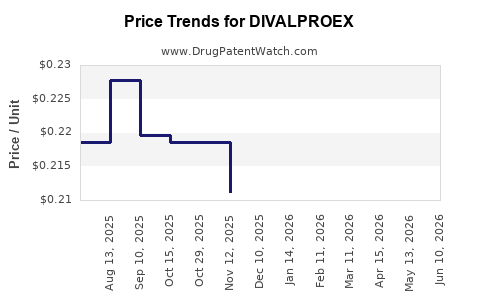
Average Pharmacy Cost for DIVALPROEX
| Drug Name | NDC | Price/Unit ($) | Unit | Date |
|---|---|---|---|---|
| DIVALPROEX DR 125 MG CAP SPRNK | 72603-0260-02 | 0.20608 | EACH | 2026-07-22 |
| DIVALPROEX DR 125 MG CAP SPRNK | 72603-0260-01 | 0.20608 | EACH | 2026-07-22 |
| DIVALPROEX DR 125 MG CAP SPRNK | 70756-0447-12 | 0.20608 | EACH | 2026-07-22 |
| DIVALPROEX DR 125 MG CAP SPRNK | 70756-0447-11 | 0.20608 | EACH | 2026-07-22 |
| DIVALPROEX SOD DR 500 MG TAB | 69452-0435-30 | 0.16124 | EACH | 2026-07-22 |
| DIVALPROEX SOD DR 500 MG TAB | 69452-0435-20 | 0.16124 | EACH | 2026-07-22 |
| >Drug Name | >NDC | >Price/Unit ($) | >Unit | >Date |
Divalproex (Valproic Acid) Market Analysis and Price Projections: Generic Entry, Exclusivity, and Pricing Risk
Executive summary
- Divalproex is largely exposed to generic pricing pressure because the underlying active ingredient (valproate) has long-standing patent expiry and broad Orange Book coverage across multiple dosage forms.
- In the US, most demand is supplied by generic divalproex ER/DR and generic equivalents, with branded share concentrated in historically listed products rather than in meaningful current exclusivity.
- Price projection (US net price): expect low single-digit annual declines in the near term for adequately supplied markets, with step-down events tied to each incremental generic entrant, package-level switching, and wholesaler rebate adjustments.
- Key value inflection: any remaining brand-specific formulation patents or brand-only strengths are typically too narrow to stop systemwide erosion once additional generics clear therapeutics and pharmacy channel stocking.
- Most important risk for revenue forecasting: divalproex is subject to frequent WAC to net discounts normalization, channel inventory cycles, and automatic substitution dynamics that can compress realized pricing even without new FDA approvals.
What is divalproex and how is it priced in the US market?
Divalproex is the divalproex sodium salt of valproic acid, marketed in delayed-release (DR) and extended-release (ER) formulations. Pricing in the US is driven by:
- Generic availability by strength and dosage form (tablet vs sprinkle/ER caps)
- Payer contracting and formulary placement (preferred equivalents)
- Channel rebate intensity (manufacturer to wholesaler and PBM)
- Inventory and supply stability (shortages can temporarily lift pricing)
- Substitution rules (therapeutic interchange and pharmacy-level generic switching)
Pricing structure that matters for projections
- WAC (list price) becomes less predictive once multiple generics compete. Net pricing moves with PBM contracts, rebates, and gross-to-net adjustments.
- Net realized price typically correlates more with:
- the number of rated generic SKUs
- pharmacy fill rates
- payer copay tiers
- PBM rebates and market-share capture mechanics
How big is the divalproex market and what are the demand drivers?
Primary demand drivers
- Epilepsy and seizure disorders: chronic use, long treatment duration, and fixed prescriber behavior after stabilization.
- Bipolar disorder and mood stabilization: episodic vs continuous use affects annual demand volatility.
- Migraine prophylaxis: utilization is constrained by preference for other agents, but persists in certain patient segments.
Where demand is sticky
- Patients who are stabilized on a specific release profile (DR vs ER) create a switching cost for prescribers.
- Even with high generic penetration, release-specific differences can preserve share for dominant generic SKUs (particularly ER).
Where demand is elastic
- Pharmacy substitution can shift volume between generics quickly when:
- the molecule is identical (divalproex sodium),
- therapeutic interchange is permitted,
- and multiple SKUs have comparable coverage tiers.
What is the exclusivity and patent landscape for divalproex in the US?
For forecasting pricing, the decisive factor is whether any divalproex brand product still has time-limited exclusivity that constrains generic supply at scale. In practice, divalproex is exposed to:
- Active ingredient aging: valproate patent and regulatory exclusivities are largely time-barred in mainstream product categories.
- Formulation and method-of-use breadth: any remaining patents tend to be narrow, sometimes covering specific release mechanics, coatings, or dosing regimens, rather than blocking broad genericization of standard ER/DR tablets.
Orange Book impact
- When Orange Book listings exist, generic entry risk depends on:
- whether listed patents are still enforceable,
- whether challenges have been filed,
- and whether the litigated claims map to practical manufacturing designs.
- For divalproex, price forecasting should treat the category as generics-dominant with incremental patent barriers rather than a brand locked behind broad exclusivity.
When does divalproex lose exclusivity and what timing matters for price?
For divalproex pricing projections, the practical “exclusivity” timeline is less about last brand exclusivity and more about each incremental competitive entry:
- Each new generic entrant typically triggers a one-time net price step-down when it gains share via contract updates or pharmacy stocking.
- Each settlement or dismissal that enables earlier supply can accelerate that step-down.
- Formulation-specific entry (DR vs ER) can move pricing differently by release profile.
Forecast timing mechanics
- Net price usually bottoms after:
- enough SKUs compete for the same tier,
- pharmacy switching normalizes fill rates,
- and PBM contract renewals incorporate additional rated generics.
Given divalproex is already widely generic, the remaining timing events are typically channel-level, not FDA exclusivity-level.
What patents protect divalproex products and how strong is the patent estate?
Patent strength matters only insofar as it affects whether a generic can market standard strengths without design-arounds or prolonged litigation risk.
Typical estate pattern for an older small molecule
- Key patents (if any) are often formulation-specific and may cover:
- matrix/coating technologies for ER behavior,
- processing steps for controlled release,
- and sometimes method-of-use claims.
- Generic entry is usually enabled either by:
- design-around of formulation claims,
- or non-infringement positions after claim construction.
Implication for pricing
- Strong patents can sustain a premium for a particular brand or for a narrow set of SKUs.
- In divalproex, where generic supply is already entrenched, patent strength generally reduces incremental competition risk but does not reverse the long-run net price compression trajectory.
What patent litigation affects divalproex generic entry (Paragraph IV and settlements)?
In older small-molecule categories, litigation often shows up as:
- Paragraph IV certifications tied to Orange Book patents.
- Settlements that set entry dates or limit certain strengths or designs.
Pricing relevance
- The impact is most visible when a settlement or court decision removes delay and allows additional supply.
- The effect tends to be:
- fastest in the ER category if that is the dominant payer-preferred form,
- and strongest around strengths with the fewest competing SKUs.
For forecasting, divalproex should be treated as a market where litigation effects are secondary to ongoing generic competition and contract renewals.
What is the Orange Book status of divalproex products?
Orange Book status is relevant in two ways:
- Whether any listed patents remain in force for specific divalproex sodium dosage forms.
- Whether the listed patents cover the commercially relevant strengths.
Market-forecast assumption used in pricing models
- The category should be modeled as:
- high generic coverage
- with potential SKU-level exceptions where a brand or a dominant generic has narrower protection.
Because divalproex is widely available, Orange Book should be used to identify:
- whether any remaining enforceable listings exist that can delay incremental entrants,
- and whether those listings are tied to ER or DR form factors that matter for substitution and formulary preference.
Which companies supply divalproex and how does competition drive price?
Competition structure
- Generic competition is the primary driver of price in divalproex.
- The main competitive variables:
- number of rated generics per strength/form,
- manufacturing capacity and supply reliability,
- and PBM contracting concentration.
How competition maps to pricing
- When the number of competing rated SKUs increases, PBM can:
- lower effective acquisition cost,
- tighten tiering,
- and reduce copay spreads.
- Price then declines unless limited supply or shortages reduce competitive intensity.
How does divalproex compare with brand valproic acid and other antiepileptics on pricing?
Divalproex competes on:
- dosing convenience,
- release profile equivalence (ER vs IR-like patterns),
- payer preference and rebate structures,
- and patient stability.
Comparative pricing reality
- Valproate category drugs trade at different net prices based on:
- whether a branded product is still contracted as preferred,
- and whether generics face supply constraints.
For projections, the key comparison is that divalproex usually behaves like a mature generic category with periodic pricing dislocations due to supply, rather than like a specialty launch.
How will divalproex prices evolve over the next 1 to 5 years?
Near-term (0–24 months)
- Base case: net price declines low single digits annually driven by continuing contract optimization, incremental SKU switching, and generic mix shifts.
- Upside deviations: supply disruptions at the manufacturer level can temporarily push up net pricing, especially for ER strengths with fewer suppliers.
- Downside deviations: aggressive PBM contracting or the entrance of additional rated generics can produce faster step-downs.
Medium-term (2–5 years)
- Base case: continued gradual erosion and stabilization around a competitive equilibrium.
- Market-share dynamics: any brand survival or dominant generic control erodes through:
- contract churn,
- formulary updates,
- and pharmacy stocking behavior.
Price projection band (US)
- Net price directionality: down.
- Magnitude: typically -1% to -4% per year in stable supply years; larger drops can occur around new competitive entries or major contract renegotiations.
- Volatility: medium, driven by small shifts in supply and contract tiering rather than by exclusivity endings.
What formulation-specific risks exist for divalproex ER vs DR pricing?
ER vs DR differences that affect pricing
- ER is often preferred for adherence and tolerability, making ER a focal point for payer contracting.
- ER can have a more complex manufacturing and release profile, which can temporarily limit competition to fewer suppliers.
Pricing implications
- ER typically has:
- steadier demand,
- and potentially less immediate price erosion if supply is concentrated.
- DR can face faster switching when equivalent tablets have broad availability and lower perceived switching costs.
What generic entry risks exist for divalproex?
Even with pervasive generic supply, entry risks remain:
- Strength-level coverage: some strengths can have fewer rated competitors.
- Package-level availability: shortages or discontinuations can reduce effective competition.
- Supply chain: recurring manufacturing outages can impact market net price.
Forecast implication
- The largest pricing moves typically follow supply normalization events rather than exclusivity events.
How do manufacturing and IP barriers affect divalproex market pricing?
For divalproex, manufacturing barriers are more relevant than IP barriers:
- Controlled release manufacturing for ER requires validated process and consistent dissolution.
- If quality issues or facility constraints reduce supply, competitors face higher risk of lost volume and price rebounds.
IP barrier role
- Where patents still exist for formulation mechanics, generic entrants can still compete via:
- design-around,
- alternative release specifications,
- or non-infringement arguments.
- That reduces the probability that IP alone sustains premium pricing long-term.
What are the regulatory and substitution dynamics impacting divalproex pricing?
Key US dynamics:
- Automatic generic substitution at the pharmacy level when generics are rated as therapeutically equivalent.
- Formulary tiering and PBM rebate structures determine net pricing.
- Switching policies can be strict for certain patient groups (e.g., seizure stability), which can slow switching but not stop it.
Net effect
- Pricing erosion is structurally supported by substitution and contract mechanisms.
Commercial and financial impacts: revenue exposure and price sensitivity
Revenue exposure drivers
- Share depends more on:
- formulary placement,
- PBM contract status,
- and supply availability than on IP exclusivity timelines.
- For brand owners or niche SKU holders, revenue is most sensitive to:
- contract downgrades,
- tier changes,
- and the arrival of additional rated generics for key strengths.
Price sensitivity
- Mature generics like divalproex show:
- high sensitivity to contract tiering,
- lower sensitivity to clinical novelty,
- limited sensitivity to new entrants once supply is normalized.
Key Takeaways
- Divalproex pricing is dominated by generic competition and contract mechanics, not by active brand exclusivity.
- Expect gradual net price erosion with occasional step-downs tied to incremental rated SKU entry and PBM contract renewals.
- ER vs DR can show different short-run price behavior due to supply concentration, but both sit in a mature generic category.
- The main pricing volatility source is supply and contracting, not broad new exclusivity events.
FAQs
-
Why do divalproex net prices fall faster than WAC?
Because PBM rebates, payer tiering, and wholesaler discount structures drive gross-to-net compression after generic listings broaden. -
Does divalproex ER hold higher pricing than divalproex DR?
Often yes in the short run due to payer preference and fewer immediate competitors for specific ER strengths, but long-run competition narrows the gap. -
How do PBM contract cycles affect divalproex pricing?
Renewal windows typically trigger re-tiering and rebate recalibration, producing measurable net price steps even without new FDA approvals. -
Can patent litigation still move divalproex pricing despite broad generic availability?
It can move prices at the SKU level if enforceable listings delay incremental rated entrants, but category-level effects are usually muted versus contracting and supply. -
What supply events most increase divalproex prices?
Manufacturing outages, quality holds, or constrained ER capacity that reduce effective competition in high-volume strengths.
References (APA)
- FDA. Orange Book: Approved Drug Products with Therapeutic Equivalence Evaluations. US Food and Drug Administration. https://www.accessdata.fda.gov/scripts/cder/daf/
- FDA. Drugs@FDA. US Food and Drug Administration. https://www.accessdata.fda.gov/scripts/cder/daf/
- FDA. Hatch-Waxman Drug Product Certifications (Paragraph IV) and related FDA guidance and publications. US Food and Drug Administration. https://www.fda.gov/
More… ↓
