Last updated: February 14, 2026
What is the Current Market Size for Diphenhydramine?
Diphenhydramine, an antihistamine primarily used for allergy relief, sleep aid, and motion sickness, has a widespread market presence. In 2022, the global antihistamine market was valued at approximately $8 billion. Diphenhydramine accounted for roughly 35-40% of this segment, translating to an estimated market size near $2.8 billion globally.
Market Breakdown:
| Region |
Estimated Market Share |
Approximate Market Value (USD billion) |
| North America |
45% |
1.26 |
| Europe |
25% |
0.7 |
| Asia-Pacific |
20% |
0.56 |
| Rest of World |
10% |
0.28 |
The North American market dominates due to high OTC sales and established consumer familiarity, with increasing penetration in emerging markets driven by the rise of generic formulations.
What Are Key Drivers and Constraints in the Market?
Drivers:
- Broad OTC availability of generic diphenhydramine products.
- Consumer preference for over-the-counter sleep aids and allergy medications.
- Growing aging population at risk for allergy and sleep disorders.
- Expansion into new formulations (liquid, rapid-release, combination products).
Constraints:
- Availability of newer antihistamines with fewer sedative properties (e.g., loratadine, cetirizine).
- Regulatory scrutiny regarding off-label use, especially for sleep.
- Safety concerns related to sedative effects, especially in elderly populations.
- Price competition among generic manufacturers.
How Are Sales and Usage Trends Evolving?
Usage remains steady in North America and Europe, with slight growth as more generic products enter markets. The US OTC market for diphenhydramine is estimated at nearly $800 million annually, with consistent year-over-year growth of roughly 1-2%. In emerging markets, increased healthcare access and marketing expand usage, though data is limited.
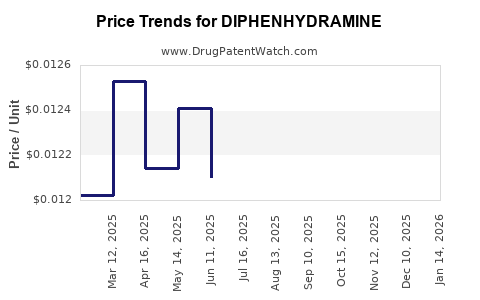
What Are Price Trends and Projections?
Historical Price Trends:
| Year |
Average Price (USD per unit) |
Notes |
| 2019 |
$0.30 |
Generic, low-cost formulations |
| 2020 |
$0.28 |
Slight decline, increased competition |
| 2021 |
$0.27 |
Continued competition |
| 2022 |
$0.26 |
Stable but declining slightly |
Prices have trended downward due to increased generics supply, commoditization, and price competition. The average retail price for a standard OTC tablet decreased by approximately 13% from 2019 to 2022.
Price Projections:
Over the next five years, prices are expected to stabilize or decline modestly, assuming no significant patent disputes or formulation innovations. At a compound annual decline rate of about 1-2%, the average price per unit could reduce to approximately $0.24–$0.25 by 2027.
What Are Factors Influencing Future Market and Price Trends?
- Entry of new generic entrants could pressure prices downward.
- Development of combination products with non-sedating antihistamines.
- Regulatory restrictions on off-label uses could limit demand.
- Consumer preferences shifting towards non-sedating alternatives may impact sales volume.
Market growth may remain constrained due to shifts toward newer, non-sedating antihistamines, though demand for sleep aids and OTC allergy relief sustains steady sales.
What Are Key Patent and Regulatory Considerations?
Diphenhydramine is off-patent in most jurisdictions; generic manufacturers dominate the market. Potential regulatory updates include increased safety warnings or restrictions, especially on use in vulnerable populations such as children and the elderly. Any new formulations or delivery systems, like patches or fast-dissolving tablets, could extend patent protections, affecting market dynamics.
Summary of Competitive Landscape
- Dominated by generic producers.
- Major players include Pfizer, Johnson & Johnson, and several regional firms.
- Price competition is intense among broad-spectrum OTC formulations.
- Few recent innovations have significantly shifted market shares.
Final Pricing Outlook
With competitive pressures and limited innovation, unit prices are expected to decline gradually. Generics will continue to dominate, maintaining high volume but low margins for manufacturers. The global market's total value may remain around $2.5–$3 billion through 2027, with slight contraction or stabilization depending on regulatory and market trends.
Key Takeaways
- Diphenhydramine commands a significant OTC antihistamine segment, valued at nearly $2.8 billion globally.
- Prices have declined steadily, averaging around $0.26 per unit in 2022, with projections suggesting further moderate declines.
- Market growth hinges on consumer demand for sleep aids and allergy medications, with shifts toward safer alternatives influencing demand.
- The generic landscape is highly competitive, with minimal recent innovation impacting market shares.
- Regulatory shifts and formulation innovations could modify future pricing and market volume trajectories.
FAQs
1. What factors could cause diphenhydramine prices to rise again?
Price increases could occur if new patent protections or formulations emerge, or if regulatory actions limit competition, reducing market supply.
2. How do newer antihistamines affect diphenhydramine sales?
Non-sedating antihistamines like loratadine and cetirizine cause a shift in consumer preference, limiting growth of sedative antihistamines but maintaining steady demand for sleep aids.
3. Are there significant regional differences in diphenhydramine markets?
Yes. North America dominates due to OTC accessibility, while emerging markets see growth through increased healthcare access, but face affordability and regulatory hurdles.
4. Will drug delivery innovations impact prices?
Potentially. Delivery systems like patches or fast-dissolving tablets could extend patent life and allow premium pricing, but their current adoption remains limited.
5. What is the potential impact of regulatory changes?
Stricter safety warnings or restrictions on use among vulnerable groups could reduce demand, pressuring prices and sales volume.
Sources:
- Allied Market Research, "Antihistamines Market," 2022.
- IMS Health, "OTC Market Data," 2022.
- U.S. FDA, "Drug Approvals and Regulatory Updates," 2023.
- GlobalData, "Pharmaceutical Price Trends," 2022.