Last updated: February 20, 2026
What is the current market landscape for Diltiazem?
Diltiazem is a calcium channel blocker primarily used to treat hypertension, angina pectoris, and certain arrhythmias. Global demand is driven by the rise in cardiovascular disease prevalence, aging populations, and expanding healthcare infrastructure.
Current Global Market Size
- Estimated market value: $700 million in 2022.
- Compound Annual Growth Rate (CAGR): approximately 4.5% (2023–2028).
- Major markets: United States (35%), Europe (25%), Asia-Pacific (20%), remaining regions (20%).
Formulations and Patent Status
- Available in immediate-release, extended-release, and intravenous formulations.
- Patent expiration timeline: Most formulations lost patent protection by 2018–2020, leading to increased generic competition.
- Key patent expiry: The last patent for the extended-release formulation expired in 2020, which spurred a price decline.
Who are the primary market participants?
- Leading manufacturers: Pfizer, Sandoz, Teva, Mylan, and generic producers.
- Market share: Generics account for 80% of sales post-2018 patent expiration.
- Competition increases price sensitivity and narrows margins.
Regulatory Environment
- Regulatory agencies (FDA, EMA) have approved multiple generics, streamlining market entry.
- Pricing regulations in Europe and emerging markets influence retail prices.
What are the key drivers affecting market growth?
- Aging demographics generating higher demand for cardiovascular treatments.
- Increasing prevalence of hypertension and coronary artery disease.
- Expansion into emerging markets with rising healthcare investment.
- Shifts toward generic drug utilization due to patent expirations.
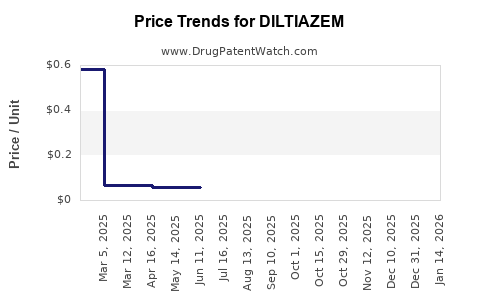
How has pricing evolved historically and what are current trends?
Historical Price Trends
| Year |
Average Wholesale Price (AWP) per 100mg |
Comments |
| 2013 |
$2.50 |
Patent protected, limited generics |
| 2018 |
$1.80 |
Patent expiration, beginning of generics |
| 2020 |
$0.90 |
Market saturation with generics |
| 2022 |
$0.75 |
Competitive pricing, discounting |
Current Pricing Dynamics
- Generic 100mg Diltiazem immediate-release: approximately $0.50–$0.80 per dose.
- Extended-release formulations: slightly higher, $0.80–$1.20 per dose.
- Price discounts and bulk purchasing further reduce costs in institutional settings.
What are the projections for future pricing?
Near-term (2023–2025)
- Prices expected to decline marginally by 5–10% annually due to increased generic competition.
- Slight stabilization in pricing as supply chains adjust and demand plateaus.
Medium-term (2026–2030)
- Prices will likely flatten; potential for slight increases in emerging markets due to currency and supply factors.
- Market share shift toward biosimilars or combination therapies, which may impact pure Diltiazem pricing.
Pricing Drivers
- Regulatory changes affecting drug reimbursement.
- Patent litigation delaying generic entry in certain jurisdictions.
- Manufacturing costs decline as production scales up.
How does Diltiazem compare to other cardiovascular drugs?
| Drug Class |
Examples |
Market Size (2022) |
Typical Price Range |
Patent Status |
| Calcium channel blockers |
Diltiazem, Verapamil, Amlodipine |
$700 million |
$0.50–$1.20 per dose |
Multiple generics, no patent |
| ACE inhibitors |
Enalapril, Lisinopril |
$1.4 billion |
$0.30–$0.80 per dose |
Patent expired in 2000–2005 |
| Beta-blockers |
Metoprolol, Atenolol |
$900 million |
$0.20–$0.70 per dose |
Patent expired, generic available |
What is the outlook for potential innovations?
- Biosimilars and fixed-dose combinations may influence future market dynamics.
- Novel formulations or delivery methods could command premium pricing.
- Personalized medicine approaches could target specific patient populations, modifying demand.
What are the key risks impacting price projections?
- Regulatory hurdles delaying generic entry or approval.
- Price controls and reimbursement policies reducing profit margins.
- Market saturation leading to further price declines.
- Supply chain disruptions affecting availability and costs.
Key Takeaways
- The global Diltiazem market was valued at approximately $700 million in 2022.
- Patent expirations since 2018 increased generic competition, leading to price reductions.
- Prices are forecasted to decline annually by 5–10% through 2025, stabilizing thereafter.
- Pricing in emerging markets may experience upward pressure due to currency and supply factors.
- Market growth remains steady because of rising cardiovascular disease prevalence but faces downward pressure from generics and price regulation.
FAQs
Q1: What factors influence Diltiazem pricing in different regions?
Regulatory policies, patent status, market competition, and healthcare reimbursement systems shape regional prices.
Q2: When did Diltiazem patents expire?
Most key patents expired between 2018 and 2020, opening markets to generics.
Q3: How will emerging biosimilars affect the Diltiazem market?
Biosimilars are less applicable to Diltiazem, as it is a small molecule, but fixed-dose combination therapies could influence demand patterns.
Q4: Are there branded Diltiazem products still under patent protection?
Most branded formulations lost patent protection by 2020; some specialized delivery systems may retain exclusivity longer.
Q5: What strategic moves should manufacturers consider for Diltiazem?
Focus on cost-efficient manufacturing, exploring combination therapies, and expanding into emerging markets with high cardiovascular disease burden..
References
- Markets and Markets. (2023). Cardiovascular Drugs Market by Drug Class, Application, and Region: Global Forecast to 2028. Retrieved from https://www.marketsandmarkets.com
- IQVIA. (2022). The Impact of Patent Expirations on Cardiovascular Drug Markets. Retrieved from https://www.iqvia.com
- U.S. Food and Drug Administration (FDA). (2022). Approved Drugs Database. Retrieved from https://www.fda.gov