Share This Page
Drug Price Trends for DIHYDROERGOTAMINE MESYLATE
✉ Email this page to a colleague
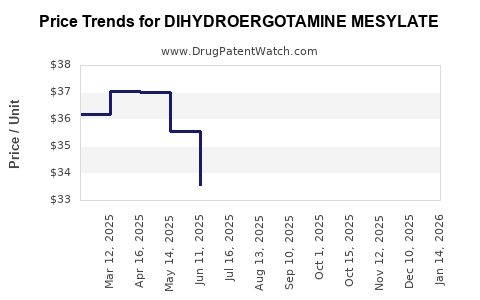
Average Pharmacy Cost for DIHYDROERGOTAMINE MESYLATE
| Drug Name | NDC | Price/Unit ($) | Unit | Date |
|---|---|---|---|---|
| DIHYDROERGOTAMINE MESYLATE 4 MG/ML NASAL SPRAY | 24201-0463-01 | 50.11667 | ML | 2026-07-22 |
| DIHYDROERGOTAMINE MESYLATE 4 MG/ML NASAL SPRAY | 24201-0463-08 | 31.51813 | ML | 2026-07-22 |
| DIHYDROERGOTAMINE MESYLATE 4 MG/ML NASAL SPRAY | 69097-0503-27 | 31.51813 | ML | 2026-07-22 |
| >Drug Name | >NDC | >Price/Unit ($) | >Unit | >Date |
Best Wholesale Price for DIHYDROERGOTAMINE MESYLATE
| Drug Name | Vendor | NDC | Count | Price ($) | Price/Unit ($) | Unit | Dates | Price Type |
|---|---|---|---|---|---|---|---|---|
| DIHYDROERGOTAMINE MESYLATE 1MG/ML INJ AMP,1ML | AvKare, LLC | 81284-0411-10 | 10X1ML | 526.63 | 2023-06-15 - 2028-06-14 | FSS | ||
| DIHYDROERGOTAMINE MESYLATE 1MG/ML INJ AMP,1ML | Golden State Medical Supply, Inc. | 00143-9273-10 | 10X1ML | 574.95 | 2023-06-23 - 2028-06-14 | FSS | ||
| DIHYDROERGOTAMINE MESYLATE 4MG/ML SOLN,NASAL, | Golden State Medical Supply, Inc. | 24201-0463-08 | 8X1ML | 954.77 | 2023-06-15 - 2028-06-14 | FSS | ||
| >Drug Name | >Vendor | >NDC | >Count | >Price ($) | >Price/Unit ($) | >Unit | >Dates | >Price Type |
Dihydroergotamine Mesylate: Patent Landscape and Market Projections
Dihydroergotamine mesylate (DHE) is an established medication used for the acute treatment of migraine headaches. Its patent landscape is characterized by expiring primary patents, with ongoing innovation focused on novel formulations, delivery methods, and potential new indications. Market projections for DHE are influenced by the emergence of biosimil and generic competition, alongside the development of newer migraine therapies.
What is the Current Patent Landscape for Dihydroergotamine Mesylate?
The primary patents covering the synthesis and early formulations of dihydroergotamine mesylate have expired. The United States Patent and Trademark Office (USPTO) and the European Patent Office (EPO) databases indicate that the foundational intellectual property for DHE has been in the public domain for a considerable period.
Key patents for the original DHE molecule and its early injectable formulations expired in the early to mid-2000s. For example, patents related to the chemical compound itself and its therapeutic use as an anti-migraine agent are no longer in force.
Current patent activity primarily centers on:
- Novel Formulations: Development of improved drug delivery systems that enhance patient compliance, efficacy, or reduce side effects. Examples include:
- Nasal spray formulations
- Oral inhaled formulations
- Sublingual formulations
- Long-acting injectable formulations
- New Delivery Devices: Patents protecting specific devices designed to administer DHE, such as specialized inhalers or auto-injectors.
- Combination Therapies: Inventions involving DHE in combination with other active pharmaceutical ingredients for enhanced migraine treatment.
- Manufacturing Processes: Improvements or novel methods for the synthesis or purification of DHE.
- New Indications: Research and patent applications exploring DHE's efficacy in conditions beyond migraine, though this area shows less activity.
Companies that have held or currently hold significant patent portfolios related to DHE formulations and delivery methods include but are not limited to Valeant Pharmaceuticals (now Bausch Health Companies), BioNebraska, Inc., and various smaller specialty pharmaceutical firms. The expiration of core patents has opened the door for generic manufacturers.
Who are the Key Players in the Dihydroergotamine Mesylate Market?
The DHE market is divided between originator companies and generic manufacturers, with a growing presence of companies developing novel delivery systems.
Originator/Branded Manufacturers:
- Bausch Health Companies: Through its legacy products, Bausch Health has been a significant player, marketing branded DHE formulations such as Migranal® (nasal spray) and D.H.E. 45® (injectable).
- Prometheus Laboratories: (Previously, through acquisitions/licensing) Has had a presence in the DHE market.
Generic Manufacturers:
The market has seen an increase in generic competition following patent expirations. Key generic players include:
- Teva Pharmaceutical Industries
- Apotex
- Hikma Pharmaceuticals
- Amneal Pharmaceuticals
- Sun Pharmaceutical Industries
Specialty Pharma/Innovators in Delivery:
These companies are focused on developing advanced DHE delivery systems, aiming to differentiate themselves from generic offerings and potentially extend market exclusivity through new patents.
- BioNebraska, Inc.: Known for its development of an intranasal DHE product.
- Impel NeuroPharma: Has developed a nasal delivery system (TRP channel modulator platform) which has been utilized for DHE with their product Trudhesa®. This represents a significant innovation in DHE delivery.
The competitive landscape is dynamic, with generic erosion impacting the sales of branded products and innovators seeking to capture market share with improved delivery technologies.
What are the Current Market Trends for Dihydroergotamine Mesylate?
The DHE market is experiencing several converging trends:
- Genericization and Price Erosion: The expiration of key patents has led to a significant influx of generic DHE products, particularly for injectable forms. This has resulted in substantial price reductions for these formulations.
- Innovation in Delivery Systems: A major trend is the development and adoption of novel DHE delivery systems, such as nasal sprays and inhaled formulations. These aim to improve patient compliance, speed of onset, and reduce side effects compared to older methods.
- Competition from Newer Migraine Therapies: DHE faces competition from newer classes of migraine drugs, including CGRP antagonists (gepants) and monoclonal antibodies. These newer therapies offer different mechanisms of action and may have better efficacy or tolerability profiles for certain patient populations.
- Focus on Acute Treatment: DHE remains primarily positioned as an acute treatment for moderate to severe migraine attacks, rather than a preventative therapy.
- Managed Care and Reimbursement: Reimbursement policies for DHE, particularly for newer formulations, are a critical factor influencing market access and physician prescribing patterns. Insurers often scrutinize the cost-effectiveness of novel delivery systems against established generics and newer migraine classes.
- Limited New Indications: While DHE has been explored for other uses, its primary market remains migraine treatment. Significant R&D investment in exploring new therapeutic areas for DHE is limited.
The market share for branded DHE injectables has diminished due to generic availability. Branded nasal sprays and newer delivery systems, like Impel NeuroPharma's Trudhesa®, are attempting to capture market share by offering advantages in administration and potentially efficacy.
What are the Projected Market Sizes and Growth Rates for Dihydroergotamine Mesylate?
Projecting specific market sizes for DHE is complex due to its mature status, generic erosion, and the fragmented nature of the market with both established generics and innovative delivery systems. However, general market dynamics can be outlined.
The injectable DHE market is likely to continue experiencing low single-digit negative growth or near-zero growth, primarily driven by generic competition and price decreases. Volumes may remain stable or slightly increase, but revenue will decline.
The nasal spray DHE market will face continued pressure from generics and newer migraine treatments. Branded nasal spray revenues are expected to stagnate or decline modestly, with market share shifting towards generics unless significant differentiation is maintained.
The nasal powder/inhaled DHE market, exemplified by products like Trudhesa® (Impel NeuroPharma), represents a growth segment. While starting from a smaller base, these innovative delivery systems have the potential for mid-to-high single-digit growth as they gain market penetration and physician adoption. The success of such products will depend on demonstrating superior clinical outcomes, patient preference, and favorable reimbursement.
Overall Market Projection:
- Total DHE Market (all formulations): Expected to exhibit flat to low single-digit annual growth (0-3%) over the next five years. This is a composite projection reflecting declines in legacy formulations and growth in newer delivery systems.
- Injectable DHE Segment: Likely to see a low single-digit annual decline (-2% to -5%) in revenue due to pricing pressures.
- Nasal Spray DHE Segment: Projected for flat to low single-digit annual decline (-1% to -3%) in revenue, with increasing generic penetration.
- Innovative Nasal/Inhaled DHE Segment: Forecasted for mid-to-high single-digit annual growth (5-15%) in revenue, driven by product adoption and market expansion.
These projections are highly sensitive to competitive dynamics, the success of new product launches, and evolving treatment guidelines for migraine management. The overall volume of DHE units prescribed may remain stable or grow slightly, but revenue will be heavily influenced by the mix of generic versus branded and innovative products.
What are the Key Challenges and Opportunities for Dihydroergotamine Mesylate?
Challenges:
- Competition from Novel Migraine Therapies: The advent of CGRP antagonists and monoclonal antibodies presents a significant challenge, as these drugs offer new mechanisms of action and may provide better efficacy and tolerability for a substantial portion of migraine sufferers.
- Generic Erosion: The widespread availability of low-cost generic DHE, especially for injectable formulations, severely limits pricing power for branded products.
- Side Effect Profile: DHE can cause side effects such as nausea, vomiting, and vasoconstriction, which can limit its use in patients with cardiovascular risk factors or those sensitive to these adverse events.
- Administration Complexity: Traditional DHE formulations, particularly injectables, can be less convenient for patients compared to oral or simpler delivery methods. Even nasal sprays require proper technique.
- Reimbursement Hurdles: Novel delivery systems, while innovative, often face significant challenges in securing favorable reimbursement from payers, which can impede uptake.
- Limited New Research: DHE is a well-established drug, and investment in novel research for new indications or significantly improved formulations beyond delivery enhancement is limited compared to newer drug classes.
Opportunities:
- Improved Delivery Technologies: Innovations in nasal delivery (e.g., intranasal powders, advanced sprays) and potentially other novel routes of administration offer significant opportunities to enhance patient compliance, speed of onset, and reduce side effects, thereby carving out a niche.
- Targeting Specific Patient Subgroups: DHE may remain a valuable treatment option for specific migraine patient populations who do not respond well to or cannot tolerate newer therapies. Personalized medicine approaches could identify these subgroups.
- Cost-Effectiveness for Specific Use Cases: In an era of increasing healthcare costs, DHE, particularly in its generic forms or via optimized delivery, can offer a cost-effective acute treatment option for many patients compared to newer, higher-priced therapies.
- Combination Therapy Potential: Exploring DHE in combination with other acute migraine medications, provided there is a synergistic effect and a favorable safety profile, could create new therapeutic avenues.
- Market Re-education and Physician Engagement: There is an opportunity to re-educate healthcare providers on the appropriate use cases and benefits of DHE, especially newer formulations, in the context of a broader migraine treatment armamentarium.
- Life Cycle Management: Companies holding patents on novel delivery systems can leverage these to extend their market exclusivity and capture value beyond the original molecule's patent expiry.
What are the Price Projections for Dihydroergotamine Mesylate?
Price projections for DHE vary significantly by formulation and market segment.
Generic Injectable DHE:
- Prices are expected to remain low and stable, reflecting a highly competitive generic market. Average wholesale prices (AWP) for a vial of DHE 45 are likely to stay in the $5-$15 range. Little to no price growth is anticipated; price decreases are more probable as competition intensifies.
Branded Nasal Spray DHE (e.g., Migranal®):
- These products face declining demand and increasing generic competition. Prices are projected to slowly decline or remain flat in real terms, with AWP likely to range from $50-$150 per unit (e.g., per mL vial or spray device) depending on dosage and package size.
Innovative Nasal/Inhaled DHE (e.g., Trudhesa®):
- This segment, representing advanced delivery systems, is expected to command premium pricing relative to generics and older formulations. Prices will likely be benchmarked against other advanced acute migraine treatments.
- Projected AWP for a course of treatment (e.g., a box of nasal devices) could range from $200-$500.
- Growth in pricing for these specific products will depend on demonstrated clinical value, payer adoption, and competition within the innovative acute treatment space. Year-over-year price increases will likely be in the low to mid-single digits (3-7%), similar to other branded specialty pharmaceuticals, subject to payer negotiations and market access.
Overall Pricing Environment:
The overall DHE market will be characterized by price polarization: extremely low prices for generic injectables and stable, but potentially declining, prices for legacy branded products, contrasted with higher, premium pricing for well-differentiated, novel delivery systems. The average selling price (ASP) across all DHE products will likely decline due to the heavy weighting of generic injectables.
Key Takeaways
Dihydroergotamine mesylate's patent landscape is dominated by expired foundational patents, leading to widespread generic availability of injectable formulations. Current innovation focuses on novel delivery systems such as nasal sprays and inhaled powders, exemplified by products like Impel NeuroPharma's Trudhesa®. The DHE market is bifurcated: generic injectables face significant price erosion and stable to declining revenues, while innovative delivery systems aim for premium pricing and mid-to-high single-digit growth. DHE competes with newer migraine therapies like CGRP antagonists, posing a challenge. However, opportunities exist in improving patient compliance through advanced delivery, targeting specific patient subgroups, and leveraging its cost-effectiveness for certain use cases. Price projections show continued low pricing for generics and legacy brands, with premium pricing for innovative formulations.
Frequently Asked Questions
- What is the primary therapeutic indication for dihydroergotamine mesylate? Dihydroergotamine mesylate is primarily indicated for the acute treatment of migraine headaches.
- How has the patent expiration impacted the price of DHE? The expiration of foundational patents has led to a significant influx of generic DHE products, particularly for injectable formulations, resulting in substantial price reductions for these forms of the drug.
- What are the main types of novel delivery systems being developed for DHE? Key novel delivery systems include advanced nasal sprays, oral inhaled formulations, and sublingual formulations, aiming to improve patient compliance and efficacy.
- What are the primary competitive threats to DHE in the migraine market? The primary competitive threats are newer classes of migraine therapies, specifically CGRP antagonists and monoclonal antibodies, which offer different mechanisms of action and potentially improved tolerability.
- Are there any new therapeutic areas being actively explored for DHE? While DHE has been explored for other uses, its primary market remains migraine treatment, and significant R&D investment in new indications for DHE is limited.
Citations
[1] U.S. Patent and Trademark Office. (n.d.). USPTO Patent Database. Retrieved from https://www.uspto.gov/patents [2] European Patent Office. (n.d.). Espacenet Patent Search. Retrieved from https://worldwide.espacenet.com/ [3] Impel NeuroPharma. (n.d.). Trudhesa® Product Information. Retrieved from https://www.impelpharma.com/trudhesa [4] Bausch Health Companies Inc. (n.d.). Migraine Treatments. Retrieved from https://www.bauschhealth.com/ [5] Generic Pharmaceutical Association. (n.d.). Generic Drug Trends Report. (Various Years). (Note: Specific report titles vary annually, consult latest publication for detailed market data).
More… ↓
