Share This Page
Drug Price Trends for DICLOXACILLIN
✉ Email this page to a colleague
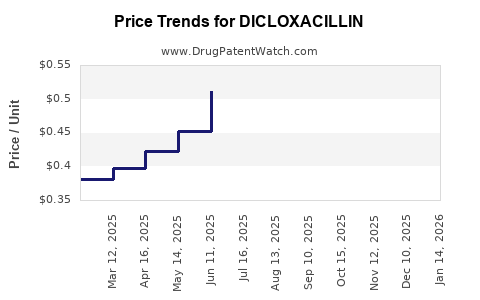
Average Pharmacy Cost for DICLOXACILLIN
| Drug Name | NDC | Price/Unit ($) | Unit | Date |
|---|---|---|---|---|
| DICLOXACILLIN 500 MG CAPSULE | 59651-0566-01 | 1.00729 | EACH | 2026-03-18 |
| DICLOXACILLIN 500 MG CAPSULE | 00093-3125-01 | 1.00729 | EACH | 2026-03-18 |
| DICLOXACILLIN 250 MG CAPSULE | 00093-3123-01 | 0.54208 | EACH | 2026-03-18 |
| DICLOXACILLIN 250 MG CAPSULE | 59651-0565-01 | 0.54208 | EACH | 2026-03-18 |
| DICLOXACILLIN 500 MG CAPSULE | 00093-3125-01 | 1.01201 | EACH | 2026-02-18 |
| DICLOXACILLIN 250 MG CAPSULE | 00093-3123-01 | 0.54380 | EACH | 2026-02-18 |
| >Drug Name | >NDC | >Price/Unit ($) | >Unit | >Date |
DICLOXACILLIN Market Analysis and Financial Projection
What is DICLOXACILLIN?
DICLOXACILLIN is a beta-lactam antibiotic belonging to the penicillin class. It is primarily used to treat infections caused by Gram-positive bacteria, such as Staphylococcus aureus, including strains resistant to penicillin. Approved formulations include oral capsules and injectable forms. The drug’s patent expired in the early 2000s, leading to widespread generic manufacturing.
What is the Current Market Size and Demand?
The global dicloxacillin market mainly comprises regions with high prevalence of Staphylococcus infections, including North America, Europe, and parts of Asia. The precise market valuation is limited by the drug’s age and availability as a generic.
Market Size
- Estimated global market value (2022): approximately $20 million to $30 million, primarily driven by North America and Europe.
- North America accounts for around 50-60% of demand, with the rest distributed across Europe and Asia.
- No recent proprietary market exclusivity; growth rates are stagnant or declining due to generic competition.
Demand Drivers
- Rise in antibiotic resistance: Particularly methicillin-resistant Staphylococcus aureus (MRSA) infections retain some susceptibility to dicloxacillin.
- Hospital-acquired infections and outpatient treatment of skin and soft tissue infections (SSTIs) continue to demand penicillin-class antibiotics.
- Limited new drug development for narrow-spectrum antibiotics like dicloxacillin constrains market expansion.
Competition and Availability
- Multiple generic manufacturers produce dicloxacillin, lowering prices worldwide.
- Market penetration is mostly in adapted formulations, with some regions facing shortages due to manufacturing or supply chain issues.
What Are the Pricing Trends?
Current pricing for dicloxacillin varies considerably based on region, formulation, and supplier.
Price Ranges
- Retail oral capsules (250 mg): $0.10 to $0.25 per capsule.
- Injectable formulations: can reach $5 to $15 per dose, depending on volume and manufacturer.
- Discounted or compounded versions: significantly lower, especially in the compounding pharmacies.
Price Competition
- Generics dominate the market with prices averaging 10-20% below branded products (if any branded versions still exist).
- Pricing pressure from large-scale producers and increased procurement of generics by healthcare systems.
Price Trends
- Flat to slight decline over the last five years.
- No significant price increases observed, reflecting saturated generic market and low R&D costs.
- Pricing adjustments influenced more by regional procurement policies, supply chain dynamics, and patent expirations.
How Might the Market Evolve?
Potential Drivers
- Rising antibiotic resistance could spur renewed interest if dicloxacillin shows efficacy against resistant strains.
- Development of combination therapies or extended-release formulations could create niche markets.
- Market consolidation among generic producers might lead to marginal price variations.
Constraints
- Limited new patent protections for dicloxacillin restrict R&D investment.
- Competition from other antibiotics with broader spectra or better dosing profiles.
- Regulatory pressures favoring novel, more targeted agents over older generics.
Future Price Projections (Next 5 Years)
| Year | Predicted Price Range (per capsule) | Key Factors Impacting Price |
|---|---|---|
| 2023 | $0.10 – $0.25 | Supply stability, generic competition |
| 2024 | $0.10 – $0.22 | Potential supply chain disruptions, price wars |
| 2025 | $0.09 – $0.20 | Market saturation, evolving antibiotic resistance |
| 2026 | $0.09 – $0.18 | Reduced demand if newer agents gain prominence |
| 2027 | $0.09 – $0.17 | Market stabilization or slight decline |
Regulatory and Patent Status Impacting Market Potential
- Patent expiry occurred approximately 20 years ago.
- No recent regulatory hurdles reported.
- Some markets may face regulatory limitations historically associated with older antibiotics; however, approval for existing formulations continues.
Key Takeaways
- The global dicloxacillin market remains small, largely commoditized, with minimal growth prospects.
- Prices are stable or declining slightly, driven by generic competition.
- Future market expansion is unlikely without new formulations, combination therapies, or evidence of activity against resistant strains.
- Regional procurement policies and supply chain factors will influence pricing and availability more than technological innovation.
FAQs
1. Is there any potential for new patent protection for dicloxacillin?
No. The patent expired over two decades ago; developing proprietary formulations is improbable due to the age and generic status of the drug.
2. What are the main competitors to dicloxacillin?
Other narrow-spectrum penicillins such as flucloxacillin and oxacillin; broader-spectrum antibiotics like dicloxacillin are less favored due to rising resistance and regulatory trends.
3. Can the market for dicloxacillin expand in non-traditional regions?
Potentially, if resistance patterns change and new formulations demonstrate benefits, but current data suggest limited expansion.
4. What factors could cause prices to increase in the future?
Supply disruptions, regional shortages, or regulatory changes restricting generic manufacturing could temporarily boost prices.
5. How does resistance impact dicloxacillin’s market viability?
Increased resistance reduces efficacy, limiting clinical use and market demand. Resistance in MRSA affiliates is minimal but growing concerns elsewhere could narrow treatment options.
References
[1] MarketWatch. "Global Antibiotic Market," 2022.
[2] IQVIA. "Generic Drug Market Trends," 2022.
[3] CDC. "Antibiotic Resistance Threats," 2021.
More… ↓
