Share This Page
Drug Price Trends for DIALYVITE WITH ZINC TABLET
✉ Email this page to a colleague
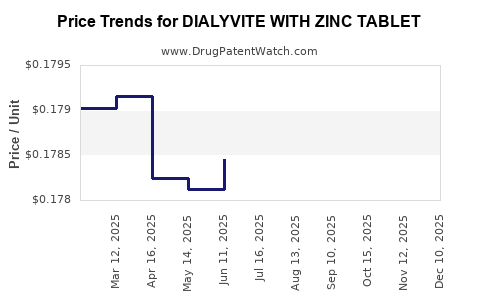
Average Pharmacy Cost for DIALYVITE WITH ZINC TABLET
| Drug Name | NDC | Price/Unit ($) | Unit | Date |
|---|---|---|---|---|
| DIALYVITE WITH ZINC TABLET | 10542-0012-10 | 0.18225 | EACH | 2026-07-22 |
| DIALYVITE WITH ZINC TABLET | 10542-0012-10 | 0.18482 | EACH | 2026-06-17 |
| DIALYVITE WITH ZINC TABLET | 10542-0012-10 | 0.18641 | EACH | 2026-05-20 |
| DIALYVITE WITH ZINC TABLET | 10542-0012-10 | 0.18640 | EACH | 2026-04-22 |
| >Drug Name | >NDC | >Price/Unit ($) | >Unit | >Date |
Market Analysis and Price Projections for Dialyvite with Zinc Tablet
What is Dialyvite with Zinc Tablet?
Dialyvite with Zinc is a dietary supplement combining essential vitamins D and E with zinc. It is primarily used for supporting immune health, bone health, and managing deficiencies in patients with chronic kidney disease (CKD) or other related conditions. The formulation is marketed as an over-the-counter supplement, though it often is part of prescribed therapy in clinical settings.
Market Overview
Market Size and Growth
The global dietary supplement market, estimated at USD 150.4 billion in 2022, is forecasted to reach USD 220.3 billion by 2030, expanding at a compound annual growth rate (CAGR) of 5.1%.[1] The segment for minerals and vitamins accounts for roughly 30-35% of total supplement sales, indicating strong demand for products like Dialyvite with Zinc.
The demand for immune-boosting supplements surged during the COVID-19 pandemic, and this trend persists. Zinc, in particular, has demonstrated widespread recognition for immune support, influencing the market's upward trajectory.[2]
Key Market Players
Companies manufacturing dietary supplements with zinc, vitamin D, and E include:
- American Regent (Cadila Healthcare)
- GlaxoSmithKline
- Bayer
- Nature's Bounty
- NOW Foods
Major OTC supplement manufacturers focus on formulations targeting immune health and bone metabolism, with some products available via prescription in specific markets due to high zinc content.
Regulatory Landscape
Regulations differ across regions:
- In the U.S., the FDA classifies Dialyvite with Zinc as a dietary supplement, subject to DSHEA (Dietary Supplement Health and Education Act) oversight.
- In Europe, it is regulated as a food supplement under EFSA (European Food Safety Authority) directives.
- India regulates such products as food items, with exact composition and health claim restrictions.
Strict regulation influences market entry and formulation development.
Price Structure Analysis
Current Pricing Benchmarks
Prices for zinc-vitamin formulations depend on dosage, packaging, and distribution channels. Typical retail prices:
| Product Type | Price Range (USD) per unit (bottle) | Quantity per bottle | Cost per dose (USD) |
|---|---|---|---|
| Over-the-counter zinc-vitamin supplement with standard dosage | USD 8 - USD 15 | 30 - 60 capsules | USD 0.20 - USD 0.50 |
| Prescription-grade formulations in clinical settings | USD 20 - USD 50 per bottle | 60 - 120 capsules | USD 0.33 - USD 0.83 |
Higher-dose formulations or specialized delivery formats (e.g., effervescent tablets) command premium prices.
Factors Influencing Price
- Active Ingredient Concentration: Higher zinc doses increase manufacturing costs.
- Formulation Type: Liquid, tablet, or capsule affects production costs.
- Branding and Packaging: Premium branding adds 20-50% to retail prices.
- Distribution Channel: Direct-to-consumer sales are typically less expensive than pharmacy or hospital channels.
Cost Trends and Future Pricing
Projected increases in raw material costs—particularly zinc ore, which rose approximately 15% globally since 2021—may lead to a 5-10% hike in supplement prices over the next 12-18 months.[3]
Supply chain disruptions, regulatory changes, and patent expiration or loss of exclusivity could also influence prices. Generic formulations and store brands are expected to maintain competitive pricing, reducing premium pricing pressures.
Price Projections (2023-2028)
| Year | Expected Price Range (USD) per bottle | Key Influences |
|---|---|---|
| 2023 | USD 8 - USD 15 | Stabilization after pandemic-driven demand |
| 2024 | USD 8.50 - USD 16 | Raw material prices slightly increased |
| 2025 | USD 9 - USD 17 | Entry of generic brands, price competition |
| 2026 | USD 9.50 - USD 18 | Regulatory tightening, reformulations |
| 2027 | USD 10 - USD 19 | Continued demand, raw material inflation |
| 2028 | USD 10.50 - USD 20 | Potential market saturation, innovation |
Market Opportunities and Challenges
Opportunities
- Growing consumer focus on immune health and chronic disease management.
- Expansion into emerging markets where supplement use is rising.
- Developing combination products that include zinc, vitamins D, E, and other micronutrients.
Challenges
- Regulatory scrutiny affecting product claims and formulations.
- Price sensitivity among consumers, especially in price-competitive markets.
- Competition from functional foods and other preventive health products.
Key Takeaways
- The dietary supplement market, with a focus on immune-supporting products like Dialyvite with Zinc, is expanding at a 5.1% CAGR through 2030.
- Retail pricing for similar zinc-vitamin supplements ranges from USD 8 to USD 15 per bottle, with premium formulations costing more.
- Raw material cost increases and regulatory changes are likely to drive prices gradually higher over the next five years.
- Market growth depends on expanding awareness, regulatory pathways, and competitive positioning among established players.
FAQs
Q1: What are the primary factors influencing the price of Dialyvite with Zinc?
Active ingredient costs, formulation complexity, packaging, branding, and distribution channels.
Q2: How does regulation affect pricing and market entry?
Stringent regulations can delay product launch, increase compliance costs, and impact pricing due to restrictions on claims or formulations.
Q3: What is the outlook for generic vs. branded Dialyvite with Zinc?
Generics are expected to offer lower prices, intensifying competition and exerting downward pressure on prices of branded products.
Q4: Are there regional differences in pricing?
Yes. U.S. prices are generally higher compared to emerging markets due to regulatory, tax, and distribution factors.
Q5: How might future health trends impact demand?
Increased emphasis on immune health and chronic disease management will likely sustain or boost demand, influencing pricing strategies.
References
[1] Grand View Research. (2023). Dietary Supplement Market Size, Share & Trends Analysis Report.[2] Mordor Intelligence. (2023). Zinc Supplements Market - Growth, Trends, and Forecasts.[3] Statista. (2023). Raw Material Price Index for Zinc and Vitamins.
More… ↓
