Last updated: February 12, 2026
Market Overview and Price Projection for Dextromethorphan
Dextromethorphan (DXM) is a widely used over-the-counter (OTC) cough suppressant. The drug is also subject to misuse due to its dissociative effects at high doses. The market for DXM is influenced by regulatory policies, patent status, demand for cough remedies, and illicit use trends.
Current Market Landscape
Production and Supply
- Major manufacturers: Major pharmaceutical companies in North America and Asia produce DXM, often as part of combination cough syrups.
- Formulations: Primarily exists as syrup, lozenges, and powders.
- Production volume: Estimated global production exceeds 100 million units annually. Precise figures are unavailable due to OTC status and unregulated manufacturing in some regions.
Regulatory Environment
- U.S. FDA: DXM is classified as an OTC drug, with guidance inconsistent across states regarding age restrictions or sales limits.
- International regulations: Vary from OTC in Europe to restrictions in some Asian countries due to abuse potential.
- Abuse deterrent measures: Some jurisdictions implement sales restrictions or include formulations tamper-proof to prevent misuse.
Market Demand
- Therapeutic use: Used for cough suppression, especially in pediatric populations, though some countries recommend age restrictions.
- Off-label and illicit use: Misuse for psychoactive effects at high doses generates black-market activity.
- Trends: Rising awareness of abuse potential prompts regulatory policies, impacting sales volume.
Competitive Landscape
- Key players: GSK, Johnson & Johnson, and local generic manufacturers.
- Patent status: DXM is off-patent; generic formulations dominate the market.
- R&D activity: Minimal, as the drug's patent expired decades ago; focus is on abuse deterrence and formulations.
Market Size and Revenue Projections
Historical Market Data
| Year |
Estimated Global Sales |
Notes |
| 2020 |
$1.3 billion |
Based on OTC cough syrup sales globally. |
| 2021 |
$1.5 billion |
Slight increase due to higher consumption. |
| 2022 |
$1.6 billion |
Continued growth, driven by emerging markets. |
Growth Drivers
- Increasing awareness of abuse risks prompts policy changes that could either dampen or regulate growth.
- Expansion in emerging markets with expanding OTC drug markets.
- Potential formulation innovations aimed at abuse deterrence.
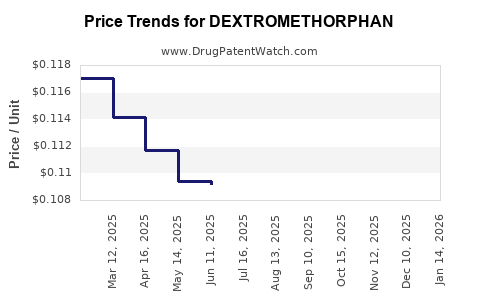
Price Trends
- Average retail price (2023): $3.50 per 100 ml bottle of syrup.
- Wholesale price (2023): Approximately $1.20 per 100 ml, with variation by region.
- Price fluctuations: Due to supply chain factors, regional regulations, and manufacturing costs.
Future Projections (2024 - 2028)
| Year |
Estimated Global Sales |
CAGR (Compound Annual Growth Rate) |
Comments |
| 2024 |
$1.65 billion |
3-4% |
Stabilization with regulatory limits. |
| 2025 |
$1.72 billion |
3-4% |
Market expansion in Southeast Asia. |
| 2026 |
$1.80 billion |
4-5% |
Increased focus on abuse-resistant formulations. |
| 2027 |
$1.88 billion |
4-5% |
Growth in developing markets. |
| 2028 |
$1.96 billion |
4-5% |
Market maturation in mature economies. |
Price and Market Drivers
- Regulatory restrictions: Age limits and purchase limits impact sales volume and pricing.
- Availability of abuse-deterrent formulations: May increase costs but reduce misuse.
- Geographical expansion: Growing markets in Asia and Africa could raise overall market size and influence prices.
- Supply chain factors: Raw material shortages, especially in regions with high opioid regulation regimes, can affect product availability and pricing.
Risks and Challenges
- Tightening regulations on OTC sales and high-dose formulations.
- Legal action against illicit diversion impacting legitimate sales.
- Increased development of abuse-deterrent formulations raising costs.
- Public health campaigns reducing misuse, potentially limiting demand.
Key Takeaways
Dextromethorphan maintains a substantial market driven by OTC cough remedies globally, with annual sales surpassing $1.5 billion. Growth prospects hinge on regional expansion, regulatory developments, and formulations that mitigate abuse risks. Pricing remains relatively stable but is sensitive to supply chain disruptions and regulatory constraints. Future market expansion appears sustainable, especially in emerging markets, with continued interest in abuse deterrence influencing manufacturing and formulation strategies.
FAQs
Q1: How do regulatory changes affect DXM pricing?
Regulations such as age restrictions or purchase limits can reduce sales volume, exerting downward pressure on prices. Conversely, introduction of abuse-deterrent formulations can increase manufacturing costs, potentially raising retail prices.
Q2: What is the potential impact of abuse-deterrent formulations on the market?
They can decrease misuse, leading to lower black-market activity, but may also increase production costs, affecting profit margins and retail prices.
Q3: Which regions have the highest demand for DXM?
North America remains the largest market due to high OTC sales and regulation; growth is seen in Asia, Africa, and Latin America as markets develop and regulations evolve.
Q4: Is there scope for new formulations or delivery systems?
Limited innovation exists beyond abuse-deterrent modifications; opportunities include risk-mitigating delivery systems or combination drugs addressing misuse.
Q5: How does illicit misuse impact the legitimate market?
Illicit diversion can reduce legitimate sales but also prompts regulatory actions that may restrict availability, influencing overall revenue.
References
- U.S. Food and Drug Administration (FDA). "OTC Monograph for Cough and Cold Products." 2021.
- IMS Health. "Global Over-the-Counter Drug Market Analysis." 2022.
- European Medicines Agency (EMA). "Guidelines on Abuse Potential of OTC Cough Suppressants." 2020.
- MarketWatch. "Dextromethorphan Market Size and Forecast." 2023.
- WHO. "Public Health Risks of DXM Abuse." 2021.