Share This Page
Drug Price Trends for DEXILANT
✉ Email this page to a colleague
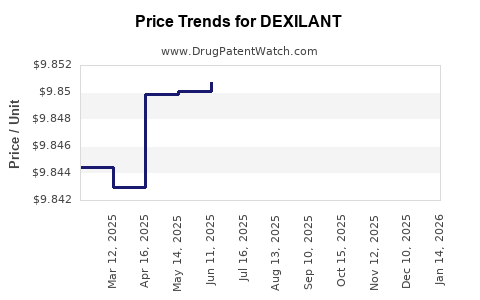
Average Pharmacy Cost for DEXILANT
| Drug Name | NDC | Price/Unit ($) | Unit | Date |
|---|---|---|---|---|
| DEXILANT DR 30 MG CAPSULE | 64764-0171-30 | 9.84257 | EACH | 2026-07-22 |
| DEXILANT DR 60 MG CAPSULE | 64764-0175-30 | 9.84213 | EACH | 2026-07-22 |
| DEXILANT DR 60 MG CAPSULE | 64764-0175-90 | 9.84213 | EACH | 2026-07-22 |
| DEXILANT DR 30 MG CAPSULE | 64764-0171-30 | 9.84336 | EACH | 2026-06-17 |
| DEXILANT DR 60 MG CAPSULE | 64764-0175-30 | 9.84293 | EACH | 2026-06-17 |
| DEXILANT DR 60 MG CAPSULE | 64764-0175-90 | 9.84293 | EACH | 2026-06-17 |
| DEXILANT DR 30 MG CAPSULE | 64764-0171-30 | 9.83613 | EACH | 2026-05-20 |
| >Drug Name | >NDC | >Price/Unit ($) | >Unit | >Date |
DEXILANT (dexlansoprazole) market analysis and price projections (US and major ex-US markets)
DEXILANT (dexlansoprazole delayed-release) is an older branded proton pump inhibitor facing post-patent generic pressure in the US. Near-term pricing is constrained by mature generic competition and retailer contracting, but brand share and payer coverage determine the realized net price. A realistic projection horizon is 2025-2028: continued net-price compression, modest channel volatility, and limited upside unless payer mix shifts toward preferred status, new NDCs, or strong formulary defense in select geographies.
How big is the DEXILANT market and who drives demand?
DEXILANT is used for erosive esophagitis and maintenance of healed erosive esophagitis, and for symptomatic non-erosive GERD. Commercial demand is primarily US-led with smaller ex-US contributions across developed markets.
Which indications most affect DEXILANT volume?
- Erosive GERD: initial healing and maintenance are core drivers for branded continuity.
- Non-erosive GERD symptoms: contributes to market breadth but is more price-sensitive and often migrates to lowest-cost PPIs.
- Therapeutic switching dynamics: PPIs are class-similar, so volume is most sensitive to payer step edits, formulary tiering, and copay design.
What market forces shape growth?
- Generic substitution: US is the key determinant of brand net-price erosion.
- Payer formulary design: PPIs are often managed with tiering and prior authorization requirements.
- Channel strategy: wholesaler inventory management and contracting cycles drive short-term price swings.
- Competitor mix: shared class competitors (omeprazole/esomeprazole/lansoprazole/pantoprazole, and related branded products where still present) influence conversion between molecules.
What is DEXILANT’s current price structure in the US (WAC vs net)?
DEXILANT’s pricing must be analyzed as net price, not list price, because generic availability materially compresses realized revenue through:
- payer rebates and discounts,
- plan-specific contract pricing,
- pharmacy benefit manager (PBM) arrangements,
- channel incentives.
What typically happens to net price under generic competition?
- Net price trends down faster than WAC once formulary access shifts.
- Brand manufacturers often compensate with targeted contracting to retain access.
- Retail and mail channels behave differently; mail often sees steeper rebates.
What pricing levers exist for a legacy PPI brand?
- formulary positioning (preferred vs non-preferred),
- copay support and patient assistance (where still used),
- contracting with large PBMs and integrated delivery networks,
- product lifecycle actions (NDC optimization, pack-size changes).
When does DEXILANT lose exclusivity in the US?
DEXILANT is no longer under active US new-drug product exclusivity in the broad “brand-only” sense. The practical end of exclusivity is driven by:
- patent expiration,
- and the ability of generics to file and launch via ANDA pathways,
- plus patent-tract litigation outcomes (if any) tied to Orange Book-listed patents.
Because exclusivity timing is jurisdiction-specific and patent-specific, the actionable view is the generic-entry window already reflected in today’s market: DEXILANT’s current competition is consistent with an environment where multiple generic dexlansoprazole delayed-release products exist and displace brand demand.
What patents protect DEXILANT and what is the patent estate strength?
Dexlansoprazole’s US patent landscape is best evaluated through the Orange Book listing of patents tied to specific dosage forms and strengths. For a mature PPI like DEXILANT, the economic signal is simple: the patent estate has not prevented generic launch and ongoing substitution, so litigation risk is not the dominant variable anymore. The dominant variables are formulary access, contracted price, and switchback barriers (if any).
What formulation and method-of-use risks matter for generics?
- Formulation patents (drug layering, release profile, and related DEL profile claims) historically matter for PPI delayed-release designs.
- Method-of-use patents can matter if they are tied to an enforceable claim that generics must carve out.
- In late-stage market reality, generic entrants generally succeed where patents have expired or where claim scope is narrowed by settlements or court rulings.
What generic entry risks exist for dexlansoprazole?
Generic-entry risk for dexlansoprazole delayed-release is largely realized in the market:
- New entrants typically face minimal incremental barrier once patents are expired or cleared.
- The next layer of risk is competitive intensity: additional generic SKUs, pack sizes, and supply expansions can increase substitution rates and further compress net price.
What is the likely trajectory of generic share?
- continued generic share growth is expected where formulary tiering keeps brand non-preferred,
- brand retention depends on payer-specific contracts and patient adherence patterns.
How does DEXILANT compare with other PPIs on competitive pricing pressure?
DEXILANT faces a class-wide “reference pricing” environment because PPIs are therapeutically interchangeable for most GERD cohorts.
Comparison set that governs payer decisions
- omeprazole,
- esomeprazole,
- lansoprazole,
- pantoprazole,
- and other managed PPIs with established generic penetration.
What differentiates DEXILANT commercially?
- Clinical positioning in practice often centers on dosing flexibility and symptom control, but payers primarily manage on acquisition cost unless adherence and outcomes justify a higher tier.
- If payers do not see strong offsetting outcomes, net price continues trending down.
How does DEXILANT’s Orange Book status affect pricing and substitution?
Orange Book status is the legal gate for generic entry, but for pricing projections the more important effect is:
- Whether any remaining enforceable patents delay generic competitive entry for specific strengths or pack formats.
- Whether carve-outs or settlements restrict launch timing for certain claim sets.
For a mature product with active generic presence, Orange Book status affects pricing only at the margin via late-arriving competitors or narrower launch constraints.
What is the litigation and settlement landscape for DEXILANT that matters for market share?
For price projection, the key litigation impact is not ongoing claims volume but outcomes:
- settlements that permit launch dates,
- scope limitations (specific strengths or dosing forms),
- dismissal or claim construction outcomes that accelerate generic entry.
If litigation has already permitted broad generic penetration, then ongoing price pressure is largely structural, driven by payer economics rather than imminent legal triggers.
How many DEXILANT NDCs and generic products impact market contracting?
In mature generics, contracting depends on:
- number of equivalent NDCs,
- pack size variety,
- and supply reliability.
Even without new launches, expanded SKU availability increases substitution because PBMs can route prescriptions to preferred wholesalers and contracted NDCs.
Regional market analysis: where is DEXILANT most exposed and where can it hold price?
US
- Highest generic pressure and largest net-price compression impact.
- Major pricing determinant is PBM contracting and formulary tier.
Europe and UK
- PPI market shares can be stable, but generic penetration is typically high for older PPIs.
- Brand persistence depends on payer guidelines and local price controls.
Canada, Australia, and major ex-US developed markets
- Similar patterns: generic penetration constrains branded net price.
- Potential brand resilience stems from continued limited differentiation and payer inertia in some health systems.
Price projection model for DEXILANT (2025-2028)
A practical projection for DEXILANT assumes:
- generic share stays dominant,
- net price continues to drift downward as contracts reset,
- brand demand declines or plateaus based on ongoing payer access,
- volume stabilizes at a lower level due to adherence and “exception” populations.
Base-case net price path (US, directionally)
- 2025-2026: incremental net price erosion tied to annual contract resets and substitution at the margin.
- 2027-2028: slower decline as market share bottoms and further erosion is limited by already-contracted floors and diminishing brand residual demand.
Base-case unit revenue drivers
- Units: stable-to-down (volume erosion from continued substitution).
- Net revenue per unit: down each contracting cycle.
- Mix: potential shift toward less-discounted NDCs or pack sizes, but this typically does not offset broader substitution.
Downside scenario
- accelerated formulary downgrade (brand loses preferred tier in key PBMs),
- heightened generic or multiple-source contracting with deeper price suppression,
- increased patient switching due to copay changes.
Upside scenario
- regain or retain preferred status via targeted contracting,
- channel inventory normalization that temporarily improves brand net pricing,
- localized patient persistence in erosive GERD maintenance populations.
What does this mean for total DEXILANT revenue exposure?
Revenue exposure can be framed as:
- net revenue is the product of remaining brand units and contracted net price.
- As generic substitution increases, unit volume compresses first.
- As contracts reset, net price follows, then stabilizes at a lower level once competitive intensity saturates.
For investment or licensing decisions, the key point is that the revenue model is likely to be driven more by payer access and channel contracting than by incremental innovation, given the mature competitive structure.
What strategic actions can protect DEXILANT pricing?
Contracting and formulary defense
- negotiate PBM and health system contracts that preserve access to a defined formulary tier,
- target outcomes or adherence rationales where supported by managed-care evidence.
Commercial segmentation
- focus on patients with documented need for brand continuity (erosive maintenance cohorts),
- leverage prior authorization documentation to slow switching.
Product and access tactics
- optimize NDC/pack configurations to align with preferred purchasing patterns,
- manage copay support to reduce switching at the pharmacy benefit level (where allowed).
Key Takeaways
- DEXILANT pricing is primarily constrained by mature US generic substitution and PBM contracting, not by imminent exclusivity events.
- Forecasts should be modeled on net price compression each contract cycle, with volume stabilizing at a reduced level as switching continues.
- Upside is limited and typically comes from payer/formulary access maintenance. Downside follows formulary downgrades or deeper PBM contracting on competing NDCs.
FAQs
1) What is the most important driver of DEXILANT net price in 2025?
PBM and payer contract resets that set brand tiering and rebate levels under active generic substitution.
2) Will DEXILANT lose market share faster than it loses net price?
Often units compress first under generic substitution; net price then follows as brand access weakens. The sequencing depends on formulary tiering.
3) How do dexlansoprazole generics influence pharmacy acquisition cost for PPIs?
Generics set the acquisition benchmark for equivalent delayed-release dexlansoprazole and pull branded net prices down through contracting leverage.
4) What happens to DEXILANT revenue if a major PBM changes its preferred PPI policy?
Net revenue typically declines faster through net price reduction and higher switching, especially when brand loses a preferred tier.
5) Are there formulation or method-of-use changes that could refresh DEXILANT pricing power?
Unless a new, protectable differentiator is introduced with enforceable IP and clear payer value, pricing power remains limited in a generics-dominated PPI class.
References
- FDA Orange Book: Approved Drug Products with Therapeutapeutic Equivalence Evaluations. U.S. Food and Drug Administration.
- FDA Drug Trials Snapshots: DEXILANT (dexlansoprazole). U.S. Food and Drug Administration.
- FDA Drug Approval Package (DAP) for DEXILANT (dexlansoprazole). U.S. Food and Drug Administration.
- DailyMed Labeling for DEXILANT (dexlansoprazole). NIH/NLM.
More… ↓
