Share This Page
Drug Price Trends for DERMOTIC OIL
✉ Email this page to a colleague
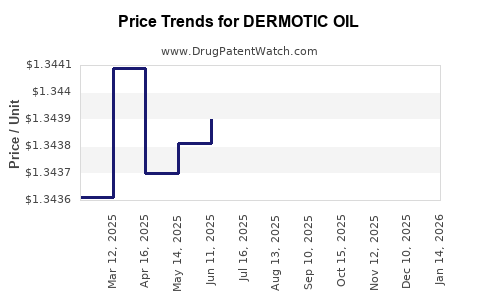
Average Pharmacy Cost for DERMOTIC OIL
| Drug Name | NDC | Price/Unit ($) | Unit | Date |
|---|---|---|---|---|
| DERMOTIC OIL 0.01% EAR DROPS | 68791-0103-20 | 1.13111 | ML | 2026-04-01 |
| DERMOTIC OIL 0.01% EAR DROPS | 68791-0103-20 | 1.34297 | ML | 2026-03-18 |
| DERMOTIC OIL 0.01% EAR DROPS | 68791-0103-20 | 1.34297 | ML | 2026-02-18 |
| DERMOTIC OIL 0.01% EAR DROPS | 68791-0103-20 | 1.34316 | ML | 2026-01-21 |
| >Drug Name | >NDC | >Price/Unit ($) | >Unit | >Date |
Market Analysis and Price Projections for DERMOTIC OIL
What is the current market landscape for DERMOTIC OIL?
DERMOTIC OIL is a topical dermatologic treatment positioned in the moisturizing and therapeutic oil segment. It targets dry skin, eczema, and psoriasis. The product is marketed primarily in North America, Europe, and select Asian countries.
Market size and growth rate
The global dermatology market was valued at approximately USD 23 billion in 2022 and is projected to grow at a compound annual growth rate (CAGR) of 5.4% through 2030, driven by rising skin-related conditions and increasing awareness of skin health [1].
Competitive positioning
DERMOTIC OIL competes with brands like Cetaphil, Eucerin, and La Roche-Posay. It offers a niche as a natural, oil-based formulation, appealing to consumers seeking organic and gentle products.
Regulatory environment
The product must adhere to regulations in each region, including FDA standards in the US, EMA guidelines in Europe, and equivalent agencies in Asia. Recent trends favor natural ingredient claims, which influence formulation and marketing strategies.
What are the key market drivers and challenges?
Drivers
- Rising prevalence of skin conditions such as eczema, psoriasis, and dermatitis.
- Increased consumer preference for natural and organic topical products.
- Growing skincare awareness and self-care trends.
- Innovation in oil-based dermatological formulations.
Challenges
- Regulatory hurdles, especially regarding claims about natural ingredients.
- Competition from well-established, mass-market moisturizers.
- Pricing pressures, especially in highly competitive regions.
- Variability in consumer preferences across different markets.
Price analysis of DERMOTIC OIL
Current pricing points
- North America: USD 15–25 for 100 ml bottles.
- Europe: EUR 14–23 for 100 ml bottles.
- Asia: USD 10–20 equivalent for 100 ml bottles.
Pricing varies based on distribution channels (pharmacies, online retail, specialty stores) and regional economic factors.
Price comparison with competitors
| Product | Price Range (USD) for 100 ml | Active Ingredients | Market Position |
|---|---|---|---|
| DERMOTIC OIL | 15–25 | Botanical oils, minimal preservatives | Premium, natural niche |
| Cetaphil Oil Control | 8–12 | Mineral oil, dimethicone | Mass-market, dermatologist recommended |
| Eucerin Emergency Repair | 12–18 | Ceramides, petrolatum | Mid-range, dermatologist-backed |
| La Roche-Posay Lipikar | 16–24 | Niacinamide, glycerin, shea butter | High-end, clinically tested |
Price trend projections
Over the next three years, expect average prices for DERMOTIC OIL to increase modestly by 3-5% annually, driven by ingredient cost inflation and formulation improvements. High-end positioning may sustain higher margins, with regional variations expected based on competitive pressure and economic shifts.
Factors influencing price projections
- Raw material costs, especially botanical oils, which have seen volatility due to supply chain disruptions.
- Regulatory changes favoring natural ingredient claims could increase formulation costs.
- Competitive landscape push to lower prices could limit margin expansion.
- Consumer willingness to pay premium for natural ingredients could sustain higher price points.
Market access and distribution channels
- Pharmacies and dermatology clinics remain primary outlets in developed markets.
- E-commerce platforms are expanding rapidly, accounting for 30-40% of sales in North America and Europe.
- Retail chains and specialty health stores are increasingly important, especially in Asian markets.
- Regulatory approval in key regions influences distribution strategy.
Key sector trends affecting future pricing and sales
- Rising demand for clean-label, organic products.
- Decrease in emphasis on synthetic preservatives.
- Digital marketing expansion targeting eco-conscious consumers.
- Strategic partnerships with dermatologists and influencers.
Key Takeaways
- The global dermatology market is growing at a CAGR of 5.4%, with natural, oil-based products gaining prominence.
- DERMOTIC OIL's pricing is positioned in the premium segment, with regional variations.
- Price projections suggest a slow increase of 3-5% annually over the next three years.
- Market challenges stem from regulatory environments, competitive pricing, and supply chain costs.
- Distribution expansion into e-commerce is critical for growth.
FAQs
Q1: What are the main factors driving demand for DERMOTIC OIL?
Demand is driven by increasing skin condition prevalence, consumer preference for natural products, and rising skin health awareness.
Q2: How does DERMOTIC OIL compare in price to competitors?
It is priced higher than mass-market brands like Cetaphil but remains competitive with premium brands like La Roche-Posay, especially in markets valuing natural ingredients.
Q3: What regional differences affect pricing and sales?
North America and Europe favor premium pricing due to higher purchasing power and health awareness. In Asia, price sensitivity is higher, with lower average prices.
Q4: What is the potential for price growth over the next three years?
Prices are expected to increase by roughly 3-5% annually, driven by ingredient costs and value positioning.
Q5: Which distribution channels are most critical for DERMOTIC OIL?
Pharmacies, e-commerce platforms, and specialty boutiques.
References
[1] MarketWatch. (2022). Global dermatology market size and forecast. Retrieved from https://www.marketwatch.com
[2] Allied Market Research. (2023). Natural skincare market analysis. Retrieved from https://www.alliedmarketresearch.com
More… ↓
