Share This Page
Drug Price Trends for DERMA-SMOOTHE-FS SCALP OIL
✉ Email this page to a colleague
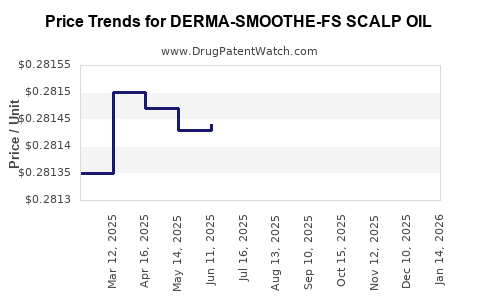
Average Pharmacy Cost for DERMA-SMOOTHE-FS SCALP OIL
| Drug Name | NDC | Price/Unit ($) | Unit | Date |
|---|---|---|---|---|
| DERMA-SMOOTHE-FS SCALP OIL | 68791-0102-04 | 0.28111 | ML | 2025-12-17 |
| DERMA-SMOOTHE-FS SCALP OIL | 68791-0102-04 | 0.28102 | ML | 2025-11-19 |
| DERMA-SMOOTHE-FS SCALP OIL | 68791-0102-04 | 0.28121 | ML | 2025-10-22 |
| DERMA-SMOOTHE-FS SCALP OIL | 68791-0102-04 | 0.28133 | ML | 2025-09-17 |
| >Drug Name | >NDC | >Price/Unit ($) | >Unit | >Date |
Market Analysis and Price Projections for DERMA-SMOOTHE-FS SCALP OIL
Introduction
DERMA-SMOOTHE-FS SCALP OIL is a topical dermatological product formulated to address scalp and hair-related skin conditions, such as dandruff, seborrheic dermatitis, and scalp psoriasis. As an emerging or existing hair and scalp health treatment, its market penetration, competitive landscape, and consequent pricing trends are crucial for stakeholders and investors. This analysis provides an in-depth review of current market dynamics, competitive positioning, regulatory factors, and future price projections.
Market Overview
Global Market Landscape for Hair and Scalp Therapeutics
The global market for hair and scalp therapeutic products has experienced consistent growth driven by increasing consumer awareness about scalp health, rising prevalence of scalp skin conditions, and a surge in demand for organic and personalized treatments. The market was valued at approximately USD 3.2 billion in 2022 and is projected to grow at a CAGR of 6.4% through 2030 [1].
North America remains the largest regional market, owing to high awareness and advanced healthcare infrastructure, followed by Europe and Asia-Pacific, where rising urbanization and disposable incomes fuel demand.
Segment Specifics: Topical Scalp Oils and Treatments
Topical scalp oils, including DERMA-SMOOTHE-FS SCALP OIL, occupy a niche within the larger scalp and hair treatment segment. This category appeals to consumers seeking natural, non-invasive solutions, and is characterized by diverse formulations, often combining plant-based extracts, oils, and medical-grade compounds.
The growing consumer shift toward natural and organic products has prompted formulators to develop scalp oils with botanical ingredients and minimal chemical additives.
Market Drivers and Barriers
Drivers
- Consumer Awareness: Increasing awareness of scalp conditions and their link to hair health propels demand.
- Product Innovation: Adoption of natural ingredients and proprietary formulations enhances market appeal.
- Online Distribution: Accelerated e-commerce channels facilitate easier access, expanding consumer reach.
- Regulatory Support: Favorable regulatory pathways for topical dermatological devices in key markets like the US and EU.
Barriers
- Regulatory Challenges: Stringent approval processes for new therapeutics extend time-to-market.
- Competitive Pricing: Intense price competition pressures profit margins.
- Efficacy Skepticism: Consumers demand evidence-backed claims; products with unproven efficacy risk rejection.
- Market Saturation: The proliferation of similar products could dilute market share.
Competitive Landscape
Major competitors include established pharmaceutical and cosmetic brands through their dermaceutical lines—such as Johnson & Johnson, L'Oréal, and Unilever—and emerging boutique brands emphasizing natural ingredients.
DERMA-SMOOTHE-FS SCALP OIL, if positioned as a scientifically validated, natural solution, can differentiate via innovative delivery systems, ingredient transparency, and clinical backing.
Regulatory and Patent Considerations
Regulatory approval is fundamental. Depending on the composition, this product might fall under OTC (Over-the-counter) classifications or require prescription status. If proprietary formulations or delivery systems are involved, patent protection can confer competitive advantages, enabling premium pricing strategies.
Pricing Strategy and Factors
Current Market Pricing
- Premium Segment: $30 — $50 per 100 ml, often associated with natural, organic, or clinically validated products.
- Mass Market: $10 — $20 per 100 ml for standard formulations without added claims or certifications.
DERMA-SMOOTHE-FS SCALP OIL's price point hinges on factors such as formulation complexity, brand positioning, clinical evidence, packaging quality, and distribution channels.
Cost Structure Considerations
- Raw Materials: Natural oils, extracts, and active ingredients can range from $2 to $8 per bottle.
- Manufacturing: Quality control and certification costs may add $3 — $7 per unit.
- Regulatory and Certification Costs: Possible one-time expenses of $50,000 — $200,000 for clinical trials or certifications.
- Distribution and Marketing: Depending on channel reach, marketing can comprise 20–30% of product cost.
Price Projection Outlook (2023-2030)
Short-term (2023-2025)
In the initial years post-launch, the product is likely to be priced at the premium end of the spectrum ($35 — $50 per 100 ml), especially if subsumed within a niche natural or clinically backed segment. Early adopters, dermatologists, and specialty salons will be targeted. Price points may stabilize around $40 — $45 per 100 ml, balancing profitability with competitive positioning.
Medium-term (2026-2028)
As the product gains wider recognition, economies of scale in manufacturing and supply chain efficiencies could enable slight reductions—bringing prices to $30 — $40 per 100 ml, expanding accessibility. Market penetration efforts and consumer education will be pivotal.
Long-term (2029-2030)
Market maturation and potential product line extensions could enable further pricing variation, possibly introducing value packs or larger sizes at discounted rates (e.g., $50 for 200 ml). Price stabilization or slight reductions to $25 — $35 per 100 ml are forecasted, depending on competitive dynamics and regulatory environments.
Regulatory and Economic Impact on Pricing
Increased regulatory costs in key markets could inflate initial pricing, while patent protections or proprietary formulations will sustain premium pricing. Conversely, expansion into emerging markets with less regulatory burden could attenuate price points, fueling volume-driven revenue.
Conclusive Insights
- Competitive Positioning: Premium pricing aligned with natural, clinically supported formulations offers the best market entry strategy.
- Distribution Channels: A mix of direct-to-consumer online sales and specialty retail boosts margin control.
- Innovation and Evidence: Proprietary ingredients and clinical validation strengthen pricing power and market differentiation.
- Scaling: Economies of scale will be critical to adjusting prices downward, expanding consumer access, and achieving market dominance.
Key Takeaways
- DERMA-SMOOTHE-FS SCALP OIL targets a growing segment of natural, dermatologically-supported scalp treatments with high consumer interest.
- Strategic positioning within premium segments can justify higher price points, especially with strong clinical backing.
- Price projections suggest initial pricing around $40 — $45 per 100 ml, with gradual reductions to $25 — $35 as manufacturing scales.
- Regulatory, patent, and marketing strategies are essential to sustain premium pricing and market share.
- Expanding distribution through online platforms and specialty clinics will be vital to growth.
FAQs
1. How does DERMA-SMOOTHE-FS SCALP OIL differentiate from existing scalp treatments?
Its differentiation hinges on proprietary formulations, natural ingredient focus, and clinical validation. Patent protections can further enhance its safety and efficacy claims, setting it apart from competitors.
2. What are the primary factors influencing the product’s price point?
Key factors include formulation complexity, ingredient costs, regulatory approval expenses, brand positioning, manufacturing scale, distribution channels, and clinical evidence.
3. How will market trends impact future pricing for DERMA-SMOOTHE-FS SCALP OIL?
As demand for natural and scientifically-backed scalp treatments increases, premium pricing is sustainable initially. Over time, economies of scale and market competition may lead to moderate price reductions.
4. What regulatory pathways should the company pursue to optimize pricing?
Securing fast-track approvals in emerging markets and obtaining dermatological claims through clinical trials will support premium pricing. Patent protections for formulations provide a competitive moat.
5. What emerging markets present the best opportunities for scaling DERMA-SMOOTHE-FS SCALP OIL?
Markets in Asia-Pacific, Latin America, and the Middle East, characterized by growing disposable incomes and increasing skincare awareness, provide promising avenues for expansion and price elasticity.
Sources
[1] MarketWatch. "Global Hair and Scalp Therapeutics Market Report 2022."
[2] Grand View Research. "Hair Care Market Size & Trends."
[3] Statista. "Consumer Demand for Natural Skincare Products."
More… ↓
