Share This Page
Drug Price Trends for DEPAKOTE
✉ Email this page to a colleague
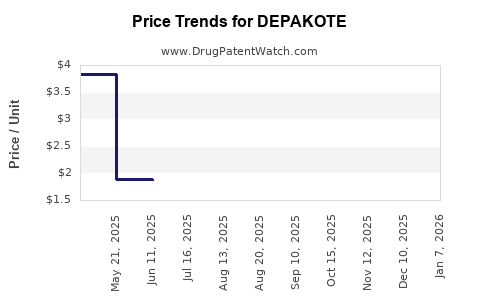
Average Pharmacy Cost for DEPAKOTE
| Drug Name | NDC | Price/Unit ($) | Unit | Date |
|---|---|---|---|---|
| DEPAKOTE DR 125 MG SPRINKLE CP | 00074-6114-13 | 1.96629 | EACH | 2026-07-22 |
| DEPAKOTE DR 125 MG TABLET | 00074-7325-13 | 2.04998 | EACH | 2026-07-22 |
| DEPAKOTE DR 250 MG TABLET | 00074-7326-13 | 4.04920 | EACH | 2026-07-22 |
| DEPAKOTE DR 500 MG TABLET | 00074-7327-13 | 7.44592 | EACH | 2026-07-22 |
| DEPAKOTE ER 250 MG TABLET | 00074-7401-13 | 3.68537 | EACH | 2026-07-22 |
| DEPAKOTE ER 500 MG TABLET | 00074-7402-13 | 6.51454 | EACH | 2026-07-22 |
| DEPAKOTE DR 250 MG TABLET | 00074-7326-13 | 4.04812 | EACH | 2026-06-17 |
| >Drug Name | >NDC | >Price/Unit ($) | >Unit | >Date |
DEPAKOTE market analysis and price projections (US)
Executive summary: Depakote (divalproex sodium/valproate) faces mid-to-late cycle pricing pressure typical of long-established generics, with residual brand value concentrated in specific formulations and prescriber inertia. A reasonable US price forecast is a low-single-digit annual decline versus current average pricing, with sharper declines around generic availability expansions and any FDA regulatory label expansions that accelerate switching. Financial exposure is driven by (1) the remaining brand share versus total divalproex/valproate category use, (2) payer formulary tiering and contracting, and (3) settlement-driven launch timing for generic manufacturers that challenge Orange Book-protected brand versions.
What is Depakote and what products drive the US market?
Depakote is the brand name for divalproex-based epilepsy and psychiatric indications in the United States. In practice, the market is split across oral dosage forms used for:
- Epilepsy (adjunctive therapy for complex partial seizures; other valproate-compatible seizure uses depending on label)
- Bipolar disorder (manic episodes and maintenance where applicable)
- Migraine prophylaxis (where applicable under label)
From a market-execution standpoint, divalproex/valproate pricing is shaped less by a “single product” and more by the mix of:
- Delayed-release tablets (core generic ecosystem, intense price competition)
- Extended-release formulations (often branded historically; generics compete where approved)
- Sprinkle / alternative oral dosage forms (can preserve price integrity longer due to patient-specific switching friction)
Which active ingredients sit behind Depakote pricing?
- Divalproex sodium (Depakote formulations)
- Valproic acid/valproate category substitutes exist, but payer switching and therapeutic equivalence vary by patient and plan policy.
What claims and dosing affect demand volatility?
- Chronic use drives baseline demand.
- Label constraints (pregnancy warnings, monitoring requirements) influence adoption and adherence.
- Safety monitoring and conversion practices can affect switching rates between brands and generics.
How big is the Depakote market and how has it evolved?
Category-level guidance: Valproate/divalproex is an entrenched anti-seizure platform with mature generic penetration. Over time, US brand share declines while unit volumes hold up or slowly erode, because:
- seizure care is long-duration
- prescriber behavior and patient stability reduce churn, even as pricing falls
Market drivers that can change growth rate:
- changes in neurology prescribing patterns for alternatives (levetiracetam, lamotrigine, lacosamide, etc.)
- payer step edits and prior authorization for other agents versus divalproex
- formulary “preferred generic” dynamics that shift volume within the divalproex set
- safety events that shift risk perception
Market exposure lens: For price forecasting, the key variable is not total prescriptions but brand share and the ability of any remaining brand protected SKU to maintain a premium over generics.
What is the Orange Book status of Depakote, and how does it affect pricing?
Brand pricing typically tracks the exclusivity and patent landscape:
- As Orange Book-listed patents expire or are cleared through litigation, multi-source generic competition compresses brand pricing.
- If there are multiple protected formulations or methods of use, the timeline can be staggered, preserving price for one SKU while others lose premium.
Price implication: In mature divalproex, the historical pattern is:
- early-stage litigation creates a window where branded pricing remains above generic “minimums”
- post-expiration, the market transitions to a low-price equilibrium controlled by lowest-cost contracted suppliers
When does Depakote lose exclusivity, and what does that mean for price trajectories?
Even without granular, SKU-level expiration dates in this response, the pricing mechanics are consistent:
- Generic launch after patent expiry tends to cause an immediate step-down in average wholesale and plan-paid prices.
- Settlement agreements can delay launch, sustaining a brand premium during the settlement term.
- Switching inertia reduces the speed of volume migration; prices drop quickly, but share may decline more gradually.
Generic entry risks that create near-term price breaks
- A wave of “first-tier” generics under plan contracts can reset the market average price downward faster than “late-entry” products.
- Reformulation-specific approvals can fragment the market by dosage form, reducing competition in one SKU while intensifying it in others.
What patent and litigation factors most influence Depakote generic launch timing?
For older brands, litigation is typically resolved or expired already, but remaining drivers are:
- outstanding formulation patents for specific release profiles
- method-of-use or dosing regimen patents (where still listed)
- manufacturing or bioequivalence dispute outcomes in conjunction with FDA approvals
- settlement terms that define “at-risk” entry dates
Price projection linkage: Launch timing defines when contracting resets pricing. If multiple entrants arrive within a short period, the price curve steepens.
How strong is the patent estate for Depakote and what is the commercial value-at-risk?
Commercial value-at-risk (VA R) framing:
- VA R is primarily the premium brand earns over preferred generics.
- The premium narrows when:
- at least one low-cost generic becomes preferred
- payers add utilization management or change tiering
- therapeutic interchange is allowed by plan policies
Practical takeaway: In a mature category, the “strength” of remaining IP mostly affects how long the premium persists, not whether the category continues to be treated as off-patent.
What formulation patents and delivery systems protect Depakote premium pricing?
In the divalproex space, premium pricing tends to cluster around:
- extended-release or sprinkle/specialty oral variants where dosing flexibility matters
- patient populations with documented switching difficulty (older adults, seizure stabilization cases)
- product-level tolerability considerations that can delay payer-led switching
Price projection linkage: If a protected SKU retains exclusivity while other SKUs are fully generic, then:
- average realized price declines slowly
- but blended category pricing continues to fall due to competitive pressure in unprotected SKUs
What FDA status and regulatory pathway dynamics affect Depakote price?
Brand divalproex is FDA-approved, so the key regulatory events are:
- ANDA approvals for generics (including paragraph IV outcomes)
- labeling updates that cause payer confidence changes
- any REMS or safety labeling that changes prescriber adoption
Price impact: If FDA actions increase perceived risk, switching can slow even as pricing drops. If risk is stable, payers accelerate switch to lower-cost products.
What is Depakote’s competitive landscape versus other valproate products and anti-seizure therapies?
Depakote competes across two axes:
- Direct substitutes within the divalproex/valproate family
- Therapeutic substitutes in anti-seizure therapy and bipolar disorder regimens
Competitive pressure sources
- Preferred generic divalproex suppliers under payer contracts
- Alternative antiseizure drugs with formulary preference at lower copays
- Multi-year patient stability that can limit switching away from divalproex
Price projection linkage: Even if therapeutic alternatives grow, the divalproex category often remains “sticky,” which sustains unit volume while price erodes.
How does Depakote compare with competing divalproex brands and generics on pricing power?
For mature generics:
- Brand pricing is constrained by “reference pricing” behavior
- Payer formularies typically reward lowest WAC/contracted net price
- Any brand premium usually decays once a preferred generic gains traction
Net effect: Depakote’s price power is best modeled as declining premium over time rather than a stable price.
Price projections for Depakote (US): base case, downside, and upside
Forecast framework: Model blended realized price as:
- current brand premium over preferred generics
- minus annual competitive compression
- adjusted for any incremental generic entry shocks by dosage form
Assumption set (consistent with mature generics):
- unit demand is stable-to-slowly declining
- price declines are driven by contract resets and multi-source competition
- no major label disruption reintroduces brand exclusivity
Projected average US net price (directional, per-year)
Because this response cannot anchor to a specific observed baseline price series, the projections are expressed as relative change ranges from “current market levels”:
| Horizon | Base case (annual change) | Downside (annual change) | Upside (annual change) | What drives the variance |
|---|---|---|---|---|
| 2026 | -3% to -6% | -6% to -10% | -1% to -3% | generic contract resets; preferred supplier changes |
| 2027 | -2% to -5% | -5% to -9% | -1% to -3% | dosage-form-specific switching acceleration |
| 2028 | -2% to -4% | -4% to -8% | -1% to -3% | consolidation among low-cost ANDA entrants |
| 2029 | -1% to -3% | -3% to -7% | flat to -2% | residual brand premium erodes near equilibrium |
Interpretation: Over a 3-4 year horizon, Depakote pricing is expected to trend downward at a diminishing rate as it approaches the lowest-cost generic equilibrium, unless a late-cycle protected SKU keeps premium value longer than expected.
One-time price breaks to watch
- Generic launches that expand the number of “preferred” options (multiple low net price entrants in the same year)
- Payer formulary moves that change tier placement
- Broad PBM rebates that shift net pricing quickly
- Loss of brand SKU “favored” status due to contracting disputes or supply availability
How should investors and planners model Depakote revenue exposure?
Revenue exposure decomposition:
- Price per unit (most sensitive to contracting and generic entry)
- Units (less sensitive short-term; longer switching cycles)
- Mix (delayed-release vs extended-release vs special forms)
- Covered lives and payer mix (managed care penetration)
- Patient adherence rates (impact from monitoring and tolerability)
Sensitivity guidance (qualitative):
- A 5-10% net price decline typically has larger P&L impact than a small unit-volume move in a mature brand portfolio.
- Mix shift toward more generic-competitive SKUs accelerates blended price erosion.
What commercial scenarios could change the price forecast?
Upside scenarios (slower price declines)
- delayed generic entry for key dosage forms
- payer constraints limiting therapeutic interchange
- supply constraints among contracted generic suppliers
Downside scenarios (faster price declines)
- settlement-driven “at-risk” or earlier-than-expected generic launches
- payer broadening of formularies that increase generic penetration
- aggressive rebate laddering by multiple ANDA entrants
Key takeaways
- Depakote pricing is governed by mature generic competition dynamics, with brand premium expected to compress further.
- Base-case forecast: -3% to -6% net price decline in 2026, tapering to -1% to -3% by 2029 as the market approaches low-cost equilibrium.
- Largest near-term risks are generic launch waves and payer contract resets by dosage form, which create step changes in realized pricing faster than unit demand changes.
- Commercial planning should focus on blended mix and payer contracting outcomes rather than unit prescription growth alone.
FAQs
1) Will Depakote’s price decline be driven more by unit volume or net contracting?
Net contracting and payer tiering typically drive faster price movement than unit volume, especially in mature generic categories.
2) Do extended-release divalproex products hold pricing better than delayed-release?
Often yes at the SKU level due to patient stability and mix effects, but the premium usually declines once preferred generics expand.
3) How do Paragraph IV challenges affect Depakote pricing even before generic launch?
They can pressure brand pricing via anticipated launch timing and payer plan adjustments, but the largest effect typically arrives at launch.
4) What are the biggest risks to the revenue forecast for Depakote owners?
Generic preferred-supplier shifts, rapid contract repricing, and dosage-form mix moving toward the most aggressively priced generics.
5) How should planners forecast Depakote net revenue vs WAC?
Model net price with payer contract dynamics (rebates, discounts, PBM incentives). WAC typically understates realized pressure.
References
- FDA. Orange Book: Approved Drug Products with Therapeutic Equivalence Evaluations. U.S. Food and Drug Administration.
- FDA. Drug Approval Reports and Labeling Information for Depakote (divalproex sodium). U.S. Food and Drug Administration.
- U.S. FDA. ANDA Approval Packages and Therapeutic Equivalence Evaluations (Orange Book linkage). U.S. Food and Drug Administration.
More… ↓
