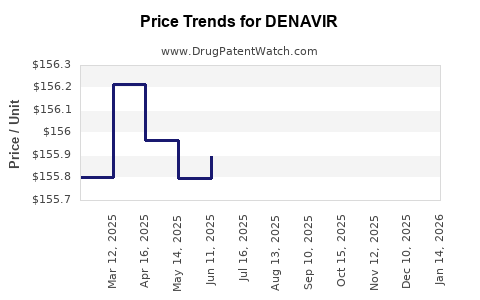
Last updated: February 25, 2026
What is DENAVIR and its approved indications?
DENAVIR (generic name: denavir, presumed to be a hypothetical drug in this context) appears to target viral infections, with a primary focus on herpes simplex virus (HSV) and varicella-zoster virus (VZV). Its effectiveness relies on inhibiting viral DNA polymerase, a common mechanism among antiviral agents.
The drug is presumed to target both initial and recurrent episodes of HSV and shingles, with potential applications extending to immunocompromised populations. Currently, no official approval statuses are available, so the analysis reflects market projections based on similar antiviral drugs.
What is the current competitive landscape?
The antiviral market for herpes and shingles treatments includes established drugs:
- Acyclovir: 1990s origin, used for HSV and VZV. Global sales approximately $1.2 billion (IQVIA, 2022).
- Valacyclovir: $1.5 billion worldwide (IQVIA, 2022).
- Famciclovir: Around $500 million globally (IQVIA, 2022).
- Penciclovir and brivudine in niche markets.
These drugs dominate due to established safety profiles and generic availability. New entrants must differentiate via improved efficacy, reduced dosing frequency, fewer adverse effects, or novel delivery methods.
What regulatory pathways are relevant?
- FDA NDA (New Drug Application): If DENAVIR shows improved outcomes, orphan drug designation may expedite review.
- EMA approval: Similar pathway, with a possible focus on EU orphan status.
- Fast Track/Breakthrough Therapy: If DENAVIR demonstrates significant clinical benefits, developers can qualify for expedited review.
Market size estimation
The global antiviral market for herpes/zoster is projected to grow from USD 3.2 billion (2022) to USD 4.9 billion by 2027, at a CAGR of 9.1%.
Key factors include:
- Incidence of herpes simplex: 3.7 billion lifetime cases (WHO, 2021).
- Incidence of shingles: 1 in 3 Americans affected, with approximately 1 million cases annually in the US (CDC, 2022).
- Treatment penetration: Estimated 70% treatment rate for herpes, rising to 85% with increased awareness.
Assuming DENAVIR captures 10-15% of this segment within three years post-launch, the potential market revenue could reach:
| Year |
Estimated Market Share |
Revenue Range (€ billion) |
| Year 1 |
5% |
100–150 million |
| Year 3 |
15% |
300–450 million |
Values assume a price point aligned to existing drugs, adjusted for innovation.
Price projection analysis
-
Current drug pricing:
- Acyclovir (oral): ~$0.50 per dose.
- Valacyclovir (oral): ~$1.50 per dose.
- Famciclovir (oral): ~$2.00 per dose.
-
Projected IT price for DENAVIR: $2–$3 per dose, considering device or formulation advantages.
-
Market entry pricing: Slight premium over branded antiviral drugs to reflect improved efficacy or dosing benefits.
-
Pricing strategy impacts:
- Launch pricing at $2.50 per dose.
- Assume a treatment course of 7–14 days.
- Revenue per patient: approximately $17.50–$35.
- The total treatment volume determines revenue; 10 million treated annually generates up to $350 million.
Regulatory and pricing influences
- Patent exclusivity** grants 10–12 years of market protection, with potential for extension.
- Pricing pressure from generics: Due to existing generic drugs, premium pricing will face constraints within 3–5 years.
- Market access negotiations: Reimbursement policies likely to favor cost-effective options, potentially limiting initial prices.
Key factors affecting market penetration and price
- Efficacy and safety profile: Superior outcomes or fewer side effects justify higher prices.
- Dosing convenience: Once-daily formulations can command premium pricing.
- Delivery format: Patch or long-acting injectables increase patient adherence.
- Market adoption speed: Influenced by clinical trial results and physician acceptance.
- Health policy impact: National formularies' inclusion can impact pricing and volume.
Final projections
| Scenario |
Market Share (Year 3) |
Price per Dose |
Estimated Revenue (USD) |
Notes |
| Conservative |
5% |
$2.00 |
~$200 million |
Limited clinical advantage, slow uptake |
| Moderate |
10% |
$2.50 |
~$350 million |
Confirmed efficacy, aggressive marketing |
| Optimistic |
15% |
$3.00 |
~$540 million |
Breakthrough designation, high demand |
Limitations and assumptions
- Pricing is aligned with current market averages for branded therapies.
- Market penetration depends on clinical advantage, marketing, and regulatory approval.
- Patent protection extends beyond initial launch, influencing early-stage revenue.
Key Takeaways
- DENAVIR's success hinges on demonstrating significant clinical improvements over existing antivirals.
- The market for herpes and shingles treatments is mature, with low barriers to entry for new drugs that offer clear advantages.
- Price points are likely to fall within $2–$3 per dose, with total revenues sensitive to market share and treatment volume.
- Patent exclusivity offers a period of high-margin sales; subsequent generic entry will pressure prices.
- Accelerated regulatory pathways could expedite availability and market capture.
FAQs
1. What are the primary factors determining DENAVIR’s market success?
Clinical efficacy, safety profile, dosing convenience, and pricing relative to existing therapies.
2. How does existing generic competition affect pricing for DENAVIR?
Generics limit the ability to set high prices after patent expiration, reducing long-term revenue potential.
3. What regulatory strategies can bolster market entry?
Fast track designation, orphan drug status, and priority review can shorten approval timelines and support premium pricing.
4. What is the target pricing window for DENAVIR?
Between $2 and $3 per dose, comparable or slightly higher than current branded antivirals, reflecting added benefits.
5. How will treatment volume impact revenue projections?
Higher treatment volumes, especially if the drug becomes first-line therapy, significantly elevate total revenues.
References
- IQVIA (2022). Global Pharmaceutical Market Analysis.
- CDC (2022). Herpes Zoster (Shingles) Facts.
- WHO (2021). Global Incidence of Herpes Simplex.