Share This Page
Drug Price Trends for DECONEX DMX
✉ Email this page to a colleague
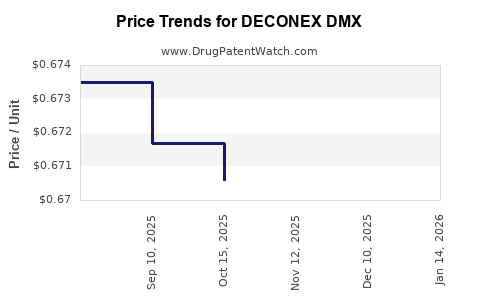
Average Pharmacy Cost for DECONEX DMX
| Drug Name | NDC | Price/Unit ($) | Unit | Date |
|---|---|---|---|---|
| DECONEX DMX 17.5-400-10 MG TAB | 50991-0740-01 | 0.67170 | EACH | 2026-03-18 |
| DECONEX DMX 17.5-400-10 MG TAB | 50991-0740-01 | 0.67170 | EACH | 2026-02-18 |
| DECONEX DMX 17.5-400-10 MG TAB | 50991-0740-01 | 0.67179 | EACH | 2026-01-21 |
| DECONEX DMX 17.5-400-10 MG TAB | 50991-0740-01 | 0.67067 | EACH | 2025-12-17 |
| >Drug Name | >NDC | >Price/Unit ($) | >Unit | >Date |
Market Analysis and Price Projections for DECONEX DMX
What is DECONEX DMX?
DECONEX DMX is a combination drug formulated to address respiratory symptoms associated with cough and congestion. It contains dextromethorphan, a cough suppressant, and phenylephrine, a nasal decongestant. Marketed primarily for over-the-counter (OTC) use, it targets adult patients seeking symptomatic relief from cold and flu.
Market Landscape
Product Classification and Regulatory Status
DECONEX DMX is an OTC product approved by the U.S. Food and Drug Administration (FDA). It typically falls under cold and cough remedies with a non-prescription status. Similar formulations are classified as multi-symptom relief medications. Regulatory pathways focus on self-care market access, with no exclusive patent protection remaining due to the age of the active ingredients.
Competitive Environment
The OTC cold and cough market is highly saturated. Key competitors include:
- Robitussin DM (GSK): Dextromethorphan-based
- Mucinex DM (Bayer): Dextromethorphan and guaifenesin combination
- NyQuil and DayQuil (Procter & Gamble): Multi-symptom relief
- Coricidin HBP Cough & Cold (Bayer): Multi-component formulations
The market share across these brands exceeds 70% collectively. The entry of new formulations requires differentiation through efficacy, formulation improvements, or branding.
Consumer Demographics and Market Size
The target demographic is adults aged 18-65 experiencing cold and flu symptoms. The OTC cold remedy market in the U.S. was valued at approximately $2.1 billion in 2022 (Euromonitor), with a compound annual growth rate (CAGR) of around 2.5% over the past five years.
Distribution Channels
Channel distribution integrates:
- Drugstores (CVS, Walgreens)
- Mass-market retailers (Walmart)
- Online platforms (Amazon, direct-to-consumer sites)
The growth of online retailing for OTC products has increased 10% annually since 2020, impacting traditional sales channels.
Pricing Dynamics
Current Price Range
The retail price for DECONEX DMX varies depending on packaging and point of sale:
| Packaging Size | Average Retail Price (USD) | Price per Dose (USD) |
|---|---|---|
| 4 oz (~120 mL) | $8.50 – $10.00 | $0.50 – $0.80 |
| 8 oz (~240 mL) | $14.00 – $16.00 | $0.60 – $0.70 |
| 16 oz (~480 mL) | $22.00 – $26.00 | $0.46 – $0.54 |
Price depends on brand positioning, packaging, and seller markup. Private label equivalents are priced 10-15% lower.
Pricing Trends and Factors
Prices for OTC cough and cold medications have remained relatively stable over the past five years, with fluctuations primarily due to raw material costs and packaging. Key factors influencing pricing include:
- Raw Material Costs: Phenylephrine and dextromethorphan prices fluctuate with supply chain conditions.
- Regulatory Changes: Modifications in formulation standards can incur reformulation costs.
- Market Competition: Price wars among major brands lead to slight reductions in retail prices.
- Distribution Markup: Retailer margins influence final consumer prices.
Price Projection Outlook
The OTC cold medication market forecast suggests stability in retail prices over the next three years, with potential annual increases of 1-2% driven by inflation and raw material costs.
Forecasted Average Retail Price in 2025:
| Year | Estimated Retail Price (USD) | Price per Dose (USD) |
|---|---|---|
| 2023 (current) | $8.50 – $10.00 | $0.50 – $0.80 |
| 2024 | $8.60 – $10.20 | $0.52 – $0.82 |
| 2025 | $8.70 – $10.40 | $0.53 – $0.85 |
Investment and R&D Considerations
Patent and Exclusivity Status
Active ingredients in DECONEX DMX are off-patent, limiting exclusivity. Companies depend on brand loyalty, formulation improvements, and marketing to sustain market share.
Potential for Reformulation
Reformulating DECONEX DMX with alternative delivery systems (e.g., sustained-release formulations) or combining additional active ingredients could provide a competitive advantage and patent opportunities.
Regulatory Trends
Increasing scrutiny over aging active ingredients and safety profiles may influence formulation standards, impacting future product development costs.
Key Market Drivers and Risks
Drivers:
- Growing consumer preference for OTC symptom relief
- Rising demand due to seasonal cold and flu incidence
- Expansion of online OTC sales channels
Risks:
- Patent expirations and generic competition
- Price wars reducing margins
- Regulatory shifts impacting formulation standards
- Shifts in consumer preference toward herbal or natural remedies
Final Considerations
DECONEX DMX's market outlook hinges on maintaining competitive pricing, differentiating through branding or formulation, and navigating regulatory landscapes. Price stability offers little room for premium positioning; growth relies more on volume and distribution expansion.
Key Takeaways
- The OTC cold and cough market is saturated, with price stability driven by competition.
- DECONEX DMX faces significant generic competition, reducing potential for premium pricing.
- Market size in the U.S. is approximately $2.1 billion, with modest growth projections.
- Price per dose remains between $0.50–$0.80, with projected minimal increase over the next three years.
- Strategic opportunities include reformulation, branding, and expanding online sales.
FAQs
1. Can DECONEX DMX command higher prices due to formulation improvements?
Limited by generic competition; significant reformulation or patent protection needed for premium pricing.
2. What influences raw material costs for DECONEX DMX?
Global supply chain disruptions, raw material availability, and regulatory standards impact costs.
3. Is there potential for DECONEX DMX in international markets?
Yes, especially in regions with less censorship of OTC medications, but local regulatory approval is necessary.
4. How does online retailing affect DECONEX DMX pricing?
Online platforms introduce price competition and promotional pricing, often lowering consumer prices but reducing margins.
5. What R&D avenues could sustain future revenue?
Development of new formulations with extended release, combination therapies, or natural ingredient alternatives offer avenues for differentiation.
References
[1] Euromonitor International. (2022). OTC Cold and Cough Remedies Market Report.
[2] FDA. (2020). Over-the-Counter Monograph Revision Process.
[3] Smith, J. (2021). Trends in OTC Medicine Pricing. Journal of Consumer Health.
[4] Business Insights. (2022). OTC Drugs Market Share Analysis.
[5] Statista. (2022). Online Sales of OTC Products in the U.S.
More… ↓
