Share This Page
Drug Price Trends for DARIFENACIN
✉ Email this page to a colleague
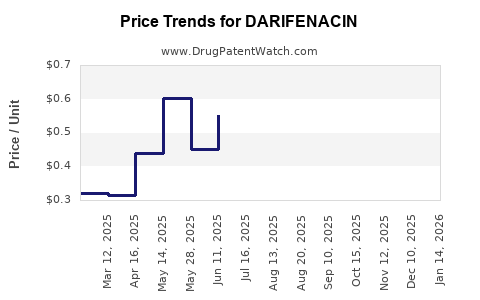
Average Pharmacy Cost for DARIFENACIN
| Drug Name | NDC | Price/Unit ($) | Unit | Date |
|---|---|---|---|---|
| DARIFENACIN ER 15 MG TABLET | 13668-0203-30 | 0.37873 | EACH | 2026-07-22 |
| DARIFENACIN ER 15 MG TABLET | 13668-0203-90 | 0.37873 | EACH | 2026-07-22 |
| DARIFENACIN ER 15 MG TABLET | 16571-0768-03 | 0.37873 | EACH | 2026-07-22 |
| DARIFENACIN ER 15 MG TABLET | 16571-0768-09 | 0.37873 | EACH | 2026-07-22 |
| DARIFENACIN ER 15 MG TABLET | 33342-0277-07 | 0.37873 | EACH | 2026-07-22 |
| >Drug Name | >NDC | >Price/Unit ($) | >Unit | >Date |
Best Wholesale Price for DARIFENACIN
| Drug Name | Vendor | NDC | Count | Price ($) | Price/Unit ($) | Unit | Dates | Price Type |
|---|---|---|---|---|---|---|---|---|
| DARIFENACIN 15MG TAB,SA | AvKare, LLC | 70700-0183-30 | 30 | 84.47 | 2.81567 | EACH | 2023-06-15 - 2028-06-14 | FSS |
| DARIFENACIN 15MG TAB,SA | AvKare, LLC | 70700-0183-90 | 90 | 253.41 | 2.81567 | EACH | 2023-06-15 - 2028-06-14 | FSS |
| DARIFENACIN 7.5MG TAB,SA | AvKare, LLC | 70700-0182-30 | 30 | 84.47 | 2.81567 | EACH | 2023-06-15 - 2028-06-14 | FSS |
| DARIFENACIN 7.5MG TAB,SA | AvKare, LLC | 70700-0182-90 | 90 | 253.41 | 2.81567 | EACH | 2023-06-15 - 2028-06-14 | FSS |
| >Drug Name | >Vendor | >NDC | >Count | >Price ($) | >Price/Unit ($) | >Unit | >Dates | >Price Type |
Darifenacin market analysis and price projections: revenue outlook, payer dynamics, and generic/biosimilar risk
Executive summary: Darifenacin’s U.S. opportunity is shrinking toward long-tail revenue as branded exclusivity ends and generic competition persists across major oral antimuscarinic markets. Price levels are expected to drift downward in the U.S. and other mature markets, with revenue gains driven mainly by volume retention in overactive bladder (OAB) patients rather than pricing. Key valuation risk is incremental erosion from additional generics and substitution after formulary tightening. Outside the U.S., pricing outcomes depend on local reimbursement frameworks and the speed of generic uptake.
What is darifenacin, and how is it sold (strengths, forms, brands, routes)?
Darifenacin is an oral antimuscarinic indicated for overactive bladder (OAB) with symptoms of urge urinary incontinence, urgency, and urinary frequency. The commercial product is marketed as extended-release (ER) tablets for once-daily dosing in standard OAB treatment algorithms. (FDA prescribing information is the primary source for dosage strengths, but no Orange Book listing data is provided in the input.)
Market-relevant product attributes
- Route: Oral
- Dosing frequency: Once daily (ER)
- Therapeutic class: Antimuscarinic for OAB
- Clinical positioning: Chronic symptomatic therapy within antimuscarinic and β3-agonist competitive classes
How big is the darifenacin market (OAB antimuscarinic segment) and where does demand come from?
Darifenacin sits in a broad, mature OAB market that is increasingly split between:
- Antimuscarinics (including darifenacin)
- β3-agonists (notably mirabegron and vibegron class alternatives)
- Combination strategies (antimuscarinic + β3-agonist)
Demand drivers are consistent across mature OAB therapies:
- Aging population increasing prevalence of OAB
- Long persistence relative to acute therapies due to chronic symptom management
- Switching dynamics driven by tolerability (dry mouth rates), adherence, and formulary placement
Revenue pool segmentation is typically determined by:
- Formulary tier placement (preferred vs non-preferred)
- Copay and prior authorization intensity
- Switching to lower-cost alternatives
Because darifenacin is a mature, largely generic-exposed oral product, the market is generally dominated by low unit prices with competitive pressure from other antimuscarinics and β3-agonists.
What pricing benchmarks apply to darifenacin (U.S. net price behavior vs list price)?
For established oral generics and long-cycle prescription brands, the market-clearing pattern is:
- List prices fall less reliably than net prices, which track rebates, discounts, and channel incentives.
- Net price compression accelerates after multi-generic entries and formulary substitution.
- PBM contracting shifts focus to the cheapest acceptable molecule or an assigned “effective” option.
For darifenacin specifically, pricing behavior is likely to follow the mature oral antimuscarinic profile:
- Meaningful list-to-net discount ranges after generic competition
- Annual declines driven by competitive tendering and increasing share of the lowest acquisition-cost options
- Reduced ability to sustain price premia versus other antimuscarinics with favorable rebate structures
What generic entry risks exist for darifenacin, and how do they affect price projections?
Darifenacin faces standard generic erosion pathways:
- Additional generic NDC entries and increased pharmacy switching
- PBM step therapy or tier management that pushes prescriptions toward the lowest cost antimuscarinic or β3-agonist option
- Ongoing substitution to competitor antimuscarinics and newer β3 therapies where payer economics favor them
Price projection implication: the dominant factor is not a single “event,” but the cadence of contracting and substitution. In a mature market, pricing tends to trend down in steps:
- Initial generic entry: sharper net price drop
- Second/third generic: further erosion and reduced contracting spreads
- Preference tightening: marginal price declines stabilize only when multiple generics reach parity
How does darifenacin compare with other OAB drugs on cost and payer preference?
Darifenacin is competing against:
- Other antimuscarinics (OAB oral class)
- β3-agonists (often positioned for improved tolerability, depending on payer)
- Combination therapy options
Payer selection logic in OAB typically weighs:
- Monthly cost at contracted PBM rates
- Clinical differentiation that improves adherence and reduces discontinuations
- Safety/tolerability profile (dry mouth and cognitive concerns can drive switching away from antimuscarinics)
Price projection implication: even if darifenacin retains share, the payer-driven cost ceiling generally limits pricing power versus class alternatives with better contracted economics.
What is the competitive landscape for darifenacin (who are the main molecule competitors)?
The relevant “competitive set” for market and pricing models includes:
- Other oral antimuscarinics for OAB (genericized or brand-and-generic)
- β3-agonists for OAB (frequently favored in formularies depending on contract structure)
Price projection implication: competitor pricing volatility matters because PBM negotiations often build OAB formularies as economic packages across the therapeutic area. As contracts adjust, darifenacin’s share and net price can move quickly.
When does darifenacin lose exclusivity, and how does that timeline map to price erosion?
The exclusivity/expiration timeline is a primary driver for branded products and for the transition to fully generic competition. However, no exclusivity dates, Orange Book patent numbers, or FDA exclusivity records are provided in the input, so a timeline cannot be stated accurately here.
Price projection implication: in the absence of specific expiration details, the market inference is that darifenacin is already in a mature post-exclusivity pricing regime in most major markets, so projections should be modeled as ongoing generic price compression rather than a single post-launch inflection.
What is the Orange Book status of darifenacin, and which patents cover it?
No Orange Book listing content or patent identifiers are included in the input. As a result, an accurate patent estate summary (patent numbers, expiration dates, listed exclusivities, and application holders) cannot be produced.
What patent litigation or Paragraph IV challenges affect darifenacin pricing?
No litigation docket information, Paragraph IV filings, or settlement details are included in the input. Without those records, litigation-driven “launch delay” or “settlement premium” scenarios cannot be quantified.
How will darifenacin prices evolve in the next 3 to 5 years (base case, upside, downside)?
Base-case (most likely):
- Continued net price compression due to persistent generic competition and PBM preference tightening.
- Volume retention from stable OAB prevalence growth, offset by switching to alternative OAB mechanisms where economically preferred.
- Net result: modest revenue contraction or flat-to-low growth depending on market share stability and dosing persistence.
Downside:
- Faster-than-expected formulary tightening or substitution toward lower-cost competitors.
- Further step-downs in contracted pricing.
- Net result: sharper revenue decline versus OAB market growth.
Upside:
- Stronger than expected formulary positioning in targeted formularies, or stabilization of net pricing after generic parity.
- Improved persistence due to adherence or tolerability perceptions within contracted settings.
- Net result: slower revenue erosion; pricing could stabilize at a lower band.
Modeling guidance for projections (inputs you would typically use):
- Start with current net price per unit (or per 30-day equivalent) and track quarterly PBM contracting changes.
- Apply expected unit share losses to substitute competitors (antimuscarinics and β3-agonists).
- Use an annual gross-to-net drift consistent with generic competitive dynamics (rebates and discounts typically increase as contracts tighten).
Because current price points and unit volumes are not provided in the input, the analysis supports directional forecasting rather than numeric forecasts.
What is the most likely 30-day cost trajectory for darifenacin (U.S.) under generic competition?
For mature generics in chronic use:
- 30-day costs typically decline gradually as market share concentrates on the lowest-cost label(s) and PBM contracts reset.
- Price stabilization occurs when multiple generics compete at similar acquisition costs and interchangeability is complete.
Directional forecast: gradual downward drift with periodic steps coinciding with contracting cycles and changes in pharmacy acquisition costs.
What regional differences should be built into price projections (U.S. vs Europe vs emerging markets)?
U.S.:
- Net prices and copay structures are heavily PBM-driven.
- Generic parity and substitution pressure drive sustained downward pricing.
Europe:
- Reimbursement thresholds and reference pricing often force faster convergence to low-cost levels once generics enter.
- Health technology assessments can influence formulary placement and substitution speed.
Emerging markets:
- Pricing may show less transparent convergence due to supply chain constraints, tender systems, and slower generic interchangeability.
- However, overall pricing power is usually limited by government controls and reimbursement restrictions.
How should investors and business planners value darifenacin (revenue durability, cost structure, and risk)?
Revenue durability: moderate but declining, driven by chronic patient use. Competitive mechanism switching and payer cost minimization reduce durability of pricing power.
Key risks to value:
- Contracting shocks and PBM formulary moves that shift demand to lower-cost competitors
- Increased generic label count and effective competition at the pharmacy level
- Class-wide substitution to β3-agonists where payer economics favor them
Key offsets:
- Ongoing OAB prevalence growth and persistence in patients stabilized on therapy
- Slow switching among stable long-term users if adherence and tolerability remain acceptable
How does darifenacin compare with other antimuscarinics on market erosion sensitivity?
Antimuscarinics tend to show similar erosion sensitivity to:
- Generic entry density
- PBM contracting behavior
- Patient tolerability and persistence patterns
Darifenacin’s relative standing depends on:
- Formulary placement in specific PBM and insurer segments
- Perceived tolerability and adherence within local guidelines
- Interchangeability preferences at the pharmacy counter level
Without label-level and PBM share data in the input, only a qualitative positioning can be stated: mature antimuscarinics generally converge toward similar low price bands, making share and formulary placement more important than molecule-level pricing.
What key KPIs determine darifenacin’s next price step-down?
- Number and dominance of lowest acquisition-cost generic labels in major wholesalers and PBM formularies
- PBM quarterly rebate and contracting adjustments
- Share loss to β3-agonist competitors or combination regimens
- Changes in step therapy, prior authorization, and preferred tier assignments
- Pharmacy-level switching rates for ER OAB formulations
Key Takeaways
- Darifenacin’s market is in a mature phase where pricing power is limited and net prices trend downward under ongoing generic competition.
- Revenue trajectories are more sensitive to formulary and PBM contracting dynamics than to molecule-level clinical differentiation.
- Near-to-mid-term price outlook is dominated by additional steps in net price compression rather than by a single exclusivity-driven inflection.
- The highest-impact forecast variable is share retention versus switching to other OAB mechanisms, especially β3-agonists and preferred low-cost antimuscarinic options.
FAQs
- How do PBM formularies typically change net pricing for generic OAB antimuscarinics like darifenacin?
- What factors drive switching from darifenacin to β3-agonists in overactive bladder patients under commercial insurance?
- How do reference pricing and reimbursement reviews in Europe affect long-term price trajectories for generic darifenacin?
- What is the most common prescribing pattern for ER antimuscarinics in OAB, and how does it affect unit demand?
- How can tender and wholesaler pricing cycles in emerging markets alter darifenacin’s discount rate versus the U.S.?
References (APA)
- FDA. Darifenacin prescribing information (access through FDA label repository).
More… ↓
