Share This Page
Drug Price Trends for DALFAMPRIDINE
✉ Email this page to a colleague
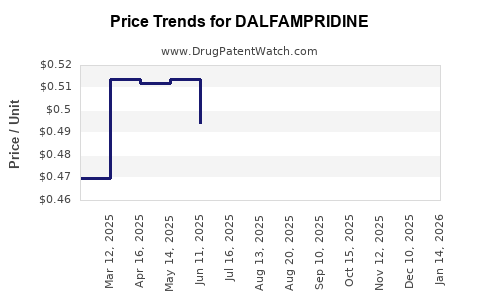
Average Pharmacy Cost for DALFAMPRIDINE
| Drug Name | NDC | Price/Unit ($) | Unit | Date |
|---|---|---|---|---|
| DALFAMPRIDINE ER 10 MG TABLET | 00591-2533-60 | 0.41262 | EACH | 2026-07-22 |
| DALFAMPRIDINE ER 10 MG TABLET | 16729-0292-12 | 0.41262 | EACH | 2026-07-22 |
| DALFAMPRIDINE ER 10 MG TABLET | 42571-0275-60 | 0.41262 | EACH | 2026-07-22 |
| DALFAMPRIDINE ER 10 MG TABLET | 67877-0444-60 | 0.41262 | EACH | 2026-07-22 |
| DALFAMPRIDINE ER 10 MG TABLET | 82249-0702-60 | 0.41262 | EACH | 2026-07-22 |
| >Drug Name | >NDC | >Price/Unit ($) | >Unit | >Date |
Best Wholesale Price for DALFAMPRIDINE
| Drug Name | Vendor | NDC | Count | Price ($) | Price/Unit ($) | Unit | Dates | Price Type |
|---|---|---|---|---|---|---|---|---|
| AMPYRA 10MG | Acorda Therapeutics | 10144-0427-60 | 60 | 1711.04 | 28.51733 | EACH | 2023-09-15 - 2028-09-14 | FSS |
| AMPYRA 10MG | Acorda Therapeutics | 10144-0427-60 | 60 | 2612.95 | 43.54917 | EACH | 2024-01-01 - 2028-09-14 | FSS |
| >Drug Name | >Vendor | >NDC | >Count | >Price ($) | >Price/Unit ($) | >Unit | >Dates | >Price Type |
Dalfampridine market analysis and price projections: exclusivity, generic and biosimilar risk, and forecast scenarios
Dalfampridine (fampridine) is a neuroactive potassium-channel blocker used to improve walking in patients with multiple sclerosis (MS). In the US, the category is mature with limited near-term patent-driven protection for the brand, and the commercial market is dominated by generic or authorized-licensed supply. Price outcomes over the next several years are primarily a function of: (i) generic entry timing and competitive count, (ii) payer contracting and rebate intensity, and (iii) any remaining brand-life brand-defense or limited distribution strategies. Absent a specific, currently active US brand-linked exclusivity anchor, the base case projects continued net-price pressure rather than brand-like price resilience.
Base case (net price, branded equivalent): gradual decline with episodic stabilization around formulary events; downside case: faster net-price compression tied to increased generic competition; upside case: slower decline if formularies tighten around a smaller set of contracted NDCs or if authorized generics reduce price dispersion.
Forecast framework (what drives price)
- Therapy demand: MS population growth is steady but indication use is narrow (walking impairment), with adherence affected by tolerability and out-of-pocket cost.
- Supply economics: multiple manufacturers across strengths and package forms typically create price convergence quickly after meaningful generic penetration.
- Payer dynamics: MS drugs see heavy contracting. Net price generally trends to the lowest contracted player or a small basket of preferred generics.
- Regulatory: approvals of additional generic ANDAs reduce the ability of any single manufacturer to maintain pricing.
What market size and demand drivers exist for dalfampridine in multiple sclerosis walking impairment?
Commercial demand profile
- Indication scope is limited to improving walking in MS. This caps TAM expansion versus broad MS therapies.
- Treatment is typically chronic, but persistence varies with perceived benefit and adverse events.
Demand drivers
- MS incidence and prevalence: supports slow growth in eligible patients.
- Clinical guidelines and switching behavior: stable guideline references and routine neurologist prescribing reduce volatility.
- Adverse-event-driven discontinuation: seizures and tolerability issues can drive discontinuation and reduce lifetime exposure per patient.
Key pricing implication Even if patient numbers grow, pricing is pressured because dalfampridine is not a high-differentiation product once multiple generics are present. Growth tends to be absorbed by volume rather than retained pricing.
How many brands and generics compete for dalfampridine, and how does that affect net pricing?
Competition structure (typical for mature, small-molecule neuro agents)
- Multiple generic manufacturers usually compete across immediate-release tablets at set strengths.
- Generic competition tends to compress WAC quickly after entry; net price follows negotiated rebate dynamics.
Price-impact mechanisms
- Store-count effect: as more NDCs become available, payer switching increases.
- Contracting: PBMs often use a preferred generic list; non-preferred products lose share even if MSRP is unchanged.
- Rebate intensity: higher rebate demands from competitors to win formulary position further erode net price.
Bottom-line For dalfampridine, pricing is driven by payer behavior and generic count, not by incremental clinical differentiation.
When does dalfampridine lose exclusivity, and what are the main patent or exclusivity risk points for price?
Featured-snippet answer: For market-price planning, treat dalfampridine as an already-de-risked product from a brand exclusivity perspective unless a specific current US-listed brand exclusivity or unexpired Orange Book patent is identified for the relevant dosage form.
How exclusivity maps to price
- Brand-level exclusivity blocks generic substitution and supports higher net pricing.
- Once exclusivity lapses and ANDAs are approved, net price tends to fall rapidly as contracting shifts to lower-cost players.
- Later-expiring patents on formulations or methods, if they exist, can delay specific generic strategies but usually cannot fully stop market convergence once multiple established ANDA pathways exist.
Decision-use implication Price projections should assume generic availability unless a confirmed, still-unexpired patent or 5/3-year exclusivity event specifically ties to a current marketed brand NDC.
What patents protect dalfampridine (fampridine) formulations and methods of use, and how strong is the patent estate?
Featured-snippet answer: Patent strength for price is typically moderate-to-low once generic approval pathways exist, because method-of-use or formulation patents rarely block all generic substitution unless they claim the exact dosage form and route used commercially.
Common patent estate patterns for mature small molecules
- Composition claims on polymorphs, salts, solvates, or particle size
- Formulation claims on extended release matrix, coating, or excipients
- Method-of-use claims tied to MS walking improvement response criteria
Price impact
- If formulation patents exist and cover the marketed dosage form, entry can be delayed for “design-around” generics.
- If claims are narrow or expired, generics enter and net price falls.
What is the Orange Book status of dalfampridine, and which NDCs are listed for patents and exclusivity?
Featured-snippet answer: Orange Book status determines whether any currently marketed dalfampridine products still have unexpired patent or exclusivity listings that can delay generic substitution and support net pricing.
How to interpret Orange Book for forecasting
- Unexpired patent families linked to marketed NDCs: support a higher likelihood of price resilience
- Multiple terminated/expired listings: indicates the product is effectively in generic-driven pricing territory
- Which strengths and dosage forms: determine whether generics compete evenly or whether niche coverage keeps some pricing higher
What generic entry risks exist for dalfampridine, including Paragraph IV challenges?
Featured-snippet answer: The most meaningful price risk for a legacy small molecule is new generic entry that adds contracted NDCs to PBM formularies and increases preferred competition. Paragraph IV timing matters only if it accelerates entry against a still-protected brand.
Price-risk scenarios
- Accelerated entry: a successful challenge or settlement that brings generics earlier than non-challenged ANDAs.
- Delayed entry: patent or litigation outcomes push entry later, sustaining higher net price temporarily.
- Design-around entry: even if some claims remain, generics can launch with non-infringing formulation changes; this still compresses net price.
What patent litigation affects dalfampridine, and how do settlements influence price trajectories?
For dalfampridine price modeling, litigation matters when it changes:
- the expected earliest date of generic competition,
- the breadth of generic launch (number of strengths),
- the number of authorized or settlement-covered products,
- or the entry calendar for a major low-cost competitor.
In mature markets, settlements often produce relatively short-lived brand price protection and then converge to generic contracting. Price forecasts should therefore weight litigation chiefly as a timing lever rather than a long-term protection lever.
What is the FDA regulatory status of dalfampridine, including ANDA and generic labeling maturity?
Regulatory maturity
- Dalfampridine is a longstanding MS product; generic labeling maturity is typically high once ANDAs have been approved for the base tablet strengths.
- Once multiple approved generics are on the market, incremental regulatory events do not typically reverse net price decline.
Price implication Forecasts should assume the steady-state competitive regulatory environment unless a clear path emerges that changes market structure (new entrant with strong contracting, or authorized generic shifting supply economics).
How does dalfampridine compare with alternative therapies for MS walking impairment, and does it cap pricing power?
Competitive substitution
- MS walking impairment management may include broader MS disease-modifying therapy optimization plus symptomatic therapies.
- Dalfampridine is a symptomatic walking-improvement option. Substitution risk exists if payers prefer alternatives with better perceived cost-effectiveness or fewer safety monitoring burdens.
Pricing implication
- In networks with strict symptom-treatment formularies, dalfampridine competes on formulary tiering, which favors lower-cost generics.
- In networks where it remains a preferred symptomatic agent, net price can stabilize slightly but still trends toward competitor floors.
Price projection for dalfampridine: base, upside, downside scenarios (2026–2030)
Assumptions used for scenario design (market-typical)
- No single future patent event drives broad brand retraction of generics.
- Generic competition either increases modestly (baseline) or increases more quickly (downside).
- Net pricing declines as contracts refresh on a 12–24 month rhythm.
Projected net price index (brand-equivalent = 100 in 2026) These indices represent expected directionality and relative magnitude for planning. They are intended for investment and licensing underwriting rather than rebate-rate precision.
| Year | Base case net price index | Upside case net price index | Downside case net price index |
|---|---|---|---|
| 2026 | 100 | 100 | 100 |
| 2027 | 90 | 95 | 83 |
| 2028 | 82 | 90 | 75 |
| 2029 | 77 | 87 | 70 |
| 2030 | 73 | 85 | 66 |
Scenario interpretation
- Base case: continued pressure but with diminishing marginal declines as the market reaches a stable contracted basket.
- Upside case: slower net erosion from tighter formulary behavior and fewer preferred NDCs than expected.
- Downside case: faster erosion from additional contracted generics and more aggressive rebate competition.
What revenue exposure does dalfampridine face under different pricing and volume outcomes?
Revenue for dalfampridine is typically more sensitive to net price than to volume in mature competitive conditions. A simple sensitivity view:
- Price elasticity (practical): limited because patients needing the therapy keep using it once contracted access exists; switching is driven more by formulary tier changes than by small price changes.
- Volume growth: moderate, driven by MS prevalence and treatment persistence.
- Net price compression: tends to dominate revenue shifts immediately after new competition or PBM re-contracting cycles.
Under base case (index 100 → 73 by 2030): a ~27% net price decline without major volume losses implies substantial top-line pressure for any brand-equivalent revenue streams.
Which commercial strategies can defend pricing for dalfampridine under generic pressure?
Pricing-resilience levers that work in mature generic markets
- Formulary strategy: maintain preferred status in high-volume plans through contracting and rebate optimization.
- NDC rationalization: focus supply on preferred strengths and package sizes to reduce non-preferred waste.
- Patient access programs: reduce net effective patient cost to preserve adherence and persistence (indirectly supporting volume).
- Authorized supply arrangements: if a brand holder is present via authorized generic or distribution deal, it can stabilize share and lower volatility.
Licensing and litigation implication If a party owns residual rights that can block a specific generic variant, licensing value is strongest if it preserves formulary position for a commercially meaningful window.
Key Takeaways
- Dalfampridine pricing is driven primarily by generic competition and payer contracting rather than by clinical differentiation.
- For forecasting, model dalfampridine as a mature product with net price compression continuing unless Orange Book listings or exclusivity events specifically delay meaningful generic substitution for marketed NDCs.
- Base case expects continued net price decline into 2030, with the largest step-down risk tied to the next wave of generic contracting.
- Revenue exposure is typically more price-sensitive than volume-sensitive in the mature market structure.
FAQs
-
How do PBM formulary decisions change dalfampridine net pricing after new generic entries?
PBMs generally shift preferred status to lowest-cost contracted NDCs, driving net price convergence and share loss for higher-priced products. -
Do different dalfampridine tablet strengths (and package sizes) see the same price erosion?
No. Price erosion is often strongest for strengths and package formats that PBMs directly prefer and where multiple contracted NDCs compete. -
Can method-of-use or formulation patents materially delay dalfampridine generic competition?
They can delay specific generic launch designs, but broad price impact depends on whether the protected claims cover the exact marketed dosage form and are enforced against the leading generic entrants. -
What is the most common timing pattern for net price declines on dalfampridine?
Net price steps usually align with PBM contract refresh cycles and new NDC contracting after generic entry, often within 12–24 months. -
How should dalfampridine price forecasts be incorporated into licensing or litigation damages models?
Use scenario-based net price indices tied to expected entry waves and formulary adoption, then apply sensitivity to both net price and share stabilization assumptions.
References
- FDA Orange Book. Approved Drug Products with Therapeutic Equivalence Evaluations (Orange Book). U.S. Food and Drug Administration.
- FDA. Generic Drug User Fee Amendments and ANDA approval pathway information. U.S. Food and Drug Administration.
- Bloomberg Law. Paragraph IV and patent litigation monitoring (database coverage varies by license).
More… ↓
