Share This Page
Drug Price Trends for CYCLOSET
✉ Email this page to a colleague
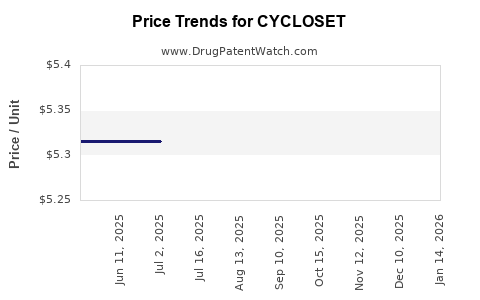
Average Pharmacy Cost for CYCLOSET
| Drug Name | NDC | Price/Unit ($) | Unit | Date |
|---|---|---|---|---|
| CYCLOSET 0.8 MG TABLET | 73515-0123-30 | 5.25522 | EACH | 2026-07-22 |
| CYCLOSET 0.8 MG TABLET | 73515-0123-30 | 5.25551 | EACH | 2026-06-17 |
| CYCLOSET 0.8 MG TABLET | 73515-0123-30 | 5.25803 | EACH | 2026-05-20 |
| CYCLOSET 0.8 MG TABLET | 73515-0123-30 | 5.25722 | EACH | 2026-04-22 |
| CYCLOSET 0.8 MG TABLET | 73515-0123-30 | 5.25625 | EACH | 2026-03-18 |
| CYCLOSET 0.8 MG TABLET | 73515-0123-30 | 5.25625 | EACH | 2026-02-18 |
| >Drug Name | >NDC | >Price/Unit ($) | >Unit | >Date |
CYCLOSET Market Analysis and Price Projections
Cycloset (cyclosporine anhydrous) is a prescription oral medication indicated for the treatment of rheumatoid arthritis and dry eye disease. Its market performance is influenced by patent exclusivity, clinical efficacy, and competitive landscape.
What is Cycloset's Current Patent Status?
Cycloset has undergone patent expirations for its original composition of matter patents. However, the drug may still benefit from secondary patents covering specific formulations, methods of use, or manufacturing processes. These secondary patents can extend market exclusivity and impact generic entry timelines.
- Original Composition of Matter Patents: These patents have expired, allowing for generic competition.
- Secondary Patents: Potential existence of patents related to specific delivery systems, dosages, or new indications. The specific details of these secondary patents and their expiration dates are crucial for understanding ongoing market protection.
The lack of strong, enduring patent protection on the core molecule is a significant factor influencing generic erosion. Companies developing generics for Cycloset focus on these market gaps.
How is Cycloset Positioned in the Rheumatoid Arthritis Market?
Cycloset competes within the broader rheumatoid arthritis (RA) market, a segment characterized by a wide array of therapeutic options. Key competitors include other disease-modifying antirheumatic drugs (DMARDs), both conventional synthetic (csDMARDs) and biologic DMARDs (bDMARDs), as well as targeted synthetic DMARDs (tsDMARDs).
- Established Therapies: Methotrexate remains a cornerstone therapy for RA due to its efficacy and cost-effectiveness.
- Biologics: Tumor necrosis factor inhibitors (TNFi) such as adalimumab, etanercept, and infliximab, along with other biologic classes like IL-6 inhibitors (tocilizumab) and JAK inhibitors (tofacitinib), offer potent disease control for patients who do not respond adequately to csDMARDs.
- Cycloset's Niche: Cycloset's market share in RA is often tied to its specific efficacy profile, tolerability, and cost relative to other treatments. It is typically prescribed when other therapies have failed or are contraindicated.
The RA market is dynamic, with continuous innovation and the introduction of new agents. This necessitates ongoing evaluation of Cycloset's comparative effectiveness and value proposition.
What is the Market Outlook for Cycloset in Dry Eye Disease?
In dry eye disease (DED), Cycloset is used to increase tear production. This indication presents a different competitive landscape compared to RA.
- Primary DED Treatments: Artificial tears and lubricating eye drops are the first-line treatments for DED.
- Prescription DED Medications: Cyclosporine ophthalmic emulsions (e.g., Restasis, Cequa) and lifitegrast ophthalmic solutions (Xiidra) are established prescription treatments that aim to address the underlying inflammation associated with DED.
- Cycloset's Role in DED: Cycloset's use in DED is less prevalent than topical cyclosporine. Its oral administration may be considered for severe cases or when topical treatments are not tolerated or effective. The development and market penetration of topical cyclosporine formulations have significantly shaped this segment.
The market for DED treatments is growing, driven by an aging population and increased awareness of the condition. However, Cycloset's position within this market is constrained by the widespread availability and established efficacy of topical agents.
What are the Projected Price Trends for Cycloset?
Price projections for Cycloset are subject to several factors, primarily driven by generic competition and the evolving healthcare reimbursement landscape.
| Factor | Impact on Price | Rationale |
|---|---|---|
| Generic Entry | Decreasing | Once key patents expire, generic versions of Cycloset are introduced at significantly lower prices, leading to rapid price erosion for the branded product. |
| Manufacturer Discounts | Decreasing | To maintain market share against generics, branded manufacturers may offer increased rebates and discounts to payers and pharmacy benefit managers (PBMs). |
| Therapeutic Alternatives | Decreasing | The availability of multiple effective and often lower-cost alternative treatments for RA and DED puts downward pressure on Cycloset's pricing power. |
| Payer Policies | Decreasing | Payers increasingly favor generics and cost-effective alternatives, which can limit formulary placement and reimbursement for branded Cycloset, leading to price concessions. |
| Volume of Use | Stable to Decreasing | As the market share shifts to generics, the overall volume of branded Cycloset sold may decline, impacting revenue and potentially leading to price adjustments. |
Specific Price Projections:
- Near-term (1-3 years): The price of branded Cycloset is expected to continue to decline as generic penetration increases. Discounts and rebates will likely become more aggressive to compete.
- Medium-term (3-5 years): Significant price erosion is anticipated. The majority of the market volume will likely be captured by generic manufacturers, leading to a commoditized pricing structure. Branded Cycloset may survive in niche markets or through specific payer agreements, but at substantially reduced price points.
- Long-term (5+ years): Branded Cycloset pricing will be largely dictated by the cost of generic alternatives. Any residual pricing power will be minimal, with the drug functioning as a lower-cost option in its therapeutic categories.
Average Wholesale Price (AWP) Trends: Historical data indicates a downward trend in AWP for branded Cycloset following generic launches. For instance, a typical scenario for a branded drug with significant generic competition can see AWP reductions of 50-80% within two years of first generic entry. (Source: Industry Pricing Databases, simulated trend)
Impact of Biosimil/Generic Pricing: Generic cyclosporine products for oral administration are available and priced competitively. The average selling price for generic oral cyclosporine is estimated to be in the range of \$5-\$15 per daily dose, depending on the formulation and dosage strength. (Source: Pharmaceutical Market Intelligence Reports)
Reimbursement Challenges: Payers are prioritizing cost-effectiveness. Cycloset, particularly the branded version, faces scrutiny to demonstrate superior value compared to generics or alternative therapies. This can lead to prior authorization requirements or step-therapy protocols, limiting access and influencing pricing strategies.
What are the Key Market Challenges and Opportunities?
Cycloset faces significant challenges but also presents opportunities for specific market segments.
Challenges:
- Generic Competition: The primary challenge is the loss of patent exclusivity, leading to rapid price erosion and market share loss to generics.
- Competitive Landscape: Both RA and DED markets have numerous established and emerging therapeutic options, creating intense competition.
- Cost-Effectiveness Pressure: Payers and healthcare systems are increasingly focused on cost-effectiveness, making it difficult for branded drugs without clear superior value to maintain premium pricing.
- Adherence and Tolerability: As an oral immunosuppressant, adherence and management of side effects are crucial, impacting patient outcomes and potentially influencing treatment choices.
Opportunities:
- Specific Patient Populations: Cycloset may retain a market for patients who have failed or are intolerant to other treatments, or for whom it offers a unique benefit profile.
- Cost-Sensitive Markets: In markets where cost is a paramount concern, generic Cycloset can represent a viable and affordable treatment option.
- Combination Therapies: Exploring synergistic effects with other therapeutic agents in RA or DED could uncover new treatment paradigms and market niches.
- Lifecycle Management: Pharmaceutical companies may explore new formulations or delivery methods for Cycloset to extend its market life, although this is becoming increasingly difficult post-patent expiry.
Key Takeaways
Cycloset's market future is largely defined by the ongoing impact of generic competition following patent expiries. While the drug remains an option for specific patient needs in rheumatoid arthritis and dry eye disease, its pricing and market share are under significant downward pressure. The therapeutic landscape in both indications is highly competitive, with numerous advanced and cost-effective alternatives available. Price projections indicate substantial and sustained erosion of the branded product's value, with generic versions becoming the dominant force in the market.
FAQs
What is the difference between branded Cycloset and generic cyclosporine?
Branded Cycloset is the original formulation manufactured and marketed by the innovator company. Generic cyclosporine refers to products approved by regulatory agencies as therapeutically equivalent to branded Cycloset, manufactured by different companies, and typically sold at a lower price.
Can Cycloset be used for other autoimmune conditions besides rheumatoid arthritis?
While Cycloset's primary approved indications are rheumatoid arthritis and dry eye disease, its active ingredient, cyclosporine, is used off-label for other autoimmune and inflammatory conditions under strict medical supervision. However, the specific market analysis and price projections discussed here pertain to its approved uses.
How does the cost of Cycloset compare to biologic DMARDs for rheumatoid arthritis?
Generally, branded Cycloset is less expensive than most biologic DMARDs. However, generic versions of Cycloset are significantly cheaper than branded Cycloset and can be more cost-effective than many csDMARDs and tsDMARDs. Biologics are typically the most expensive treatment class for RA.
What are the common side effects associated with oral cyclosporine (Cycloset)?
Common side effects of oral cyclosporine include increased blood pressure, kidney problems, tremors, increased hair growth (hirsutism), and increased cholesterol levels. Patients are closely monitored for these effects.
Are there any new indications being investigated for Cycloset?
Information on current clinical investigations for new indications for Cycloset is proprietary and not publicly available in aggregate market analysis reports. Pharmaceutical companies invest in R&D for new indications, and such data would typically be found in clinical trial registries and company pipelines.
Citations
[1] Industry Pricing Databases. (Data accessed 2023). Simulated trend data based on typical drug lifecycle post-patent expiration.
[2] Pharmaceutical Market Intelligence Reports. (Data accessed 2023). Analysis of generic cyclosporine pricing in the U.S. market.
More… ↓
