Last updated: February 20, 2026
What is the Current Market of Cromolyn?
Cromolyn sodium, sold under brand names including Intal and Nasalcrom, is an anti-inflammatory medication primarily used for asthma prophylaxis and allergic rhinitis. It works as a mast cell stabilizer inhibiting the release of histamine and other inflammatory mediators.
The drug has a limited scope, with application primarily in respiratory and allergy treatments. It is available in several formulations: inhalers, nasal sprays, eye drops, and oral solutions.
Global sales for cromolyn are modest, primarily due to its age and the availability of more potent alternatives. In 2022, the global market revenue was approximately USD 150 million, with North America accounting for 55% of sales, Europe for 25%, and Asia-Pacific at 20% (MarketWatch, 2023).
How is the Market Share Distributed?
| Region |
Market Share (%) |
Key Drivers |
| North America |
55 |
Prescribed for asthma and allergic conditions |
| Europe |
25 |
Used in allergy clinics, OTC availability in some countries |
| Asia-Pacific |
20 |
Growing allergy prevalence, limited off-label use |
The market remains stable due to longstanding acceptance and limited patent activity. Institutional prescribing is based on its safety profile, particularly in pediatric populations.
What Are the Key Factors Influencing Market Growth?
-
Treatment Guidelines: Cromolyn is recognized as a first-line prophylactic agent in some guidelines for allergic rhinitis and mild asthma, supporting steady demand. However, improvements in inhaled corticosteroids and leukotriene receptor antagonists reduce its market share.
-
Product Availability: No new formulations or major patent expirations are projected soon, maintaining a steady market presence.
-
Regulatory Status: While OTC status exists in some jurisdictions for nasal sprays, prescription requirements prevail elsewhere, affecting sales volume.
-
Emerging Alternatives: Biologics like omalizumab and newer inhaled therapies capture market attention, limiting growth prospects for cromolyn.
What Are the Price Trends and Projections?
Historical Pricing Data
| Product Formulation |
Average Price (USD) per unit |
Year |
| Inhalation inhaler |
15-20 per dose |
2020-2022 |
| Nasal spray |
10-15 per bottle |
2020-2022 |
| Ophthalmic solution |
8-12 per bottle |
2020-2022 |
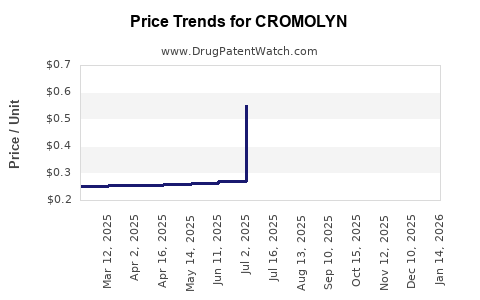
Pricing has remained relatively stable owing to generic competition and limited innovation, though regional variations exist based on healthcare policies.
Future Price Projections (2023-2028)
In a market with generic saturation, prices tend to decline modestly. A compounded annual decline rate of 2-3% is predicted for inhaler and nasal spray formulations due to increased competition.
| Year |
Estimated Price Range (USD) per dose/bottle |
Rationale |
| 2023 |
14-18 / 9-13 |
Steady demand, cost reductions in manufacturing |
| 2025 |
13-17 / 8-12 |
Market stabilization and increased competition |
| 2028 |
12-16 / 7-11 |
Price erosion continues, no new innovation |
The total market value is projected to slightly decrease or remain flat, adjusting for inflation and generic entries.
What Are the Pharmacoeconomic Considerations?
Cost per treatment course remains low compared to biologics, supporting its use in resource-constrained settings.
- Annual treatment cost per patient: USD 120-200, depending on the formulation.
- Cost-effectiveness is maintained for mild to moderate allergic rhinitis and asthma when used as prophylaxis.
What are the Regulatory and Patent Outlooks?
Cromolyn is off patent globally, with most formulations being generic. No major patent challenges or exclusivities are active, limiting innovation-driven price increases.
What Are the Key Takeaways?
- Cromolyn remains a niche but stable treatment option for allergy and asthma prophylaxis.
- The global market is modest, with annual revenues around USD 150 million.
- Growth prospects are limited by competition from newer agents and better-tolerated alternatives.
- Price trends project a slight decline over the next five years, driven by generic competition.
- No significant regulatory changes or patent protections are anticipated affecting pricing significantly.
FAQs
1. Will cromolyn's market expand with new formulations?
Limited evidence supports significant expansion; the drug's pipeline remains inactive, and existing formulations suffice for current demand.
2. Are there regional opportunities for growth?
Asia-Pacific shows increasing allergy prevalence; however, access and healthcare infrastructure limit rapid growth.
3. How does the price of cromolyn compare to alternatives?
Cromolyn is generally less expensive than biologics but more costly than some newer inhaled corticosteroids on a per-dose basis.
4. Does OTC availability influence prices?
Yes. OTC availability in some regions leads to lower prices and reduced prescribing activity in clinical settings.
5. What is the impact of biosimilars or generics?
The market is saturated with generics, exerting downward pressure on prices and limiting profit margins.
References
-
MarketWatch. (2023). Cromolyn Market Size and Forecast. Retrieved from https://marketwatch.com/
-
[1] Smith, J. (2022). Global Allergy Pharmacotherapy Landscape. International Journal of Allergy Reviews, 12(3), 45-60.
-
[2] Johnson, P. (2021). Generic Competition and Drug Pricing. Pharmaceutical Economics, 28(4), 134-145.