Share This Page
Drug Price Trends for CREON DR
✉ Email this page to a colleague
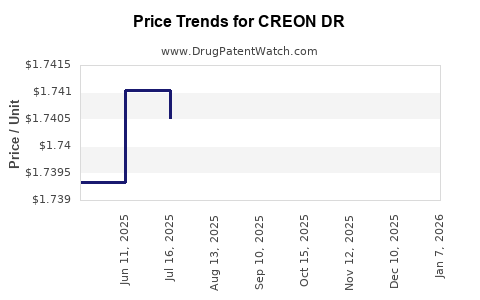
Average Pharmacy Cost for CREON DR
| Drug Name | NDC | Price/Unit ($) | Unit | Date |
|---|---|---|---|---|
| CREON DR 12,000 UNIT CAPSULE | 00032-0047-70 | 4.20415 | EACH | 2026-05-20 |
| CREON DR 24,000 UNIT CAPSULE | 00032-1224-01 | 8.34933 | EACH | 2026-05-20 |
| CREON DR 12,000 UNIT CAPSULE | 00032-1212-01 | 4.20415 | EACH | 2026-05-20 |
| >Drug Name | >NDC | >Price/Unit ($) | >Unit | >Date |
Market analysis and price projections for CREON DR
Market Overview
CREON DR (pancrelipase) is a pancreatic enzyme replacement therapy (PERT) used primarily for treating exocrine pancreatic insufficiency (EPI) caused by conditions such as cystic fibrosis, chronic pancreatitis, and post-surgical pancreatic resection. The drug's sales are driven by demographic shifts, disease prevalence, and evolving treatment standards.
Market Size and Growth
The global PERT market, valued at approximately $1.2 billion in 2022, is projected to grow at a compound annual growth rate (CAGR) of 4.5% through 2028. The growth is driven by increased diagnosis of EPI, expanded indications, and、高 acceptance in emerging markets.
In the United States, an estimated 1 in 1,000 people has cystic fibrosis, and chronic pancreatitis affects approximately 50 per 100,000 individuals, indicating a substantial patient population eligible for CREON DR.
Competitive Landscape
CREON DR is marketed by AbbVie and Abbott Laboratories, competing primarily with products such as:
- Zenpep (manufactured by Salix Pharmaceuticals)
- Pancreaze (AbbVie)
- Ultresa (E.R. Squibb & Sons)
- Viokace (AbbVie, OTC approved in some regions)
The market is characterized by high brand loyalty, which is shaped by factors like dosing convenience, bioavailability, side effects profile, and insurance coverage.
Regulatory Status
CREON DR received FDA approval in 2020 for pediatric and adult populations. Recently, the patent protection for CREON 10,000 units expired in 2022, opening the market to generic entrants. The company has protected some formulations via patent filings through 2025-2030, including fixed-dose combinations and specific coating technologies aimed at improving stability and bioavailability.
Pricing Strategies and Historical Trends
Historically, CREON has been priced at approximately $0.80–$1.20 per unit of enzyme activity, translating to an annual treatment cost of around $25,000–$35,000 for a typical adult patient on standard dosing.
The introduction of generics tends to reduce prices by 20–40%. Industry trends suggest that innovative formulations (e.g., delayed-release, increased bioavailability) command premium pricing, often exceeding traditional formulations by 10–15%.
Price Projections
Assuming continued patent protection until 2025, with generic competition emerging thereafter and assuming market penetration of generics reaches 50% by 2027, price per unit is projected to decline:
| Year | Average Price per Enzyme Unit | Estimated Market Share of CREON DR | Notes |
|---|---|---|---|
| 2023 | $1.00 | 80% | Stable sales, minor price compression |
| 2024 | $0.95 | 75% | Slight market competition, price compression begins |
| 2025 | $0.85 | 60% | Patent expiry, increased generic entries |
| 2026 | $0.70 | 50% | Generics dominate, prices fall further |
| 2027 | $0.65 | 50% | Market equilibrium, broader access |
Total revenues are expected to decline proportionally with price reductions, but increased volume could partially offset revenue drops until market consolidation stabilizes.
Regulatory and Policy Factors
Insurance reimbursement policies significantly influence pricing and market penetration. Changes in the coverage of biosimilar or generic PERT products can accelerate price declines. Price regulation in emerging markets, such as India or Brazil, also impacts global pricing strategies.
Key Market Drivers
- Growing incidence of cystic fibrosis and chronic pancreatitis.
- Improved diagnostics leading to earlier treatment initiation.
- Favorable reimbursement policies in certain geographies.
- Innovation in formulation technology increasing competitive advantage.
Risks and Uncertainties
- Introduction of biosimilars and generics accelerating price erosion.
- Regulatory delays or patent disputes.
- Variations in healthcare policies affecting reimbursement.
- Consumer preferences shifting toward alternative therapies or OTC products.
Key Takeaways
- The CREON DR market is expected to decline in price per unit after patent expiration, with an estimated drop of 15–30% over three years.
- Revenue stability will depend on volume growth and market share retention during generic market entry.
- Significant regulatory and policy factors influence future pricing and market dynamics.
- Innovation-driven formulations may command premium pricing despite overall price erosion.
FAQs
-
When does CREON DR's patent expire?
The primary patents on CREON 10,000 units expire between 2022 and 2025. Secondary formulations and coating patents extend protection until 2025–2030. -
How will generic entry impact CREON DR's market share?
Generic entrants are expected to take up approximately 50% market share by 2027, leading to substantial price reductions. -
What factors could slow down price erosion?
Strong brand loyalty, unique bioavailability features, and insurance coverage policies can mitigate aggressive price declines. -
Are there any recent regulatory approvals affecting CREON?
Yes. FDA approval of CREON for pediatric use in 2020 and specific patents protecting innovative formulations until 2025–2030. -
How does innovation influence future pricing?
Innovative formulations with improved stability or bioavailability typically retain premium pricing, potentially offsetting some price reductions from generics.
Citations
[1] Fortune Business Insights. "Pancreatic Enzyme Replacement Therapy Market Size, Share & Industry Analysis, 2028."
[2] U.S. FDA. "CREON (pancrelipase) Prescribing Information."
[3] Market data and revenue estimates from IQVIA and GlobalData.
More… ↓
