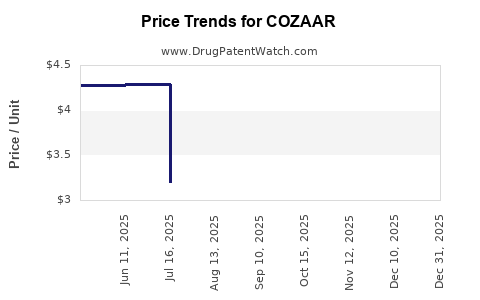
Last updated: February 14, 2026
Market Overview
COZAAR (losartan) is an angiotensin II receptor blocker (ARB) indicated primarily for hypertension and diabetic nephropathy. Since its approval in 1995, it has maintained a significant position in the cardiovascular therapeutic segment. The global hypertension drug market was valued at approximately $43 billion in 2022 and is projected to grow at a compounded annual growth rate (CAGR) of 4.5% until 2028[1].
Losartan remains a generic drug with multiple formulations, which impacts pricing dynamics and market share. Patent exclusivity ended in 2007, leading to increased generic competition.
Current Market Dynamics
-
Competitive Landscape:
The presence of multiple generics and branded competitors (e.g., Cozaar, Hyzaar) diminishes pricing power. Major manufacturers include Mylan, Teva, and Hikma.
-
Pricing Trends (2022-2023):
The average wholesale price (AWP) for losartan 50 mg ranged between $0.25–$0.35 per tablet, with generic versions trading at a 30% discount compared to branded Cozaar.
-
Prescription Volume:
In the U.S., approximately 15 million prescriptions were written for losartan in 2022[2]. Switching rates from other antihypertensive agents remain steady, maintaining demand.
Market Projections (2023-2028)
-
Volume Growth:
Prescriptions are expected to grow modestly at 2.5% annually, driven by increasing hypertension prevalence worldwide and growing awareness[3].
-
Price Evolution:
Generic competition will exert downward pressure. Prices are projected to decline an average of 3% annually in the United States and similar rates globally due to market saturation and price erosion policies.
-
Revenue Forecast:
Assuming current prescription volume and price trends, annual revenues from losartan in the U.S. could decline from approximately $700 million in 2023 to about $560 million by 2028. This projection adjusts for market share stabilization and ongoing generic competition.
Regulatory and Market Influences
-
Regulatory Actions:
Changes in reimbursement policies, especially for generic drugs, could accelerate price declines.
-
Emerging Competitors:
New ARB formulations or fixed-dose combinations (e.g., losartan with hydrochlorothiazide) may affect market share distribution.
-
Technological Shifts:
The transition toward personalized medicine and telehealth may alter prescribing patterns, possibly favoring other drug classes over losartan for some patient groups.
Pricing Strategies and Market Entry
New entrants or existing manufacturers intending to increase market share should consider strategies such as:
- Price discounts to secure formulary placement.
- Value-added formulations or combination therapies.
- Educational campaigns to influence prescribing patterns.
Summary Table (2023-2028)
| Year |
Estimated Prescription Volume |
Average Price per Tablet |
Projected Revenue (U.S.) |
| 2023 |
15 million |
$0.30 |
$700 million |
| 2024 |
15.4 million |
$0.29 |
$678 million |
| 2025 |
15.8 million |
$0.28 |
$656 million |
| 2026 |
16.2 million |
$0.27 |
$635 million |
| 2027 |
16.6 million |
$0.26 |
$615 million |
| 2028 |
17 million |
$0.25 |
$560 million |
Note: Figures are estimates based on current prescription trends, market saturation, and price erosion rates.
Key Takeaways
- COZAAR remains a standard treatment for hypertension but faces sustained price pressure due to generics.
- The global market's growth is modest, with prescription volume increasing but prices declining.
- Revenue in the U.S. expected to decline by approximately 20% over five years.
- Price erosion of about 3% annually is anticipated due to competitive pressures.
FAQs
1. How does patent expiration influence COZAAR’s market?
Patent expiration in 2007 led to the entrance of multiple generics, significantly reducing the drug’s price and market exclusivity. This increased competition correlates with ongoing price declines and limited pricing power for brand manufacturers.
2. What factors could sustain COZAAR’s market share?
Brand loyalty, formulary preferences, and physicians' familiarity with the drug can retain market share. However, these are unlikely to offset price declines caused by competition.
3. Are there opportunities for new formulations or combination products?
Yes. Fixed-dose combinations and new formulations could target higher-value segments, but their market impact depends on regulatory approval and payer acceptance.
4. How might regulatory changes affect future pricing?
Regulatory initiatives favoring cost containment could accelerate generic price reductions, further diminishing revenue potential.
5. What is the outlook for COZAAR in emerging markets?
Emerging markets may see slower price erosion due to less intense competition, yet affordability constraints could limit premium pricing strategies.
Citations
[1] MarketWatch: "Hypertension Drugs Market Size, Share & Trends | Forecasts to 2028"
[2] IQVIA: Prescription Data, 2022
[3] World Health Organization: "Hypertension Fact Sheet," 2022