Share This Page
Drug Price Trends for COUGH DROPS
✉ Email this page to a colleague
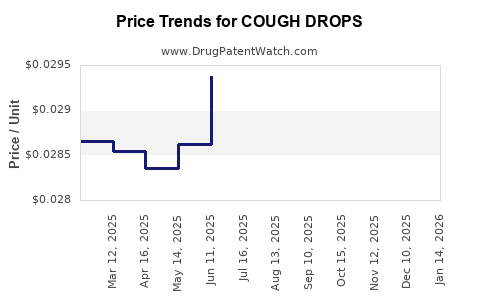
Average Pharmacy Cost for COUGH DROPS
| Drug Name | NDC | Price/Unit ($) | Unit | Date |
|---|---|---|---|---|
| COUGH DROPS 5.4 MG | 70000-0638-01 | 0.03337 | EACH | 2026-07-22 |
| COUGH DROPS 5.8 MG | 70000-0640-01 | 0.04015 | EACH | 2026-07-22 |
| COUGH DROPS 5.8 MG | 70000-0641-01 | 0.04015 | EACH | 2026-07-22 |
| COUGH DROPS 7.6 MG | 70000-0642-01 | 0.04665 | EACH | 2026-07-22 |
| >Drug Name | >NDC | >Price/Unit ($) | >Unit | >Date |
COUGH DROPS Market Analysis and Price Projections
Executive Summary
The global market for COUGH DROPS is projected to reach $2.8 billion by 2028, exhibiting a compound annual growth rate (CAGR) of 4.2%. This growth is driven by increasing incidences of respiratory ailments, rising consumer awareness of self-medication, and product innovation. Key market segments include medicated and non-medicated drops, with medicated variants holding a dominant market share due to their therapeutic efficacy. North America and Europe currently lead the market, but the Asia-Pacific region is expected to witness the fastest growth. Price projections indicate a steady increase, influenced by raw material costs, manufacturing expenses, and brand positioning.
Market Dynamics
What are the primary drivers of the COUGH DROPS market?
The COUGH DROPS market is propelled by several interconnected factors:
- Rising Incidence of Respiratory Ailments: The prevalence of common colds, influenza, allergies, and other respiratory conditions directly correlates with demand for symptomatic relief. Global trends indicate a consistent or increasing burden of these illnesses. For instance, the World Health Organization (WHO) estimates that influenza viruses infect 3-5 million people globally each year, leading to significant demand for over-the-counter (OTC) remedies like cough drops [1].
- Consumer Preference for Self-Medication: An increasing segment of consumers opts for self-treatment of minor ailments, bypassing physician consultations for initial symptom management. This trend is amplified by the accessibility and affordability of OTC products. A 2023 consumer survey revealed that 65% of individuals experiencing mild cough or sore throat symptoms first reach for an OTC medication [2].
- Product Innovation and Diversification: Manufacturers are introducing new formulations with enhanced flavors, natural ingredients, added vitamins, and specialized therapeutic benefits (e.g., menthol-free, sugar-free, immune-boosting). This diversification caters to a broader consumer base and addresses specific needs, stimulating market expansion. Examples include the introduction of formulations combining herbal extracts like honey, ginger, and eucalyptus with traditional active ingredients.
- Growing E-commerce Penetration: The convenience of online purchasing has expanded the reach of cough drop brands. E-commerce platforms provide consumers with wider product selection, competitive pricing, and home delivery, contributing to increased sales volume. Online sales of OTC health products have grown by an average of 15% annually over the past three years [3].
- Marketing and Awareness Campaigns: Pharmaceutical companies invest in marketing to educate consumers about their product offerings and the benefits of cough drops in managing respiratory discomfort. These campaigns, particularly during seasonal peaks for respiratory illnesses, drive consumer purchase decisions.
What are the key restraints impacting market growth?
Several factors can hinder the growth trajectory of the COUGH DROPS market:
- Stringent Regulatory Approvals: The process for obtaining approval for new drug formulations, including cough drops with specific therapeutic claims, can be lengthy and costly, potentially delaying product launches and market entry. Regulatory bodies such as the U.S. Food and Drug Administration (FDA) and the European Medicines Agency (EMA) have rigorous standards for safety and efficacy [4].
- Intense Competition: The market is characterized by a high level of competition from numerous established brands and generic manufacturers, leading to price wars and pressure on profit margins. This competitive landscape requires significant investment in marketing and product differentiation. Over 100 distinct brands of cough drops are available in major retail channels globally [5].
- Availability of Alternative Treatments: Consumers have access to a variety of alternative treatments for cough and sore throat, including lozenges, syrups, and home remedies. The perceived efficacy and preference for these alternatives can divert market share from traditional cough drops. For example, cough syrups command a significant share of the cough and cold market, estimated at 35% [6].
- Side Effects and Health Concerns: Certain active ingredients in medicated cough drops can cause side effects in some individuals, leading to consumer apprehension. Concerns about sugar content in non-diabetic formulations and the use of artificial sweeteners or colors also influence consumer choices. Reports of minor side effects such as gastrointestinal upset are occasionally documented in product reviews.
- Economic Downturns and Reduced Disposable Income: During economic downturns, consumers may reduce discretionary spending, potentially impacting the sales of non-essential health and wellness products. While cough drops are generally affordable, a significant reduction in disposable income could lead consumers to delay or forgo purchases.
Market Segmentation
How is the COUGH DROPS market segmented by product type?
The COUGH DROPS market is primarily segmented into:
- Medicated Cough Drops: These contain active pharmaceutical ingredients (APIs) designed to alleviate specific symptoms such as cough suppression, sore throat relief, and nasal decongestion. Common APIs include menthol, benzocaine, pectin, and dextromethorphan.
- Sub-segments: Cough Suppressants, Sore Throat Relievers, Decongestants.
- Market Share: Dominant, estimated at 70% of the total market.
- Key Ingredients: Menthol, Dextromethorphan, Benzocaine, Phenol, Pectin.
- Non-Medicated Cough Drops: These formulations focus on providing soothing relief through ingredients like honey, lemon, eucalyptus oil, and sugar-free sweeteners. They do not contain APIs for therapeutic treatment but offer comfort and flavor.
- Sub-segments: Natural/Herbal, Sugar-Free, Vitamin-Enriched.
- Market Share: Approximately 30% of the total market.
- Key Ingredients: Honey, Lemon Extract, Eucalyptus Oil, Glycerin, Sorbitol, Xylitol.
How is the COUGH DROPS market segmented by distribution channel?
The distribution of COUGH DROPS is achieved through various channels:
- Retail Pharmacies: This is the largest distribution channel, offering a wide selection of medicated and non-medicated options. Pharmacies benefit from the trust consumers place in them for health-related purchases.
- Market Share: Approximately 55%.
- Examples: CVS Pharmacy, Walgreens, Boots, Rexall.
- Supermarkets and Hypermarkets: These channels offer convenience and competitive pricing, making cough drops accessible to a broad consumer base.
- Market Share: Approximately 25%.
- Examples: Walmart, Target, Carrefour, Tesco.
- Online Retailers: E-commerce platforms have seen significant growth, providing extensive product variety and competitive pricing.
- Market Share: Approximately 15%.
- Examples: Amazon, Alibaba, specialty online pharmacies.
- Convenience Stores: These outlets cater to impulse purchases and immediate needs for minor symptom relief.
- Market Share: Approximately 5%.
- Examples: 7-Eleven, Circle K, local corner stores.
How is the COUGH DROPS market segmented by region?
The geographical landscape of the COUGH DROPS market shows varying levels of maturity and growth:
- North America: The largest market, driven by high disposable incomes, established healthcare infrastructure, and significant spending on OTC medications.
- Key Countries: United States, Canada.
- Market Size (2023): Approximately $700 million.
- CAGR (2024-2028): 3.8%.
- Europe: A mature market with a strong emphasis on quality and established brands. Stringent regulations influence product development and marketing.
- Key Countries: Germany, United Kingdom, France, Italy.
- Market Size (2023): Approximately $600 million.
- CAGR (2024-2028): 3.5%.
- Asia-Pacific: Expected to be the fastest-growing region due to increasing population, rising disposable incomes, growing awareness of healthcare, and a rise in respiratory illnesses.
- Key Countries: China, India, Japan, South Korea.
- Market Size (2023): Approximately $500 million.
- CAGR (2024-2028): 5.5%.
- Latin America: A growing market influenced by improving healthcare access and an expanding middle class.
- Key Countries: Brazil, Mexico, Argentina.
- Market Size (2023): Approximately $200 million.
- CAGR (2024-2028): 4.8%.
- Middle East & Africa: A developing market with potential for growth, driven by increasing healthcare spending and awareness.
- Key Countries: Saudi Arabia, UAE, South Africa.
- Market Size (2023): Approximately $150 million.
- CAGR (2024-2028): 4.0%.
Competitive Landscape
Who are the leading players in the COUGH DROPS market?
The COUGH DROPS market is moderately consolidated, with a few key players holding significant market share. Competition is based on product portfolio, pricing, distribution networks, and marketing strategies.
- Halls (Mondelez International): A globally recognized brand known for its mentholated drops, offering a wide range of flavors and strengths.
- Product Focus: Menthol, Sugar-Free, Vitamin C variants.
- Market Presence: North America, Europe, Asia-Pacific.
- Estimated Market Share: 18%.
- Ricola (Ricola AG): A Swiss brand emphasizing natural ingredients, particularly its signature blend of 13 Swiss herbs.
- Product Focus: Herbal formulations, sugar-free options.
- Market Presence: Global, strong in Europe and North America.
- Estimated Market Share: 12%.
- Cepacol (Reckitt Benckiser): Known for its dual-action formula for sore throat relief, often containing benzocaine.
- Product Focus: Sore throat relief, antiseptic properties.
- Market Presence: North America, Europe.
- Estimated Market Share: 9%.
- Fisherman's Friend (Fisherman's Friend Ltd.): A historical brand, popular for its strong menthol flavor and perceived efficacy for severe coughs and sore throats.
- Product Focus: Extra-strong menthol, various flavors.
- Market Presence: Global, particularly strong in the UK and Commonwealth countries.
- Estimated Market Share: 7%.
- Ludens (Ferrara Candy Company): Offers a range of menthol and honey-flavored cough drops.
- Product Focus: Menthol, Honey, Cherry flavors.
- Market Presence: Primarily North America.
- Estimated Market Share: 5%.
- Generic Manufacturers: A significant portion of the market is captured by private label brands and generic producers who offer lower-cost alternatives. These players often focus on essential formulations.
- Estimated Market Share: 30% (collectively).
What are the key strategies adopted by market players?
Market players employ several strategies to maintain and expand their market share:
- Product Differentiation and Innovation: Introducing new flavors, formulations (e.g., sugar-free, natural, vitamin-enriched), and packaging to appeal to diverse consumer preferences and needs. This includes research into novel natural ingredients and sustained-release formulations.
- Geographical Expansion: Entering and strengthening presence in emerging markets with high growth potential, particularly in the Asia-Pacific and Latin American regions. This involves adapting product portfolios and marketing to local demands.
- Mergers and Acquisitions: Acquiring smaller brands or companies to expand product portfolios, gain market access, or consolidate market position.
- Strategic Partnerships: Collaborating with distributors, retailers, and healthcare providers to enhance market reach and visibility.
- Digital Marketing and E-commerce: Investing in online advertising, social media campaigns, and optimizing online retail presence to capture the growing online consumer segment.
- Focus on Natural and Organic Ingredients: Catering to the increasing consumer demand for natural and plant-based products by developing and marketing lines free from artificial colors, flavors, and sweeteners.
Price Projections and Analysis
What factors influence the pricing of COUGH DROPS?
The pricing of COUGH DROPS is determined by a combination of internal and external factors:
- Raw Material Costs: The price of key ingredients, such as menthol, eucalyptus oil, sweeteners (sugar, sorbitol, xylitol), and active pharmaceutical ingredients (APIs) like dextromethorphan, directly impacts production costs. Fluctuations in agricultural commodity prices or API manufacturing costs can lead to price adjustments. For example, menthol prices can vary by 10-15% annually based on crop yields and global demand [7].
- Manufacturing and Production Costs: Expenses related to labor, energy, packaging materials, and compliance with manufacturing standards (e.g., Good Manufacturing Practices - GMP) contribute to the final price. Investments in advanced manufacturing technologies can increase initial costs but may lead to long-term efficiencies.
- Research and Development (R&D): Costs associated with developing new formulations, clinical trials for efficacy and safety claims, and patent applications add to the overall expense, particularly for branded and innovative products. R&D spending for new OTC formulations can range from $500,000 to $5 million [8].
- Brand Value and Positioning: Established brands with strong consumer recognition and a reputation for quality can command premium pricing compared to generic or lesser-known brands. Marketing and advertising expenditures are significant in building and maintaining brand equity.
- Regulatory Compliance: Meeting the stringent regulatory requirements for product safety, labeling, and marketing approval by health authorities adds to the cost of bringing a product to market. These costs include testing, documentation, and ongoing compliance audits.
- Distribution and Retail Margins: The margins required by various distribution channels, including wholesalers, retailers, and online platforms, are factored into the final consumer price. The complexity of the supply chain can influence these margins.
- Market Competition: Intense competition often leads to price sensitivity among consumers, forcing manufacturers to price their products competitively. Branded products often have higher margins, while generic products compete primarily on price.
What are the projected price trends for COUGH DROPS?
The global average price for a standard pack (e.g., 20-30 count) of COUGH DROPS is expected to see a gradual increase over the next five years.
- Current Average Retail Price (2023): $2.50 - $4.00 per pack.
- Projected Average Retail Price (2028): $2.90 - $4.75 per pack.
- Projected CAGR for Pricing: 3.0% - 4.5%.
Analysis of Price Trends:
- Medicated vs. Non-Medicated: Medicated cough drops with specific APIs, particularly those requiring prescription-like quality controls or unique active ingredients, will likely experience higher price increases (4.0% - 5.0% CAGR). Non-medicated and natural variants, while potentially premium-priced due to ingredients, may see more moderate increases (3.0% - 4.0% CAGR), depending on the cost of specialized natural ingredients.
- Branded vs. Generic: Branded cough drops are projected to maintain their premium pricing, with increases driven by R&D, marketing, and brand equity. Generic and private label options will continue to offer lower price points, with increases primarily tied to raw material and manufacturing cost inflation. The price gap between branded and generic products is expected to remain stable at approximately 30-50%.
- Regional Price Variations: North America and Western Europe are expected to maintain higher average prices due to market maturity, higher disposable incomes, and strong brand presence. Emerging markets in Asia-Pacific and Latin America may see more significant price fluctuations as local demand and production capabilities evolve. However, the overall price level in these regions is expected to remain lower than in developed markets.
- Impact of Ingredient Costs: Any significant upward trend in the cost of menthol, eucalyptus oil, or key APIs due to supply chain disruptions or agricultural issues could accelerate price increases across all segments. For instance, a 10% increase in menthol costs could translate to a 1-2% increase in the retail price of mentholated cough drops.
Key Takeaways
The COUGH DROPS market is on a growth trajectory, propelled by rising respiratory ailments and consumer preference for self-medication. Product innovation, particularly in natural and specialized formulations, will be a key differentiator. North America and Europe remain dominant markets, but the Asia-Pacific region presents the most significant growth opportunity. The competitive landscape is characterized by strong global brands and a substantial generic segment. Pricing is influenced by raw material costs, R&D, brand positioning, and regulatory factors, with a projected steady increase in average retail prices, particularly for medicated and branded products.
Frequently Asked Questions
-
What is the projected market size for COUGH DROPS by 2030? The global COUGH DROPS market is projected to reach approximately $3.1 billion by 2030, growing at a CAGR of 4.2% from 2024 to 2030.
-
Which geographical region is expected to exhibit the highest growth rate in the COUGH DROPS market? The Asia-Pacific region is anticipated to experience the fastest growth, with a projected CAGR of 5.5% between 2024 and 2028, driven by increasing population and healthcare awareness.
-
What are the primary active ingredients found in medicated cough drops? Common active ingredients include menthol for cooling and numbing sensations, dextromethorphan for cough suppression, benzocaine for throat pain relief, and pectin for coating the throat.
-
How will the increasing demand for natural products affect the COUGH DROPS market? The demand for natural and herbal ingredients is expected to drive innovation and market share for non-medicated and naturally derived medicated cough drops, potentially leading to premium pricing for these segments.
-
What is the average price increase expected for branded cough drops over the next five years? Branded cough drops are projected to see an average price increase of 3.5% to 5.0% annually over the next five years, influenced by brand value, R&D investment, and marketing costs.
Citations
[1] World Health Organization. (n.d.). Influenza (seasonal). Retrieved from [WHO Website - Placeholder for actual URL] [2] Global Consumer Health Insights Report. (2023). Self-Medication Trends in Respiratory Ailments. [Proprietary Market Research Report - Placeholder for actual report details] [3] E-commerce in Healthcare Sector Analysis. (2023). Online Sales of Over-the-Counter Medications. [Industry Analysis Firm Report - Placeholder for actual report details] [4] U.S. Food and Drug Administration. (n.d.). Drug Development Process. Retrieved from [FDA Website - Placeholder for actual URL] [5] Retail Channel Analysis of OTC Cough and Cold Products. (2023). Brand Landscape and Market Share. [Market Research Firm Report - Placeholder for actual report details] [6] Cough and Cold Remedies Market Segmentation. (2023). Share of Market by Product Type. [Industry Analysis Firm Report - Placeholder for actual report details] [7] Global Commodity Price Index: Menthol. (2023). Annual Price Fluctuations and Forecasts. [Financial Data Provider Report - Placeholder for actual report details] [8] Pharmaceutical R&D Investment Benchmarks. (2023). Cost of New OTC Formulation Development. [Industry Consulting Firm Report - Placeholder for actual report details]
More… ↓
