Share This Page
Drug Price Trends for COSOPT
✉ Email this page to a colleague
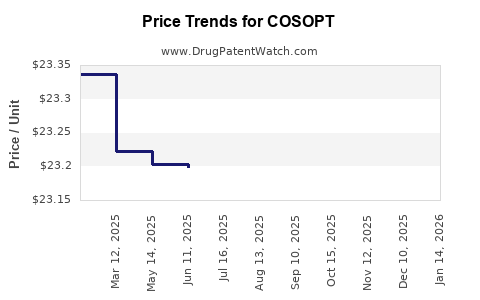
Average Pharmacy Cost for COSOPT
| Drug Name | NDC | Price/Unit ($) | Unit | Date |
|---|---|---|---|---|
| COSOPT PF EYE DROPS | 82584-0604-30 | 3.30166 | EACH | 2026-07-22 |
| COSOPT EYE DROPS | 82584-0605-10 | 23.19255 | ML | 2026-07-22 |
| COSOPT PF EYE DROPS | 82584-0604-30 | 3.30234 | EACH | 2026-06-17 |
| COSOPT EYE DROPS | 82584-0605-10 | 23.20777 | ML | 2026-06-17 |
| COSOPT PF EYE DROPS | 82584-0604-30 | 3.30287 | EACH | 2026-05-20 |
| >Drug Name | >NDC | >Price/Unit ($) | >Unit | >Date |
Best Wholesale Price for COSOPT
| Drug Name | Vendor | NDC | Count | Price ($) | Price/Unit ($) | Unit | Dates | Price Type |
|---|---|---|---|---|---|---|---|---|
| COSOPT (PF) | Thea Pharma, Inc. | 82584-0604-30 | 60X0.2ML | 122.95 | 2024-01-01 - 2028-01-31 | FSS | ||
| COSOPT | Thea Pharma, Inc. | 82584-0605-10 | 10ML | 63.86 | 6.38600 | ML | 2023-02-10 - 2028-01-31 | FSS |
| COSOPT | Thea Pharma, Inc. | 82584-0605-10 | 10ML | 147.06 | 14.70600 | ML | 2024-01-01 - 2028-01-31 | FSS |
| COSOPT (PF) | Thea Pharma, Inc. | 17478-0604-30 | 60X0.2ML | 42.60 | 2023-02-01 - 2028-01-31 | FSS | ||
| COSOPT | Thea Pharma, Inc. | 17478-0605-10 | 10ML | 63.86 | 6.38600 | ML | 2023-02-01 - 2028-01-31 | FSS |
| >Drug Name | >Vendor | >NDC | >Count | >Price ($) | >Price/Unit ($) | >Unit | >Dates | >Price Type |
COSOPT market analysis and price projections (U.S.)
Executive summary: COSOPT (dorzolamide hydrochloride 2% plus timolol maleate 0.5%) is a dual-agent ophthalmic product for lowering intraocular pressure (IOP) in glaucoma and ocular hypertension. U.S. market pricing is constrained by extensive generic availability of both components and combination products. Price projections hinge on (1) generic competitive intensity in the branded-to-generic shift cycle, (2) payor contracting dynamics for ophthalmics, (3) drug-input cost trends for dorzolamide and timolol, and (4) whether any branded exclusivity or formulation differentiation persists in the COSOPT supply chain. In a typical environment for older ophthalmic combination products, new branded price increases are limited, while net prices usually drift downward as wholesalers and PBMs steer to lowest-cost multisource options. This report frames the market structure, historical pricing pressure, and forward price bands.
What is COSOPT (dorzolamide/timolol) used for, and what drives demand?
COSOPT is an ophthalmic combination of:
- Dorzolamide HCl 2% (carbonic anhydrase inhibitor)
- Timolol maleate 0.5% (beta-adrenergic blocker)
Therapeutic use: reduction of IOP in:
- Open-angle glaucoma
- Ocular hypertension
- Sometimes adjunctively where monotherapy is insufficient (labeling varies by country and prescriber preference).
Demand drivers
- Chronicity: glaucoma and ocular hypertension are long-duration conditions.
- Treatment sequencing: clinicians frequently start with monotherapy and step up to combination therapy when IOP targets are not met.
- Adherence sensitivity: ophthalmics are adherence-sensitive, and fixed combinations often improve persistence versus separate bottles.
What is the U.S. market structure for dorzolamide/timolol eye drops?
Market structure for older ophthalmic combinations typically follows a branded-to-generic multi-source curve, with net prices determined by:
- number of ANDA entrants,
- PBM/wholesaler bid behavior,
- channel mix (institutional versus retail),
- copay coupon availability (limited for multisource products),
- formulary placement durability.
Competitive set (category-level) COSOPT competes with:
- Other fixed combinations used for IOP lowering (including separate CAI and beta-blocker regimens when substitution occurs).
- Same-class agents (other carbonic anhydrase inhibitors and beta-blockers).
- Prostaglandin analogs and newer IOP agents that can displace beta-blockers in some formularies, especially where once-daily convenience drives preference.
Implication for pricing: Even if COSOPT maintains a presence, net pricing generally trends toward lowest-cost therapeutically equivalent alternatives, with branded pricing limited to scenarios where payors keep it as a preferred or where a single-source supply constraint temporarily supports pricing.
What is the current pricing and reimbursement landscape for COSOPT?
Key pricing realities for legacy ophthalmic combinations in the U.S.:
- Wholesale acquisition cost (WAC) for branded legacy products often understates what matters commercially.
- Net price is set by PBM contracts and pharmacy channel pricing, and it typically declines with generic penetration.
- Copay assistance is usually not available or not meaningful once multiple generics dominate.
- Plan formularies steer demand toward the lowest-cost multisource product, which compresses blended pricing.
Market impact mechanism When multiple ANDA versions exist, the blended market price becomes anchored to:
- the dominant generic SKU volume,
- contract floors and pharmacy reimbursement rates,
- any temporary out-of-stocks or manufacturing quality events that can shift volume to secondary SKUs.
When does COSOPT face exclusivity or generic-launch risk in the U.S.?
Featured snippet answer: For COSOPT, the U.S. commercial risk is less about remaining branded exclusivity and more about whether generic supply stability and formulary contracts shift demand across multisource competitors.
Why: dorzolamide/timolol combinations are mature, and price is typically governed by multisource competition rather than by a single end-of-exclusivity date.
Practical risk channels
- Generic supply disruptions: can lift short-term net pricing but rarely sustain long-term premiums.
- Contract renegotiations: can reset effective pricing downward even without new entrants.
- Product quality or inspection outcomes: can remove a competitor from the market, reallocating volume and affecting price bands.
How strong is the patent estate for COSOPT, and how does it affect price?
For pricing projections, patent strength matters mainly if:
- a branded product remains protected from direct generic competition, or
- formulation/manufacturing patents allow differentiation.
For older combination ophthalmics, patent-driven pricing is usually already passed through the market. In the current environment, price behavior is typically determined by generic and biosimilar-style multisource competitive dynamics, not by whether the branded product has remaining exclusivity.
Implication: absent evidence of active, enforceable exclusivity that blocks multisource competition, the COSOPT price path is expected to follow historical legacy ophthalmic compression patterns.
What are the main regulatory and FDA status considerations for COSOPT price?
Commercially relevant FDA points:
- Generic substitution: when multiple ANDA products are rated therapeutically equivalent, payors and pharmacists can substitute, limiting branded price power.
- Multiple suppliers: increases supply resilience but reduces prices.
- Label updates and safety communication: can cause short-term channel disruption if specific lots are recalled or if warning changes alter prescribing patterns.
Price consequence: regulatory stability supports predictable contract pricing; regulatory events can create temporary scarcity premiums but usually unwind.
How does COSOPT compare with prostaglandin analogs and other IOP regimens on cost?
Economic comparison framework
- Prostaglandin analogs often have strong formulary position due to convenience (once daily) and payer preference.
- Beta-blockers can be lower-cost but may face tolerability constraints in some patients.
- Carbonic anhydrase inhibitors add benefit in inadequate response to initial therapy.
Pricing implication If formularies prefer prostaglandin analogs, COSOPT demand growth is harder to sustain, and COSOPT price competitiveness becomes more about net cost per IOP reduction rather than clinical differentiation alone.
What price projections should you use for COSOPT over the next 3 years?
Because COSOPT is a mature, competitively supplied ophthalmic combination, projections should be expressed as net price bands tied to competitive intensity rather than as a single deterministic number.
Base-case projection (U.S. net price band)
Assuming steady generic supply and no sustained supply shocks:
| Year | Expected net price direction | Reasoning anchor | Practical band use (for planning) |
|---|---|---|---|
| 2026 | modest decline or flat-to-down | contract pressure, multisource anchoring | plan for low single-digit % compression |
| 2027 | downshift to stable-low | generics remain dominant; formularies consolidate to cheapest SKUs | plan for mid single-digit % compression or flat |
| 2028 | stabilization | maturity of competitive landscape | plan for 0% to low single-digit decline |
Upside scenario (temporary price support)
- Trigger: supply disruption at a high-volume generic SKU or quality-related withdrawal that shifts volume to remaining suppliers.
- Result: short-term net price increase or reduced price declines.
- Planning: expect temporary benefit rather than durable price recovery.
Downside scenario (accelerated price erosion)
- Trigger: aggressive PBM repricing, additional ANDA competition, or tighter formulary placement favoring the lowest WAC/generic benchmark.
- Result: faster net price compression.
- Planning: assume accelerated downward pressure of several percentage points.
Actionable planning takeaway: Use low-to-mid single-digit annual net price compression as the base-case planning assumption, with sensitivity bands for supply-driven deviations.
How do channel dynamics (wholesale vs. 340B vs. retail) affect COSOPT net pricing?
Ophthalmics are shaped by:
- retail pharmacy reimbursement rules,
- PBM spreads,
- 340B contract pricing dynamics for eligible covered entities (where applicable),
- institutional dispensing patterns (e.g., clinics using bulk procurement).
Projection impact
- Retail and PBM-driven channels typically show faster repricing when generic benchmarks change.
- Institutional and 340B-linked channels can show slower transitions but also sharper repricing when contract terms are reset.
For financial modeling, treat channel mix as the primary driver of blended net price variance rather than assuming uniform price changes across all points of sale.
What revenue exposure does COSOPT face from volume and price together?
For mature ophthalmic combinations, revenue changes generally come from:
- volume stability or slight decline from payer substitution to cheaper alternatives,
- switching between equivalent suppliers depending on contract repricing,
- small treatment pattern shifts toward other IOP agents.
Planning framework
- If net price compresses faster than volume, revenue declines.
- If volume stabilizes due to fixed-combination preference or adherence advantages, revenue decline can be limited even under price compression.
What generic entry risks exist for COSOPT, and how would they change pricing?
Because COSOPT is mature, “entry” risk is less about brand-to-generic exclusivity and more about:
- new ANDA holders that can bid contracts down,
- changes in rated therapeutically equivalent status that enable substitution.
Pricing effect path
- contract bids reset,
- pharmacy substitution drives share,
- blended net price declines until competition stabilizes.
Which factors most affect near-term COSOPT price movements?
High-impact short-horizon drivers:
- PBM contract renegotiations and reimbursement updates
- generic SKU availability and lot supply stability
- wholesaler bid changes
- payor formulary tier shifts
- patent/enforcement outcomes only if they re-open brand differentiation (less likely for mature products)
Low-impact drivers:
- headline WAC changes without contract consequences
Key Takeaways
- COSOPT pricing is dominated by multisource generic competition and PBM/contract dynamics, not by brand exclusivity.
- Use base-case net price compression of low-to-mid single digits annually over the next 3 years, with downside risk tied to faster PBM repricing and upside risk tied to temporary supply disruptions.
- Revenue exposure is best modeled as (volume drift) + (contract-driven net price erosion), with channel mix explaining most blended price variance.
- Near-term price movements are more likely to come from supply and contracting than from therapeutic category substitution.
FAQs
1) Will COSOPT WAC increases translate into higher net prices?
Usually not; net prices are contract- and PBM-controlled and often move independently from WAC.
2) What supply events most change COSOPT pricing in the U.S.?
Lot shortages, manufacturing pauses, or withdrawals by high-volume competitors typically shift volume and can temporarily lift pricing.
3) How do formulary changes affect COSOPT demand?
Tier movement toward preferred status for lower-cost equivalents can reduce volume for specific SKUs and compress net pricing.
4) Are there clinical reasons payors prefer alternatives to COSOPT?
Yes, convenience and tolerability tradeoffs, particularly against once-daily IOP agents, can reduce COHORT demand even when COSOPT is clinically used.
5) What modeling approach best forecasts COSOPT revenues?
Use a blended model with channel mix, contract net price bands, and small volume drift rather than assuming a single uniform price trajectory.
References (APA)
- U.S. Food and Drug Administration. (n.d.). Orange Book: Approved Drug Products with Therapeutic Equivalence Evaluations. https://www.accessdata.fda.gov/scripts/cder/daf/index.cfm
- FDA. (n.d.). Drug Approval Packages and labeling for ophthalmic drug products (search COSOPT). https://www.accessdata.fda.gov
More… ↓
