Share This Page
Drug Price Trends for COSENTYX (150 MG
✉ Email this page to a colleague
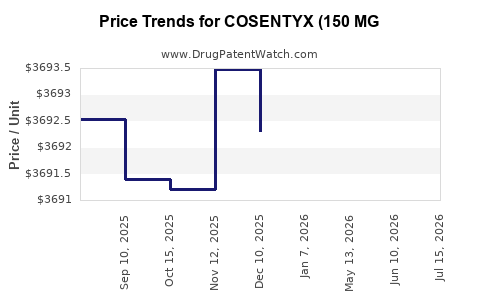
Average Pharmacy Cost for COSENTYX (150 MG
| Drug Name | NDC | Price/Unit ($) | Unit | Date |
|---|---|---|---|---|
| COSENTYX (150 MG/ML) 300 MG DOSE-2 SYRINGES | 00078-0639-98 | 3936.20917 | ML | 2026-07-22 |
| COSENTYX (150 MG/ML) 300 MG DOSE-2 SYRINGES | 00078-0639-98 | 3965.64399 | ML | 2026-01-07 |
| COSENTYX (150 MG/ML) 300 MG DOSE-2 SYRINGES | 00078-0639-98 | 3706.20933 | ML | 2025-12-17 |
| >Drug Name | >NDC | >Price/Unit ($) | >Unit | >Date |
Cosentyx (secukinumab) 150 mg market analysis and price projections
Cosentyx (secukinumab) 150 mg is a global IL-17A biologic with a large installed base in plaque psoriasis and psoriatic arthritis, plus expanding use in ankylosing spondylitis and non-radiographic axial spondyloarthritis. Competitive pricing pressure is structurally capped by biologic switching friction and payer contracting, but erosion risk rises as biosimilar entry expands across geographies. Price trajectories in the US are driven by net price (rebates), channel mix, and biosimilar adoption for secukinumab; in EU by national tendering and formulary positioning. Overall, the near-term outlook is stable-to-down modestly on a per-treated-patient basis, with steeper declines in markets where secukinumab biosimilars gain faster uptake.
Core demand drivers
- Durable penetration in plaque psoriasis and psoriatic arthritis where IL-17A inhibition has entrenched prescriber preference.
- Ongoing line extensions across axial spondyloarthritis subtypes (including nr-axSpA) and potential future indications that maintain patient continuity.
Core value drivers (150 mg)
- 150 mg presentation maps to common dosing regimens used in practice (often 300 mg loading and maintenance schedules).
- Real-world persistence and step-up dosing favor continued utilization of the 150 mg vial/pen SKU portfolio rather than a wholesale shift to competitor mechanism products.
How big is the Cosentyx (150 mg) market and what segments drive volume?
Primary commercial segments
- Plaque psoriasis (PsO)
- Psoriatic arthritis (PsA)
- Ankylosing spondylitis (AS)
- Non-radiographic axial spondyloarthritis (nr-axSpA)
Featured question answer (volume mix)
- The highest-volume demand historically comes from PsO and PsA, with axial spondyloarthritis contributing a growing share as guideline adherence and payer coverage broaden.
Which dosing and presentation patterns support 150 mg usage?
Cosentyx is used for common maintenance regimens that often require 300 mg doses. In practice, that typically translates into utilization of two 150 mg administrations per dosing time period rather than a full migration away from the 150 mg SKU mix.
What patient journeys influence payer contracting and net price?
- Switch stability: IL-17A patients can have fewer discontinuations than with less targeted regimens in some payer cohorts, supporting higher contract retention.
- Line-of-therapy mix: As IL-17A becomes earlier in treatment algorithms in some systems, loyalty contracts tend to shift toward volume commitments.
How strong is the competitive landscape for Cosentyx (150 mg) pricing?
Direct mechanism competition (IL-17 axis)
- Brodalumab (IL-17RA)
- Ixekizumab (IL-17A)
- Biosimilars and brand IL-17A alternatives across geographies
- TNF inhibitors and other systemic agents compete for formulary placement even when mechanism differs
Key pricing reality
- Biologic price competition is not purely per-mg. It is payer-specific net cost per effective regimen, adherence, and patient persistence. When alternative IL-17A products sit on preferred tiers, net price pressure increases for Cosentyx.
How do ixekizumab and other IL-17s affect projected net price?
- If payers run head-to-head contracting or tendering for IL-17A class, Cosentyx faces negotiated discounts.
- If the payer’s patient mix has strong clinical outcomes on Cosentyx, discounts often still occur but with slower unit erosion.
When does Cosentyx (150 mg) lose exclusivity and how does that affect price?
Cosentyx is a biologic, so “exclusivity” is not only patent-based. Practical price erosion is typically gated by:
- biosimilar approvals
- launch timing
- payer switching policies
- contract renewals and net-to-wholesale dynamics
What drives the timing of biosimilar-driven price declines?
- First launch effect: largest immediate discounts often occur in markets where biosimilar switching is encouraged.
- Adoption curve: price falls are larger when payers implement step-therapy, automatic substitution in some systems, or financial incentives for prescribers and pharmacies.
How does biosimilar adoption translate into 150 mg pricing changes?
- Early stage: small volume share shift; net price discounts moderate.
- Mid stage: tiering and tendering compress net prices more aggressively, with greater impact on branded basket pricing.
- Late stage: price floors are often set by the remaining originator’s contract leverage and the competitive number of biosimilars.
What is the Orange Book status of Cosentyx (secukinumab) 150 mg?
Cosentyx is a biologic drug. The Orange Book framework is for approved drug products that rely on FDA’s traditional small-molecule and biologic-with-AB-rated listed patents approach. For biologics, the patent listing and exclusivity landscape is typically reflected through FDA biologics systems and patent-provision frameworks rather than Orange Book entries in the same manner as conventional generics.
Net effect for pricing
- The key question for price projection is not Orange Book alone but biosimilar approval and use-based switching.
What patents protect Cosentyx 150 mg and how do patent cliffs affect price projections?
For biologics, patent estate composition often includes:
- composition-of-matter for the antibody
- formulation and manufacturing process patents
- method-of-use and dosing regimen patents
- secondary patents around subcutaneous delivery, concentrations, and device elements
Featured question answer
- Price cliffs typically align with the earliest enabling patents that prevent biosimilar launch, and then follow with enforcement outcomes, settlements, and payer adoption of the biosimilar portfolio.
How do method-of-use and formulation patents affect 150 mg unit economics?
- Even after a biosimilar clears certain barriers, originator price pressure can be delayed if biosimilar labeling is narrower (or if dosing administration differs in practice).
- Delivery-device and presentation differences can affect switching speed and payer policy, moderating initial unit price declines.
What is the FDA regulatory status of Cosentyx (150 mg) and how does it affect launch timing for competitors?
Featured question answer
- Regulatory status impacts biosimilar and follow-on product timing. Competitors can be constrained by the approved route, dosing regimen language, and manufacturing comparability requirements.
What FDA pathways matter for price?
- Biosimilar development and approval timelines set the start of market share erosion.
- Label similarity supports faster payer switching; narrower label language can slow adoption and keep branded net prices higher for longer.
How do biosimilars of secukinumab change Cosentyx (150 mg) price forecasts?
Price projection logic
- Once biosimilars enter, originator net price declines are typically driven by:
- payer formulary tiering
- tendering and volume purchase agreements
- utilization management tools like step therapy
- originator defensive contracting
Key adoption pattern
- If multiple biosimilars launch, originator discounts may accelerate and compress net price spread.
- If only one biosimilar launches initially, originator discounts can remain more gradual, with an adoption curve that favors maintaining some net premium.
Scenario-based pricing outcomes (directional)
- Base case: modest annual net price decline after biosimilar uptake begins, with a larger drop in the first 12 to 24 months post-launch.
- Fast adoption case: steeper decline once payers implement switching policies, with quicker volume share reallocation from the brand.
- Slow adoption case: smaller net price compression where physician/patient switching is limited and contracts preserve premium pricing longer.
What price erosion should investors expect for Cosentyx (150 mg) across regions?
Regional dynamics
- US: high rebate intensity and payer contracting sophistication; net price can decline faster after biosimilar adoption reaches meaningful share.
- Europe: tender-based systems and national formulary structures drive variation; some markets see earlier tender-triggered originator discounts.
- Emerging markets: slower uptake may delay biosimilar impact but pricing pressures can still emerge through reference pricing and budget caps.
Which countries typically see faster originator discounts?
Markets with:
- centralized procurement mechanisms
- aggressive national or regional tendering
- formal biosimilar switching policies
What about margin effects vs revenue effects?
- Even if unit prices fall, revenue impact depends on volume retention and contracting strategy.
- Contracts that preserve volume can cushion revenue declines, even with lower net price per vial.
How does Cosentyx (150 mg) compare with ixekizumab on price resilience?
Mechanism adjacency
- Both are IL-17A-axis competitors, so pricing is constrained by payer willingness to substitute within the class.
Featured question answer
- Price resilience is driven by historical persistence and payer outcomes metrics, not just gross price. The originator that maintains the highest treated-patient share after competitive contracting tends to preserve net price longer.
What operational factors shift net pricing?
- Administration convenience (device, dosing schedule)
- Patient-reported outcomes that affect adherence
- Switching friction due to prior treatment history
What commercial risks exist for Cosentyx 150 mg if competitors gain formulary share?
Primary risks
- Contract loss in large payers or PBMs leading to immediate net price pressure.
- Increased “preferred” placement of alternative IL-17 agents or secukinumab biosimilars.
- Utilization management that limits initiation and targets non-switchable or maintenance patients first.
How quickly can adoption change?
- After a strong payer policy change (step edits, exclusions), volume transfer can occur within a few quarters.
- Originator defense typically changes through renegotiated rebates and added patient support programs, which moderates but rarely eliminates erosion.
What generic entry risks exist for Cosentyx (150 mg)?
Cosentyx is a biologic. The relevant “generic” equivalent is biosimilars, not AB-rated small-molecule generics. The market risk is biosimilar entry and adoption.
Featured question answer
- Generic entry risk is principally biosimilar-driven and is timed by regulatory approval and patent litigation outcomes.
What formulations are protected for Cosentyx (150 mg) and how does that matter for competitors?
For biologics, formulation and manufacturing patents can matter even if the antibody itself is biosimilar. Typical areas that can slow or complicate biosimilar substitution include:
- concentration and stability profiles tied to storage and handling
- subcutaneous administration compatibility
- device-associated delivery constraints
How does this affect pricing timelines?
If a competitor’s product launches with restrictions or slower real-world substitution, branded pricing can hold up longer before larger market share reallocation triggers more aggressive discounts.
What patent litigation affects Cosentyx (150 mg) pricing?
Biosimilar entry is often shaped by:
- patent infringement suits
- dismissal or invalidation outcomes
- settlement agreements that set launch timing windows
- licensing deals tied to specific geographies, formulations, or product presentations
Featured question answer
- Litigation outcomes influence not only “if” a biosimilar can launch but “when” and “how fast” it gains share, which directly affects branded net price.
What licensing deals and settlements could change the price curve?
When originator and biosimilar sponsors reach agreements, the effects usually show up as:
- delayed commercial launch relative to approval date
- royalty structures or co-marketing terms
- geographic restrictions that segment payer adoption speed
What is the net price impact of delayed biosimilar launch?
- Delays extend originator bargaining leverage in contracts, often keeping net price higher during the delay window.
What is the revenue exposure for Cosentyx 150 mg under different price scenarios?
Revenue exposure depends on:
- share of total Cosentyx revenue attributable to 150 mg presentations versus other presentations
- percentage of revenue in markets with early biosimilar uptake
- net-to-gross dynamics based on payer mix
Directional exposure framework
- High exposure: markets with early biosimilar launch, centralized procurement, and aggressive switching.
- Moderate exposure: markets with slower adoption, mixed payer behavior, and more constrained tendering.
- Lower exposure: markets with strong persistence, decentralized purchasing, and more limited switching incentives.
Key Takeaways
- Cosentyx 150 mg pricing is primarily exposed to IL-17 class competition and secukinumab biosimilar adoption curves, not to small-molecule generic pathways.
- Net price declines tend to accelerate in the first 12 to 24 months after biosimilar uptake reaches meaningful share.
- Regional procurement and switching policies control the slope of branded price erosion, with faster declines in centralized tender markets.
- Patent and formulation/device protections can delay real-world substitution, extending branded net price resilience.
FAQs
- How fast do secukinumab biosimilars typically capture share after launch, and how does that map to net price declines?
- What payer behaviors cause slower Cosentyx (150 mg) price erosion: step therapy, prior authorization, or formulary tiering?
- Does switching between IL-17A biologics (Cosentyx vs ixekizumab) reduce clinical risk enough to accelerate net price compression?
- How do originator settlements that delay biosimilar launch change the revenue and price risk timeline for Cosentyx?
- Which countries’ tendering systems usually deliver the earliest branded discount pressure for IL-17 biologics?
References
- FDA. Drugs@FDA. Accessed via FDA databases for biologics status and labeling (secukinumab/Cosentyx).
- FDA. Orange Book. Accessed for patent listing frameworks relevant to drug exclusivity (note: biologics may be tracked via additional FDA patent/exclusivity mechanisms).
- EMA. European Public Assessment Reports (EPAR) and Assessment Reports for secukinumab and related regulatory decisions.
- PubMed / peer-reviewed literature on secukinumab biosimilar development comparability and real-world switching/persistence themes.
More… ↓
