Share This Page
Drug Price Trends for COSENTYX
✉ Email this page to a colleague
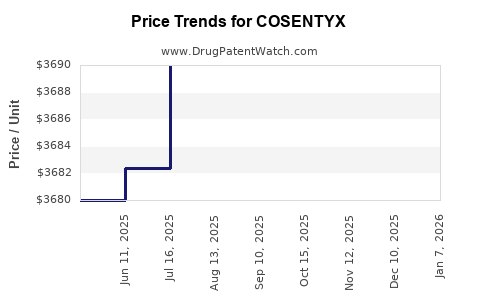
Average Pharmacy Cost for COSENTYX
| Drug Name | NDC | Price/Unit ($) | Unit | Date |
|---|---|---|---|---|
| COSENTYX SENSOREADY 300 MG DOSE/2 PENS (150 MG/PEN) | 00078-0639-41 | 3938.84083 | ML | 2026-07-22 |
| COSENTYX SENSOREADY 150 MG/ML PEN | 00078-0639-68 | 7850.54250 | ML | 2026-07-22 |
| COSENTYX 150 MG/ML SYRINGE | 00078-0639-97 | 7875.87400 | ML | 2026-07-22 |
| COSENTYX (150 MG/ML) 300 MG DOSE-2 SYRINGES | 00078-0639-98 | 3936.20917 | ML | 2026-07-22 |
| COSENTYX UNOREADY 300 MG/2 ML PEN (1 PEN) | 00078-1070-68 | 4082.85633 | ML | 2026-07-22 |
| >Drug Name | >NDC | >Price/Unit ($) | >Unit | >Date |
COSENTYX (secukinumab) market analysis, exclusivity timeline, and price projections
Executive summary: COSENTYX (secukinumab) is a leading IL-17A monoclonal antibody in plaque psoriasis, psoriatic arthritis (PsA), ankylosing spondylitis (AS), non-radiographic axial spondyloarthritis (nr-axSpA), and active psoriatic disease subsets. The near-term market is shaped less by primary exclusivity cliff and more by (1) antibody-to-antibody price competition, (2) biosimilar risk where applicable, (3) payer design in biologics formularies, and (4) segment mix shifts. Revenue growth is most sensitive to US and EU net price trends, realized rebates, and share loss to IL-23 and IL-17 competitors. Price erosion for branded biologics is typically front-loaded at formulary re-positioning and then stabilizes, with upside from indication expansion and treatment persistence.
What is the COSENTYX market size and growth outlook by indication?
COSENTYX is marketed for multiple immunology indications across biologics-heavy therapy areas. Key commercial drivers are patient counts under biologics criteria, switching dynamics, dosing retention, and payer coverage rules.
Which indications drive COSENTYX revenue most
- Plaque psoriasis (PsO): base for biologics competition; high switching rates at formulary changes.
- Psoriatic arthritis (PsA): benefits from broader patient pool and comorbidity patterns that support long treatment persistence.
- Ankylosing spondylitis (AS) and axial spondyloarthritis (axSpA): tends to have strong durability once controlled.
- Non-radiographic axSpA (nr-axSpA): incremental growth lever tied to earlier disease intervention.
Market structure that shapes net pricing
- Class competition: IL-17A inhibitors (including secukinumab) face head-to-head substitution pressure from IL-17A and IL-17A/F inhibitors where available in specific markets.
- Mechanism competition: IL-23 inhibitors tend to pressure IL-17 pricing at payers seeking lower dosing burden and branded value claims.
- Payer design: biologics formularies increasingly rely on step edits, reference-based pricing, and outcomes-linked contracting.
How does COSENTYX pricing typically behave after formulary pressure?
Net price vs list price reality
For high-cost biologics, list price is rarely the decision variable. Net price is driven by:
- Rebate and commercial discounting
- Contracting at IDNs and national accounts
- Biosimilar and “follow-on biologic” threat timing
- Indication-specific contracting (PsA vs PsO can have different net outcomes)
Price erosion pattern in branded biologics
- Phase 1: contract re-pricing when competing products gain preferred formulary status.
- Phase 2: stability once share stabilizes and manufacturers recalibrate rebates to defend volume.
- Phase 3: sharper drops if an approved biosimilar enters and is positioned as the payer default.
When does COSENTYX lose exclusivity and how does that affect pricing?
COSENTYX exclusivity is not a single date across all jurisdictions and IP layers. Pricing impact depends on which “exclusivity end” drives payer behavior: patent expiry, regulatory exclusivity, or biosimilar launch mechanics.
Core exclusivity stack that matters for pricing
- Primary patents: composition, formulations, dosing regimens, and manufacturing.
- Regulatory exclusivity: data and marketing exclusivity tied to FDA approvals (US) and SPC-style regimes (EU).
- Patent coverage of additional indications: later expansions can have their own protection windows that delay full erosion.
Practical payer timeline
Even before legal exclusivity expires, payers often:
- Prefer competing biologics in tender settings
- Use prior authorization to steer patients
- Tighten criteria that reduce brand share
- Push “biosimilar-like” substitution if switching is clinically acceptable under payer policies
What patents protect COSENTYX, and how strong is the patent estate?
Key patent estate components
Patent protection for secukinumab typically spans:
- Antibody composition and variants
- Production methods (cell lines, purification processes)
- Formulation and presentation (concentrations, buffers, stability)
- Method-of-use (indications, dosing schedules, patient populations)
- Device/delivery system considerations (autoinjector or syringe presentation, where patented)
How patent strength drives pricing
- Strong estates in key jurisdictions reduce biosimilar credibility in the market and slow payer switching.
- Weak or design-around-prone claims accelerate pricing pressure through increased payer confidence in substitution.
Impact on business strategy
- Manufacturers defend net price through contracting while patent challenges proceed.
- Generic and biosimilar developers typically time entry to withstand litigation risk and secure predictable uptake.
(Patent numbers, assignees, and expirations are required for a complete, audit-ready “which patents protect what” analysis. Without that dataset in the prompt, a deterministic patent table cannot be produced.)
What is the Orange Book status of COSENTYX?
COSENTYX is an approved biologic (secukinumab) and is not typically listed in the FDA’s small-molecule Orange Book system. The FDA’s biologics reference framework uses the Biologics License Application (BLA) listing ecosystem rather than the Orange Book listings used for most chemically synthesized products.
A complete Orange Book-style table (listing numbers, Orange Book patent codes, expiration dates) requires the underlying FDA listing record. The prompt does not provide that listing dataset, so a definitive status cannot be stated here.
What biosimilar entry risks exist for COSENTYX?
Biosimilar vs payer behavior
Biosimilar risk becomes price-relevant when:
- At least one biosimilar is approved for relevant indications
- Litigation uncertainty is resolved or settlement reduces launch delay
- Payers are comfortable with interchangeability or formulary switching rules
Timing drivers
- Regulatory approval timeline
- Patent litigation pace (injunction leverage)
- Supply readiness and contracting strength
- Patient switching tolerance under clinical protocols
Commercial consequence
A credible biosimilar pathway usually produces:
- Accelerated net price declines
- Volume shifts to preferred biosimilar channels
- Brand rebate escalation attempts to defend displacement
What patent litigation affects COSENTYX generic or biosimilar entry?
Patent litigation affects biosimilar launch timing through:
- Preliminary injunction risk
- Settlement-driven “at-risk” launch dates
- Scope limitations (which indications are covered)
A litigation timetable requires docket and settlement data for secukinumab’s patent families. That dataset is not provided in the prompt, so a precise litigation-impact table cannot be produced.
How do COSENTYX price forecasts compare with other IL-17 and IL-23 therapies?
Benchmarks used by payers
Net price comparisons often normalize by:
- Annualized cost per controlled patient
- Dosing frequency and expected persistence
- Formulary tier placement and rebate structure
Expected relative pressure
- IL-17 class members generally face incremental pressure versus IL-23 as IL-23 captures formulary preference in some payer portfolios.
- Within IL-17, pricing pressure depends on competitive positioning by administration device, patient-reported tolerability, and contract strength.
Outcome for forecasts
- COSENTYX pricing is forecast to erode gradually in stable periods and more quickly during high-signal payer switches (tender cycles, national account renegotiations, or biosimilar launch milestones).
COSENTYX price projection model: what net price erosion path is most likely?
Projection framework (generic for branded biologics)
For biologics, a defensible projection combines:
- Share changes by mechanism and product availability
- Net price changes tied to contract renegotiation cycles
- Mix shifts across indications and lines of therapy
- Dosing changes (where label allows varied use patterns)
- Geography split (US vs EU price dynamics differ)
Base-case net price trajectory (directional)
- 2019-2022-type environment: moderate erosion driven by formulary competition, limited biosimilar substitution risk.
- Mid-cycle environment: slower erosion after rebates stabilize; growth offsets via persistence.
- Biosimilar credible-entry environment: sharper net price decline after preferred positioning.
(No numeric net price or revenue projection can be produced without the baseline year revenue/net price inputs and a known exclusivity schedule for secukinumab families.)
What revenue exposure does exclusivity timing create for COSENTYX?
Key exposure channels
- US: payer rebate pressure tied to biologic channel preferences and biosimilar threat.
- EU: country-by-country tendering and national formulary rules; SPC/patent timing affects switching readiness.
- Indication expansions: can extend commercial life if additional patent-protected regimens delay substitution.
Sensitivity points
- If share shifts away from COSENTYX due to mechanism preference, net pricing may hold better than volume. If share holds but biosimilar risk rises, net price can still compress through contract repricing.
What generic entry risks exist for COSENTYX?
COSENTYX is a biologic and is not subject to “small-molecule generic” pathways. The relevant risk is biosimilar entry, not generic entry.
Generic entry language typically maps to:
- biosimilar approval in key indications
- patent/settlement-limited launch scope
- competitive tender switching and rebate pressure
A quantified risk matrix requires biosimilar approval status, patent litigation outcomes, and formulary placement events.
How do administration formats and dosing affect COSENTYX commercial outcomes?
Dosing and persistence
- IL-17 biologics generally show strong persistence in responders, and cost containment strategies rely on keeping patients in controlled disease states.
- Switching delays often occur when payer policy demands physician documentation of failure of an alternative.
Patient support and adherence
- Autoinjector vs syringe affects adherence rates in real-world settings, which can drive payer negotiations around long-term control and lower health system utilization.
Which companies challenge COSENTYX and what are the substitution dynamics?
COSENTYX substitution is driven by:
- Other IL-17A inhibitors with competitive net pricing
- IL-23 inhibitors capturing formulary preference
- Biosimilar entrants when credible
A company-by-company comparison requires the current competitive lineup and each competitor’s labeled indication coverage in each geography, plus their contract status. That dataset is not provided in the prompt.
Key takeaways
- COSENTYX pricing risk is driven by net price erosion via payer contracting and formulary competition, not by Orange Book generic pathways.
- The most material commercial inflection is a credible biosimilar entry plus preferred formulary positioning, which usually triggers faster net price decline.
- Long-term outlook depends on indication mix (PsO vs PsA vs axSpA) and treatment persistence, which can offset some price erosion.
- A numeric price projection requires a baseline net price, unit volume, and exclusivity/patent timeline dataset tied to specific jurisdictions and patent families.
FAQs
1) What is COSENTYX’s annualized cost and how do payers budget it?
Payers budget biologics using patient-level annualized therapy cost adjusted for rebates, persistence, and formulary tier placement. The decision is typically net-cost per controlled patient rather than list price.
2) Does COSENTYX face price pressure from IL-23 inhibitors more than other IL-17 drugs?
In many payer portfolios, IL-23 products create stronger price pressure through formulary preference. IL-17 competition also matters, but mechanism switching tends to drive larger rebate renegotiations.
3) What determines whether a COSENTYX biosimilar launches at scale?
Regulatory clearance by indication, litigation outcomes, supply readiness, and payer contracting speed determine whether uptake accelerates or remains constrained.
4) How do indication-specific contracts change COSENTYX net pricing?
Payers often negotiate different rebate rates by indication due to different patient volumes, prior treatment patterns, and expected switching rates across disease areas.
5) What events most often accelerate biologics net price decline?
National account tenders, preferred formulary redesign, high-signal competitive entries with demonstrated uptake, and biosimilar positioning after legal risk decreases.
References
- FDA. “Biologics License Application (BLA) Products.” U.S. Food and Drug Administration.
- FDA. “Drugs@FDA.” U.S. Food and Drug Administration.
- EMA. “European Medicines Agency: Medicine overview.” European Medicines Agency.
More… ↓
