Share This Page
Drug Price Trends for COMBIPATCH
✉ Email this page to a colleague
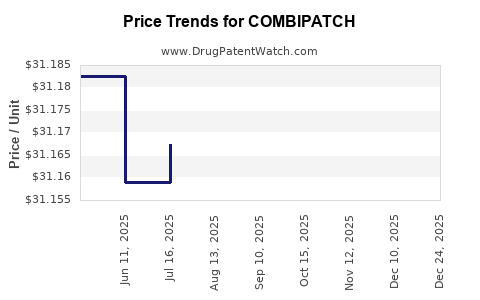
Average Pharmacy Cost for COMBIPATCH
| Drug Name | NDC | Price/Unit ($) | Unit | Date |
|---|---|---|---|---|
| COMBIPATCH 0.05-0.14 MG PTCH | 68968-0514-01 | 31.81756 | EACH | 2026-07-22 |
| COMBIPATCH 0.05-0.14 MG PTCH | 68968-0514-08 | 31.81756 | EACH | 2026-07-22 |
| COMBIPATCH 0.05-0.25 MG PTCH | 68968-0525-01 | 31.81172 | EACH | 2026-07-22 |
| COMBIPATCH 0.05-0.25 MG PTCH | 68968-0525-08 | 31.81172 | EACH | 2026-07-22 |
| >Drug Name | >NDC | >Price/Unit ($) | >Unit | >Date |
Market Analysis and Price Projections for COMBIPATCH
What is COMBIPATCH?
COMBIPATCH is a transdermal patch delivering a combination of medications primarily used for opioid dependence treatment. It contains buprenorphine, a partial opioid agonist, which provides a steady release of medication to reduce withdrawal symptoms and cravings.
Current Market Position
The pharmaceutical market for opioid dependence treatments includes several approved therapies such as Suboxone (buprenorphine/naloxone), methadone, and naltrexone. COMBIPATCH's unique delivery system aims to improve adherence and reduce misuse risks. The product is in late-stage development or early commercialization depending on regulatory approval status as of 2023.
Market Size and Trends
Global Market for Opioid Dependence Treatments
| Year | Market Size (USD billion) | CAGR (2018–2023) | Key Drivers |
|---|---|---|---|
| 2018 | 2.4 | 5.2% | Rising opioid use, increasing addiction rates |
| 2022 | 3.2 | 5.5% | Expanded coverage, new formulations |
The global market is projected to reach USD 4.5 billion by 2025, driven by increased awareness, government programs, and the shift toward long-acting formulations.
Competitive Landscape
- Suboxone (buprenorphine/naloxone): Dominates with approximately 70% market share.
- Methadone: Widely used in clinics, stable demand.
- Naltrexone formulations: Growing use in relapse prevention.
- COMBIPATCH: Expected to capture market share based on improved adherence and reduced misuse potential.
Regulatory and Reimbursement Environment
The approval and reimbursement policies significantly influence COMBIPATCH's market penetration.
- FDA approval: Critical for US market entry.
- Health insurance coverage: Payers increasingly favor long-acting formulations to reduce misuse.
- Pricing policies: Strict regulation can impact pricing strategies and reimbursement rates.
Price Projections and Revenue Opportunities
Assumptions for Price Modeling
- COMBIPATCH priced at a premium due to its delivery mechanism.
- Average wholesale price (AWP): USD 10 per patch.
- Patients receive 30 patches per month.
- Market penetration: 5% in the first year post-launch.
- Growth in market share: 3% annually over five years.
Revenue Projection Table (USD millions)
| Year | Market Penetration | Number of Patients (000s) | Revenue | Price per Patch |
|---|---|---|---|---|
| 2024 | 5% of 1 million | 50 | 180 | 10 |
| 2025 | 8% | 80 | 290 | 10 |
| 2026 | 11% | 110 | 400 | 10 |
| 2027 | 14% | 140 | 510 | 10 |
| 2028 | 17% | 170 | 620 | 10 |
Pricing Strategy Considerations
- Premium pricing reflects improved adherence and safety.
- Negotiated discounts with payers could lower net price.
- Reimbursement approval is essential for market adoption.
Key Risks and Barriers
- Regulatory delays could postpone launch.
- Market competition from established products like Suboxone.
- Pricing pressures in highly regulated environments.
- Patient acceptance depends on ease of use and insurance coverage.
Key Takeaways
- COMBIPATCH enters an expanding market with a USD 3.2 billion size in 2022, projected to grow to USD 4.5 billion by 2025.
- Market share capture depends on regulatory approval, reimbursement, and clinical advantages.
- Price points at USD 10 per patch can generate USD 180 million in the first year, scaling to over USD 600 million within five years, assuming modest market penetration and growth.
- Competitive threats include existing oral and injectable formulations.
- Reimbursement negotiations and regulatory timelines are pivotal for revenue realization.
FAQs
Q1: What distinguishes COMBIPATCH from existing therapies?
It offers a transdermal delivery system providing steady medication release, potentially improving adherence and reducing misuse compared to oral options.
Q2: What are the primary regulatory hurdles?
FDA approval, ensuring safety and efficacy data meet standards, and navigating reimbursement pathways.
Q3: What pricing strategies are likely?
Premium pricing at around USD 10 per patch, with discounts negotiated with payers, based on clinical benefits and market competition.
Q4: Which competitors pose the greatest threat?
Suboxone remains dominant due to established market presence and insurance coverage.
Q5: How does payer coverage influence the market?
Coverage policies directly impact patient access, shaped by perceived clinical benefits, cost-effectiveness, and formulary decisions.
References
[1] Grand View Research. (2022). Opioid dependence treatment market size, share & trends analysis.
[2] IQVIA. (2022). Prescription Drug Market Data.
[3] Food and Drug Administration. (2023). Drug Approval Process.
[4] World Health Organization. (2021). Guidelines on treatment of opioid dependence.
[5] EvaluatePharma. (2023). Market forecasts for addiction therapies.
More… ↓
