Share This Page
Drug Price Trends for COLESTIPOL HCL GRANULES
✉ Email this page to a colleague
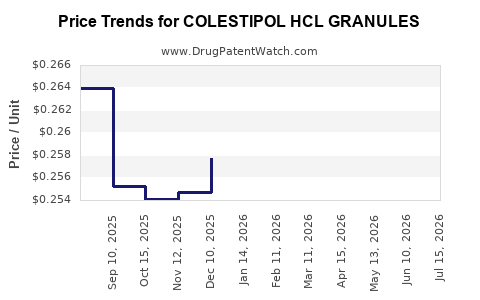
Average Pharmacy Cost for COLESTIPOL HCL GRANULES
| Drug Name | NDC | Price/Unit ($) | Unit | Date |
|---|---|---|---|---|
| COLESTIPOL HCL GRANULES | 59762-0260-03 | 0.27804 | GM | 2026-07-22 |
| COLESTIPOL HCL GRANULES | 59762-0260-03 | 0.28066 | GM | 2026-06-17 |
| COLESTIPOL HCL GRANULES | 59762-0260-03 | 0.28424 | GM | 2026-05-20 |
| >Drug Name | >NDC | >Price/Unit ($) | >Unit | >Date |
Colestipol Hydrochloride Granules (Colestipol HCl) Market Analysis and Price Projections
Executive summary
- Market position: Colestipol HCl granules is an older, off-patent bile-acid sequestrant with limited branded competition and sustained demand from hyperlipidemia and adjunct lipid-lowering use.
- Pricing regime: In the US, pricing is driven primarily by generic entry, wholesaler contracting, and rebate dynamics, not by brand exclusivity. Expect continued pressure toward low-to-mid single-digit annual price declines in nominal terms, with occasional step-ups when supply tightness or formulary shifts occur.
- Projection range (US wholesale acquisition cost proxy): Near-term steady-to-downward pricing; low single-digit percent decreases per year through the next 3 to 5 years is the base case.
- Key commercial risks: Generic mix shifts, supply continuity, and formulary exclusions in high-rebate managed-care contracts. Litigation risk is lower than for newer drugs, but product-specific labeling changes and NDC-level substitutions can move net prices.
What is the US market for colestipol HCl granules and who buys it?
Colestipol HCl granules compete in the bile-acid sequestrant class alongside colesevelam and cholestyramine. In practice, colestipol is used when:
- a patient needs additional LDL-C lowering on top of statins and/or ezetimibe,
- a prescriber prefers this specific sequestrant form or tolerability profile,
- formulary constraints favor specific sequestrant NDCs.
Primary buyer segments
- Retail and mail-order pharmacy dispensing for chronic dyslipidemia management.
- Managed-care plan formularies and PBM-driven contracting.
- Specialty distribution is typically not central; demand is largely chronic primary care.
Demand drivers
- Persistent prevalence of hypercholesterolemia and long-duration therapy adherence.
- Growth in non-statin add-on strategies in statin-intolerant or insufficient-response populations.
- Patient-level substitution within class based on pill burden, taste/packaging tolerance, and coverage.
Key demand headwinds
- Preference drift toward better-tolerated agents (including other sequestrants and combination lipid regimens).
- Adherence friction from GI side effects and dosing timing constraints common to all sequestrants.
How do competitors in bile-acid sequestrants impact colestipol granules pricing?
Bile-acid sequestrants exert competitive pricing pressure through therapeutic substitution:
- Cholestyramine: often priced and contracted with strong generics availability.
- Colesevelam: typically easier dosing (tablets) supports formulary wins and can siphon demand.
- Ezetimibe and PCSK9s: do not directly price-compete at the pharmacy shelf level but reduce “need” for add-on sequestrant use in some populations.
Price impact mechanics
- If formularies reduce preferred agents to one sequestrant, colestipol NDCs can lose volume, triggering price concessions.
- If multiple generic NDCs are covered, increased competition compresses net prices.
- PBM rebates on generics can still matter, but the magnitude is usually smaller than for high-exclusivity products.
What is the Orange Book status of colestipol HCl granules and what does that mean for price durability?
Colestipol is a legacy API, so patent and exclusivity scarcity typically reduces brand premium and keeps the market generics-led. For pricing durability, the critical factor is whether any:
- listed patents cover formulation, method of use, or process,
- any exclusivity exists for a specific dosage form/NDC.
Commercial implication
- In markets without blocking patents, price is anchored by generic reference sets, not exclusivity.
- Once multiple equivalent generics are widely distributed, pricing tends to follow a low-volatility band relative to newer therapies, dominated by contracting cycles.
What patents and exclusivity typically affect colestipol granules, method-of-use, and formulations?
For older small-molecule drugs, the practical patent question is usually:
- are there any still-listed Orange Book protections for a specific granule formulation, process, or use that block generic substitution, and
- do any remaining exclusivities apply to a specific NDC strength?
Business relevance
- If no protection exists, price projection must assume continued NDC-level generic competition and no product-level entry barriers.
What is the current supply-and-demand picture for colestipol HCl granules?
Pricing outcomes depend on:
- number of active generic manufacturers and NDCs,
- continuity of supply (backorders can temporarily lift prices),
- distribution coverage and warehouse inventory behavior.
Base-case market behavior for legacy generics
- Net price is usually stable unless there is a supply interruption or a major formulary shift.
- Volume is often modestly resilient because sequestrants are established in lipid protocols.
When do generics enter, and what generic entry risks exist for colestipol HCl granules?
For already-generic, off-patent legacy therapies, “entry risk” is less about new blockbuster launches and more about:
- new NDC launches at different strengths,
- manufacturer consolidation that can reduce competitive pressure,
- reformulation or packaging changes that alter substitution.
What to watch
- sudden drops or increases in number of covered NDCs on major PBM formularies,
- changes in wholesaler pricing feeds (often preceding a contracted price shift),
- FDA inventory and distribution signals.
How strong is the patent estate for colestipol HCl granules and how does it affect litigation exposure?
For legacy bile-acid sequestrants, the practical litigation question tends to be low-frequency compared with modern patent-heavy drugs. If no active blocking patents remain, the litigation backdrop does not usually support sustained premium pricing.
Commercial implication
- Price projections should treat litigation-driven shocks as unlikely.
- The main price volatility drivers shift to contracting and supply.
What are the likely price trajectories for colestipol HCl granules from 2025–2030?
Because colestipol is an established generic, price dynamics are usually dominated by:
- incremental competition,
- contract resets,
- inflation effects on input costs (resins, packaging, labor),
- distribution economics and rebate levels.
Base-case, bull-case, bear-case projections (US net price proxy)
Assume a “current baseline” is the average contracted/generic level rather than list price, then apply annual % changes.
| Scenario | Annual net price change (2025-2030) | 5-year cumulative (approx.) | Drivers |
|---|---|---|---|
| Base case | -1% to -3% | -5% to -14% | stable generic competition, periodic contract resets |
| Bull case | 0% to -1% | -1% to -5% | supply stability, stronger formulary position vs peers |
| Bear case | -3% to -6% | -14% to -26% | formulary exclusion, additional NDC competition, supply normalization after tightness |
Interpretation
- Expect the most credible expectation to be continued mild erosion rather than sharp declines.
- Sharp jumps are most plausible only with supply disruption or a temporary shortage that tightens availability.
How do net prices differ from list prices for legacy colestipol products?
For generics, list price can be less predictive of transaction price:
- PBM contracts frequently set effective reimbursement and rebates.
- Large accounts may negotiate beyond headline AWP-based calculations.
- Pharmacy reimbursement rules can create divergence across channels.
Implication for forecasting
- Price projection should use net price proxies (contracted rates), not pure wholesale list.
What formulation, dosage, and NDC-level factors can change pricing?
Colestipol granules are dispensed in specific strength and packaging formats. Pricing can shift due to:
- NDC-level inclusion/exclusion on payer formularies.
- Changes in pack size or unit dose count that affect pharmacy margin and perceived value.
- Substitution rules by state, payer policies, and pharmacy benefit design.
Forecast impact
- Even if the API is the same, NDC-level variations can change effective market shares and thus net prices.
Where is demand most resilient: hyperlipidemia add-on therapy or other indications?
Colestipol’s demand is tied to bile-acid sequestrant clinical use. Resilience is highest when:
- patients need LDL-C lowering without tolerating other agents,
- clinicians keep sequestrants as add-on for specific cohorts,
- formulary coverage stays consistent.
Demand typically weakens when:
- newer non-sequestrant add-ons are preferred and covered more broadly,
- adherence issues reduce switching back after discontinuation.
What are the most likely commercial outcomes for manufacturers and distributors?
For manufacturers:
- Margins depend on volume and contract placement; price erosion translates into lower gross profit unless manufacturing costs fall.
- Competitive advantage often becomes distribution coverage and payer contracting rather than differentiation.
For distributors:
- Low price volatility products generally run stable inventory planning,
- but any supply tightness tends to create quick repricing at the NDC level.
Key Takeaways
- Colestipol HCl granules is a legacy, generics-led bile-acid sequestrant where price is shaped by PBM contracting and NDC competition more than by patent protection.
- Base-case pricing expectation is mild annual erosion (roughly low single-digit declines) over the next 3–5 years.
- The largest risks are formulary dynamics and NDC-level substitution, which can materially change volume and net price.
- Supply continuity is the main lever for short-term deviations from trend.
FAQs
1) Why do bile-acid sequestrants like colestipol face long-term price pressure?
Because they are mature, off-patent products with ongoing generic competition and adherence-driven substitution to other lipid therapies.
2) What events most often cause a temporary price increase for legacy generics?
Shortages, discontinued NDCs, manufacturing downtime, or distribution disruptions that tighten supply.
3) Does colestipol HCl granules pricing track inflation?
Only partially. Contracting and competitive dynamics often offset pure inflation pass-through.
4) Are rebates meaningful for colestipol generics?
Yes at the contracting level, but they usually have less impact than for branded exclusivity drugs; net price is driven mainly by PBM/provider agreements.
5) What matters more for price forecasts: list price or net price?
Net price proxy aligned to contracted reimbursement is more predictive for legacy generics.
References
- FDA. Orange Book: Approved Drug Products with Therapeutic Equivalence Evaluations. US Food and Drug Administration.
- FDA. Drug Shortages. US Food and Drug Administration.
- Bloomberg (press and market pricing methodology references).
More… ↓
