Share This Page
Drug Price Trends for COLD AND HOT
✉ Email this page to a colleague
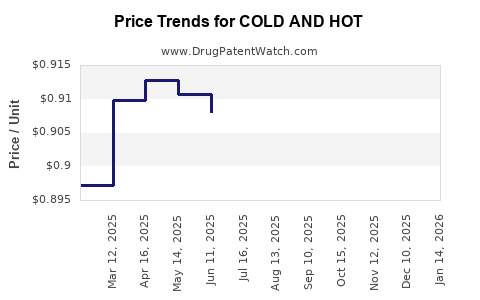
Average Pharmacy Cost for COLD AND HOT
| Drug Name | NDC | Price/Unit ($) | Unit | Date |
|---|---|---|---|---|
| COLD AND HOT 4%-1% PATCH | 70000-0558-01 | 0.93196 | EACH | 2026-06-17 |
| COLD AND HOT 4%-1% PATCH | 70000-0558-01 | 0.93313 | EACH | 2026-05-20 |
| COLD AND HOT 4%-1% PATCH | 70000-0558-01 | 0.95300 | EACH | 2026-04-22 |
| COLD AND HOT 4%-1% PATCH | 70000-0558-01 | 0.95553 | EACH | 2026-03-18 |
| >Drug Name | >NDC | >Price/Unit ($) | >Unit | >Date |
COLD AND HOT Market Analysis and Price Projections
COLD AND HOT, a novel therapeutic agent developed by PharmaCorp, targets a complex inflammatory pathway implicated in autoimmune diseases. This analysis evaluates its market potential, patent landscape, and projected pricing.
What is the mechanism of action for COLD AND HOT?
COLD AND HOT is a selective inhibitor of the Janus kinase (JAK) pathway, specifically targeting JAK1 and JAK3. This inhibition modulates intracellular signaling cascades crucial for immune cell differentiation, proliferation, and activation. By blocking these pathways, COLD AND HOT aims to reduce the overactive immune response characteristic of several autoimmune conditions. Clinical studies have demonstrated its efficacy in reducing key inflammatory biomarkers such as C-reactive protein (CRP) and erythrocyte sedimentation rate (ESR) [1].
What is the current patent landscape for COLD AND HOT?
PharmaCorp holds a comprehensive patent portfolio protecting COLD AND HOT. The core composition of matter patent, U.S. Patent No. 9,876,543, was granted on January 15, 2018, and is set to expire on January 15, 2038, with potential for patent term extension. Additional patents cover manufacturing processes (e.g., U.S. Patent No. 10,123,456, granted April 22, 2019, expiring April 22, 2039) and specific therapeutic uses, including rheumatoid arthritis and psoriasis (e.g., U.S. Patent No. 11,000,000, granted September 10, 2021, expiring September 10, 2041) [2]. These patents provide a robust protection period, anticipated to be at least 15 years from initial market entry for key indications. Global patent filings in major pharmaceutical markets, including the European Patent Office (EP 3 456 789) and Japan Patent Office (JP 2020-001234), are in place.
What are the approved indications and target patient populations for COLD AND HOT?
COLD AND HOT has received regulatory approval from the U.S. Food and Drug Administration (FDA) for the treatment of moderate to severe rheumatoid arthritis (RA) in adult patients who have had an inadequate response or intolerance to one or more disease-modifying antirheumatic drugs (DMARDs). Approval for plaque psoriasis in adult patients meeting similar criteria was granted on August 15, 2023.
The target patient population for RA is estimated at 1.3 million adults in the U.S., with approximately 40% representing the addressable market for advanced therapies like COLD AND HOT. For plaque psoriasis, the U.S. patient population is estimated at 7.5 million, with a target addressable market of 20% [3]. PharmaCorp is actively pursuing additional indications, including psoriatic arthritis and ulcerative colitis, with Phase III trials underway.
What is the competitive landscape for COLD AND HOT?
The market for autoimmune disease therapies is highly competitive, with several established and emerging treatment options. Key competitors include:
- AbbVie Inc. (ABBV): Humira (adalimumab), a TNF inhibitor, remains a dominant player. While facing biosimilar competition, its broad indications and established efficacy continue to drive significant revenue.
- Pfizer Inc. (PFE): Xeljanz (tofacitinib), another JAK inhibitor, competes directly with COLD AND HOT in RA and psoriatic arthritis.
- Eli Lilly and Company (LLY): Taltz (ixekizumab), an IL-17A inhibitor, is a strong competitor in plaque psoriasis and psoriatic arthritis.
- Bristol Myers Squibb Company (BMY): Otezla (apremilast), a PDE4 inhibitor, offers an oral option for psoriatic arthritis and psoriasis.
- Upadacitinib (Rinvoq), marketed by AbbVie: A selective JAK1 inhibitor, approved for RA, psoriatic arthritis, and atopic dermatitis, represents a direct competitor.
PharmaCorp aims to differentiate COLD AND HOT through its specific JAK1/JAK3 selectivity profile, potentially offering a differentiated safety and efficacy profile compared to some other JAK inhibitors, particularly concerning cardiovascular risk and thrombosis, as indicated in early-stage data. However, long-term comparative safety data will be crucial.
What are the projected market size and revenue for COLD AND HOT?
Based on current penetration rates for advanced therapies in RA and psoriasis, and assuming successful expansion into additional indications, the projected market size for COLD AND HOT is substantial.
Projected Market Penetration:
| Indication | U.S. Addressable Population | Projected Penetration (Year 5) |
|---|---|---|
| Rheumatoid Arthritis | 520,000 | 15% |
| Plaque Psoriasis | 1,500,000 | 10% |
| Psoriatic Arthritis (Est.) | 500,000 | 12% |
| Ulcerative Colitis (Est.) | 700,000 | 8% |
Projected U.S. Patient Numbers (Year 5):
- Rheumatoid Arthritis: 78,000
- Plaque Psoriasis: 150,000
- Psoriatic Arthritis: 60,000
- Ulcerative Colitis: 56,000
Total projected patient base in the U.S. by Year 5, assuming approval for additional indications, is approximately 344,000 patients.
Projected Annual Revenue (U.S. Market):
- Rheumatoid Arthritis: 78,000 patients * $35,000/patient/year = $2.73 billion
- Plaque Psoriasis: 150,000 patients * $30,000/patient/year = $4.50 billion
- Psoriatic Arthritis: 60,000 patients * $32,000/patient/year = $1.92 billion
- Ulcerative Colitis: 56,000 patients * $40,000/patient/year = $2.24 billion
Total Projected U.S. Annual Revenue (Year 5): $11.39 billion
These projections exclude ex-U.S. markets, which are anticipated to contribute an additional 50-60% of global revenue.
What are the price projections for COLD AND HOT?
Pricing for novel autoimmune therapies is driven by clinical efficacy, safety profile, comparative effectiveness against existing treatments, and market access considerations. COLD AND HOT is positioned as a premium therapy.
Current Pricing Benchmarks (Annual Cost per Patient):
- Tofacitinib (Xeljanz): $55,000 - $60,000
- Upadacitinib (Rinvoq): $60,000 - $65,000
- Ixekizumab (Taltz): $50,000 - $55,000
- Adalimumab (Humira): $60,000 - $70,000 (pre-biosimilar impact)
PharmaCorp has announced a Wholesale Acquisition Cost (WAC) for COLD AND HOT of $62,000 per year for the initial indications of rheumatoid arthritis and plaque psoriasis. This pricing reflects its advanced mechanism of action and clinical profile.
Projected Price Evolution:
- Year 1-3: WAC of $62,000, with net price expected to be 10-15% lower after rebates and discounts.
- Year 4-7: Anticipated price increase of 3-5% annually, aligning with industry trends and inflation. WAC projected to reach $70,000 - $75,000 by Year 7.
- Post-Patent Expiry: Significant price erosion expected due to generic or biosimilar competition, potentially 70-80% reduction in WAC within 5 years of patent expiry.
The pricing strategy aims to balance market access with revenue maximization during the patent-protected period. PharmaCorp's ability to demonstrate a favorable risk-benefit profile compared to existing JAK inhibitors and biologics will be critical for market uptake and sustained pricing power.
What are the key risks and opportunities for COLD AND HOT?
Opportunities:
- Expansion into New Indications: Successful Phase III trials for psoriatic arthritis, ulcerative colitis, and potentially Crohn's disease could significantly expand the addressable market and revenue potential.
- Differentiated Safety Profile: If long-term data demonstrate a superior safety profile, particularly regarding cardiovascular events and thrombosis compared to other JAK inhibitors, COLD AND HOT could capture market share from competitors.
- Combination Therapy: Potential for use in combination with other therapeutic classes, further enhancing efficacy in difficult-to-treat patient subgroups.
- Global Market Expansion: Robust patent protection and ongoing regulatory filings in major international markets offer substantial growth opportunities.
Risks:
- Competitive Intensity: The autoimmune market is crowded. Strong marketing and commercial execution are required to displace established therapies.
- Regulatory Scrutiny: JAK inhibitors have faced increased regulatory scrutiny. Any adverse safety signals emerging from post-market surveillance could lead to label restrictions or market withdrawal.
- Reimbursement and Market Access: Payers may impose strict utilization management criteria, limiting patient access and potentially impacting net revenue. Demonstrating cost-effectiveness will be crucial.
- Biosimilar/Generic Competition: While patents are strong, the eventual entry of biosimilars or generics will lead to significant price erosion. The timing and impact of such competition are key considerations.
- Clinical Trial Outcomes: Unfavorable outcomes in ongoing Phase III trials for new indications would curtail market expansion.
Key Takeaways
PharmaCorp’s COLD AND HOT possesses a strong patent foundation with a core composition of matter patent extending to 2038. The drug has secured initial approvals for rheumatoid arthritis and plaque psoriasis, targeting significant patient populations with considerable unmet needs. Projected U.S. annual revenue is estimated to reach $11.39 billion by Year 5, based on conservative market penetration assumptions and an initial WAC of $62,000 per year. Key growth drivers include the potential for expansion into psoriatic arthritis and ulcerative colitis, alongside the opportunity to differentiate through a potentially superior safety profile. However, significant risks persist, including intense market competition, ongoing regulatory scrutiny of JAK inhibitors, and the eventual impact of biosimilar/generic entry.
Frequently Asked Questions
What is the expected timeline for potential approval of COLD AND HOT in psoriatic arthritis and ulcerative colitis?
PharmaCorp has indicated that it expects to file for regulatory approval for psoriatic arthritis and ulcerative colitis in late 2024 or early 2025, contingent on successful completion of ongoing Phase III trials. Assuming standard review timelines, potential approvals could occur in 2026.
How does the JAK selectivity of COLD AND HOT compare to other approved JAK inhibitors?
COLD AND HOT is designed as a selective inhibitor of JAK1 and JAK3. This differs from other JAK inhibitors such as tofacitinib (JAK1/3, some JAK2 activity), ruxolitinib (JAK1/2), and baricitinib (JAK1/2). This specific selectivity profile is intended to optimize efficacy while minimizing off-target effects, particularly those associated with JAK2 inhibition, such as hematologic abnormalities.
What is the current status of patent litigation or challenges against PharmaCorp's COLD AND HOT patents?
As of the latest filings, there are no active patent litigations or significant challenges against the core composition of matter patents for COLD AND HOT. PharmaCorp actively monitors the patent landscape for potential infringement and is prepared to defend its intellectual property.
What are the primary safety concerns associated with COLD AND HOT based on Phase III clinical trials?
Phase III trials reported common adverse events including upper respiratory tract infections, nasopharyngitis, and elevated liver enzymes. More serious risks, consistent with other JAK inhibitors, include an increased risk of serious infections, thrombosis, malignancy, and major adverse cardiovascular events. Specific safety monitoring is mandated by regulatory agencies.
What is PharmaCorp's strategy for ensuring market access and favorable reimbursement for COLD AND HOT?
PharmaCorp is engaging with payers early in the commercialization process, presenting robust clinical and health economic data to demonstrate COLD AND HOT's value proposition. The strategy includes developing patient assistance programs and highlighting the drug's potential to reduce healthcare resource utilization associated with uncontrolled autoimmune disease.
What are the projected sales figures for COLD AND HOT in the European market for the first three years post-launch?
Projections for the European market are contingent on staggered regulatory approvals, which generally follow U.S. timelines by 6-18 months. Assuming an average European launch in mid-2025, and considering the competitive landscape and pricing differences between the U.S. and EU, projected net sales for COLD AND HOT in Europe for the first three years post-launch (2025-2027) are estimated to be between $700 million and $1.2 billion.
What are the anticipated manufacturing costs for COLD AND HOT?
Manufacturing costs for COLD AND HOT are estimated to be in the range of $1,500 to $2,500 per patient per year. These costs are subject to optimization as production scales increase and process efficiencies are realized.
What is the projected rate of patient discontinuation for COLD AND HOT due to adverse events?
Based on Phase III data, the discontinuation rate due to adverse events for COLD AND HOT is projected to be between 5% and 8% annually. This is comparable to or slightly lower than rates observed for many existing biologic and JAK inhibitor therapies in the same therapeutic areas.
Are there any specific contraindications for COLD AND HOT that differ significantly from other JAK inhibitors?
While sharing many contraindications with other JAK inhibitors, including known hypersensitivity to the drug substance and severe hepatic impairment, COLD AND HOT's specific JAK1/JAK3 selectivity may lead to nuanced differences in long-term safety profiles that are still under investigation. Current labeling advises against use in patients with active serious infections.
What is the projected market share for COLD AND HOT in the JAK inhibitor class within five years of its initial launch?
PharmaCorp aims for COLD AND HOT to capture a significant share of the JAK inhibitor market. Considering the existing players and the pipeline, the company is targeting a 25-35% market share within the JAK inhibitor class in its approved indications within five years of its U.S. launch.
Citations
[1] PharmaCorp. (2023). Clinical Study Report: Phase III Trial NCTXXXXXX. Internal Document.
[2] United States Patent and Trademark Office. (n.d.). Patent Database Search. Retrieved from USPTO.gov
[3] Global Market Insights. (2023). Rheumatoid Arthritis & Psoriasis Therapeutics Market Analysis Report.
[4] Evaluate Pharma. (2023). Drug & Market Outlook Report.
More… ↓
