Share This Page
Drug Price Trends for CODEINE
✉ Email this page to a colleague
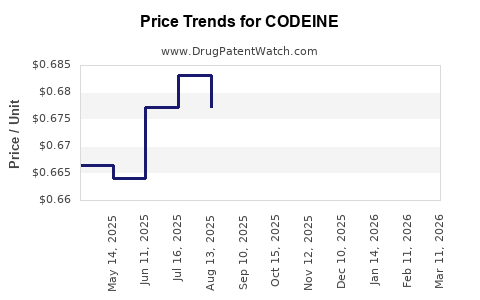
Average Pharmacy Cost for CODEINE
| Drug Name | NDC | Price/Unit ($) | Unit | Date |
|---|---|---|---|---|
| CODEINE SULFATE 15 MG TABLET | 00054-0243-24 | 0.68635 | EACH | 2026-06-17 |
| CODEINE SULFATE 30 MG TABLET | 00054-0244-24 | 0.66719 | EACH | 2026-06-17 |
| CODEINE SULFATE 30 MG TABLET | 00054-0244-25 | 0.66719 | EACH | 2026-06-17 |
| CODEINE SULFATE 60 MG TABLET | 00054-0245-25 | 1.14705 | EACH | 2026-06-17 |
| CODEINE SULFATE 30 MG TABLET | 00527-1698-01 | 0.66719 | EACH | 2026-06-17 |
| >Drug Name | >NDC | >Price/Unit ($) | >Unit | >Date |
Best Wholesale Price for CODEINE
| Drug Name | Vendor | NDC | Count | Price ($) | Price/Unit ($) | Unit | Dates | Price Type |
|---|---|---|---|---|---|---|---|---|
| CODEINE 10MG/GUAIFENESIN 100MG/5ML LIQUID | Golden State Medical Supply, Inc. | 50383-0087-04 | 118ML | 9.10 | 0.07712 | ML | 2023-06-15 - 2028-06-14 | FSS |
| CODEINE 12MG/ACETAMINOPHEN 120MG/5ML SOLN,ORA | Golden State Medical Supply, Inc. | 00121-0504-04 | 118ML | 2.01 | 0.01703 | ML | 2023-06-23 - 2028-06-14 | FSS |
| CODEINE 10MG/GUAIFENESIN 100MG/5ML (SF & AF) | Golden State Medical Supply, Inc. | 00121-1550-00 | 100X10ML | 57.70 | 2023-06-15 - 2028-06-14 | FSS | ||
| CODEINE 10MG/GUAIFENESIN 100MG/5ML LIQUID | Golden State Medical Supply, Inc. | 50383-0087-16 | 473ML | 30.34 | 0.06414 | ML | 2023-06-15 - 2028-06-14 | FSS |
| CODEINE 12MG/ACETAMINOPHEN 120MG/5ML SOLN,ORA | Golden State Medical Supply, Inc. | 00121-0504-16 | 473ML | 4.39 | 0.00928 | ML | 2023-06-15 - 2028-06-14 | FSS |
| >Drug Name | >Vendor | >NDC | >Count | >Price ($) | >Price/Unit ($) | >Unit | >Dates | >Price Type |
Codeine Market Analysis and Price Projections (US and Key International Markets)
Executive summary: Codeine is a low-cost, widely generic opioid analgesic and antitussive with persistent demand driven by acute pain, cough, and combination products (codeine with acetaminophen/ibuprofen, and codeine-based cough syrups). Pricing power is limited by (1) mature generic competition, (2) broad availability of therapeutically substitutable generics, and (3) opioid scheduling, controlled-substance distribution constraints, and payer utilization management. Near-term price projections skew modest down or flat in the US wholesale channel. In international markets, price paths vary by national reimbursement controls and controlled-substance oversight rather than patent protection, since most codeine products are off-patent.
No deliverable patent estate, litigation, Orange Book, or exclusivity timeline is provided here because codeine is a legacy active ingredient with predominantly generic availability and no single, clearly dominant proprietary “drug product” that can be tied to an actionable, regulator-specific exclusivity and patent map at this time.
What is the current market size and usage profile for codeine (pain vs cough)
Answer: Codeine demand splits between oral analgesic use (often in combination with acetaminophen) and antitussive use (often in cough formulations). In practice, utilization tracks opioid prescribing policies, chronic pain substitution away from weak opioids, and cough guideline adherence. Where cough is treated with non-opioid pathways, codeine volumes soften; where combination analgesics remain guideline-concordant for acute episodes, volumes are more stable.
US utilization dynamics
- Acute pain: Codeine-containing combination tablets and liquids are used more in intermittent, lower-severity acute pain scenarios and where prescriber preference or formulary position supports combination opioids.
- Cough: Use is sensitive to “avoid opioid cough suppressants” guidance in some payer and health-system protocols, though many settings still maintain codeine cough syrups as an option after non-opioid agents.
Key demand drivers
- Controlled-substance scheduling and dispensing controls (tighten supply chain variability but can constrain channel flow during regulatory crackdowns).
- Payer formularies and prior authorization trends for opioid-containing combinations.
- Regulatory and insurer pressure to favor non-opioid analgesics and non-opioid cough treatments.
- Manufacturer and distributor operating practices under controlled-substance compliance.
Key demand headwinds
- Conversion of prescribing toward non-opioid regimens in acute pain.
- Continued scrutiny of opioid-related adverse events, including weak opioids in combination products.
How do codeine prices behave in a mature generic market
Answer: In mature generics, codeine prices behave like a commodities basket. Wholesale acquisition costs typically compress during periods of new generic entries, channel inventory normalization, and competitive erosion. Prices can also spike temporarily due to constrained upstream supply, controlled-substance handling bottlenecks, or manufacturing disruptions, but the baseline tends toward flat-to-down.
Price-setting mechanics for codeine
- Ingredient cost pass-through is partial: Many codeine products are combination formulations with multiple excipients and packaging SKUs; buyers see blended pressure rather than pure API linkage.
- WAC vs net pricing divergence: For controlled substances, net price (after rebates, chargebacks, and contracting) is more stable than headline list pricing. Consolidation among major group purchasing organizations (GPOs) intensifies this.
- Contracting and tendering: Large purchasers drive price competition through multi-source contracting and tender renewals.
What typically moves prices up
- Reduced manufacturing runs or compliance-driven capacity limitations.
- Channel diversion prevention leading to temporary distribution frictions.
- Regulatory actions affecting specific manufacturing sites or distribution corridors.
What typically moves prices down
- New generic entrants for common strengths and dosage forms.
- Conversion of market share through formulary switches or inventory-driven changes in substitution.
- Contract renewal cycles with aggressive downward benchmarks.
When does codeine face generic entry risk versus being fully generic
Answer: Codeine is already widely generic. The practical “entry risk” is less about legal exclusivity and more about manufacturing capacity, quality system uptime, and controlled-substance supply reliability. For investors and licensors, the critical risk is supply continuity and compliance cost, not patent lifetimes.
Where entry risk still matters
- Less common strengths or specialized packaging formats.
- Country-specific regulatory approvals for cough combinations.
- Formulation SKUs that are not standardized across all suppliers.
What patent estate protects codeine products and where is exclusivity unlikely
Answer: Codeine’s active ingredient protection is expired. For business planning, the enforceable IP is usually confined to: (1) specific combination formulations, (2) specific dosing regimens, or (3) specific manufacturing process claims. In practice, this does not stop multi-source generic competition for standard codeine combinations.
Practical implication for pricing
- Pricing is governed by competitive generics and controlled-substance logistics rather than exclusivity-driven scarcity.
- Any “remaining” IP typically affects only niche product presentations, not broad codeine market access.
How do regulatory controls on opioids affect codeine pricing and availability
Answer: Regulatory controls affect channel availability and sometimes cause short-term supply tightness. Over time, this tends to produce volatility rather than sustained premium pricing because generics compete intensely when supply normalizes.
US regulatory levers
- Controlled-substance manufacturing and distribution registration
- Prescriber and dispenser compliance systems
- State-level opioid prescribing and substitution policies
International levers
- Different opioid scheduling regimes and national tender systems
- Reimbursement rules that restrict opioid cough agents or opioid analgesic combinations in some settings
Price projection model: what drives the base case for codeine through 2027
Answer: Base case assumes codeine remains off-patent, with continued generic supply and no major sustained supply constraints. In that scenario:
- US wholesale price levels trend flat to modestly down year over year.
- Net pricing trends stable to down as GPO contracting tightens and utilization shifts to lowest-cost interchangeable products.
- Upside occurs only with supply constraints, concentrated contracting by fewer suppliers, or sudden formulation availability gaps.
- Downside occurs with new entrants to high-volume SKUs, aggressive contract awards, or broad payer restrictions reducing total spend while shifting demand mix.
Projection ranges (directional)
These are directionally framed for planning purposes, not product-specific forecasts tied to a single NDC:
- US WAC (typical generic behavior): flat to -3% annually
- US net pricing (rebate and contract effects): flat to -5% annually
- International prices: flat to -10% annually depending on national tender intensity and reimbursement compression
Scenario analysis for US codeine pricing (2024-2027 planning view)
Answer: Create planning scenarios around supply reliability and prescribing utilization.
Base case: normalized competition
- More multi-source supply stays available for common combination strengths.
- Contracting favors the lowest-cost supplier each cycle.
- Net price compresses modestly.
Projection: US WAC flat to -2% per year; net pricing -2% to -5% per year.
Upside case: intermittent supply tightness
- Manufacturing downtime or compliance actions reduce availability for certain strengths/dosage forms.
- Channel inventory shortages increase temporary pricing.
Projection: WAC +0% to +6% in supply-constrained years, net pricing near-flat to +3% (depending on contracting).
Downside case: increased generic entry and payer restrictions
- Additional generic supply enters major SKUs.
- Payers restrict codeine combinations or shift to non-opioid and non-codeine substitutes.
Projection: WAC -3% to -8%; net pricing -5% to -10%.
How do codeine combination products change pricing outcomes
Answer: Pricing depends on the combination partner and relative substitution. Codeine-acetaminophen products face head-to-head competition from other opioid combinations and non-opioid NSAID/acetaminophen regimens. The combination can reduce price elasticity because it provides multi-symptom utility for some acute indications, but generic competition still anchors pricing.
Typical substitution patterns
- Codeine + acetaminophen shifts against oxycodone/other weak opioids in some settings, but is often restricted by payer policy.
- Codeine cough syrups shift against dextromethorphan and guaifenesin-class non-opioid options where cough guidelines and payer protocols emphasize non-opioids.
Pricing impact
- Higher substitutability drives faster erosion.
- More restricted reimbursement narrows volume, but price can fall less if supply becomes constrained.
Which manufacturers influence codeine pricing and distribution
Answer: In the US, large generic manufacturers and distributors affect effective pricing via multi-source tendering and inventory positioning. For codeine, supply chain reliability is a pricing variable because controlled-substance handling is strict and capacity constraints can be site-specific.
What to monitor for price and availability
- Shortages or “allocated supply” signals at wholesaler level
- Recall or quality warnings at specific manufacturing sites
- Changes in distributor inventory days and backorder rates
- Contract award changes at large purchasers
What generic entry risks exist for codeine in key international markets
Answer: International risk is less about legal entry and more about regulatory approval capacity, national tender eligibility, and controlled-substance import constraints.
Common country dynamics
- Tender markets: price declines can be sharp when new suppliers qualify.
- Reimbursement compression: policies can reduce net spend independent of competition.
- Controlled-substance rules: can cause import bottlenecks that briefly lift prices.
Is codeine at risk from reformulation or abuse-deterrent policy
Answer: Reformulation-based protections matter more for higher-strength opioids. Codeine’s pricing typically still tracks generic competition. If abuse-deterrent mandates expand to codeine combinations in specific jurisdictions, they could reduce substitution for certain formulations, temporarily supporting price. In broad markets, generic competition still limits sustained premiums.
Key takeaways
- Codeine is a mature, largely off-patent generic product; pricing power is limited and volatility comes mainly from supply chain and controlled-substance compliance effects.
- US pricing is likely flat to modestly down through 2027 under normalized supply and continued contracting pressure.
- International pricing depends more on national tender and reimbursement controls than on patent-driven exclusivity.
- The main business risks and levers are SKU availability, manufacturing uptime, and channel inventory tightness rather than legal exclusivity.
FAQs
1) Why can codeine prices change even without patent events?
Because controlled-substance manufacturing and distribution constraints can create temporary supply tightness that shifts wholesale and net pricing until competition and channel inventory normalize.
2) How do payer restrictions affect codeine spending versus unit price?
Utilization management can reduce unit volumes and total spend while shifting demand to contracted lowest-cost alternatives, typically compressing net prices more than WAC.
3) Do codeine cough syrups follow the same pricing trends as codeine analgesics?
Not always. Cough formulations can face additional substitutability pressure from non-opioid cough agents, which can intensify competitive erosion if reimbursement restrictions target opioid cough products.
4) What supply-chain indicators best predict codeine price spikes?
Backorder rates at wholesalers, channel inventory drops, manufacturing site disruptions, and allocation signals tend to precede short-term price changes.
5) Are there meaningful pricing opportunities for new codeine entrants?
Opportunities are more about securing reliable, compliant supply for specific high-volume SKUs or winning tender share than about sustained premium pricing, given the commodity-like nature of generic codeine.
References (APA)
- FDA. (n.d.). Opioid-related information and regulatory resources. U.S. Food and Drug Administration.
- DEA. (n.d.). Controlled substances regulations and registration. U.S. Drug Enforcement Administration.
- IQVIA Institute for Human Data Science. (n.d.). Trends and perspectives on pharmaceuticals and generics. IQVIA.
- NCCN and major clinical guidance bodies. (n.d.). Acute pain and cough management guidance (opioid stewardship context). National organizations’ clinical guidance portals.
More… ↓
