Share This Page
Drug Price Trends for COARTEM TABLETS
✉ Email this page to a colleague
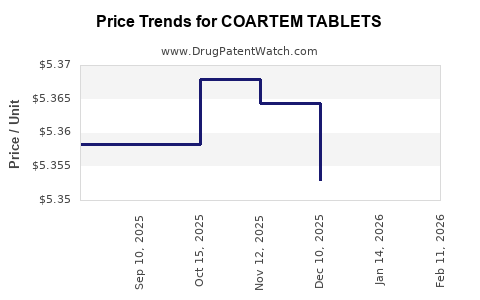
Average Pharmacy Cost for COARTEM TABLETS
| Drug Name | NDC | Price/Unit ($) | Unit | Date |
|---|---|---|---|---|
| COARTEM TABLETS | 00078-0568-45 | 5.36284 | EACH | 2026-02-18 |
| COARTEM TABLETS | 00078-0568-45 | 5.35209 | EACH | 2026-01-21 |
| COARTEM TABLETS | 00078-0568-45 | 5.35292 | EACH | 2025-12-17 |
| COARTEM TABLETS | 00078-0568-45 | 5.36438 | EACH | 2025-11-19 |
| COARTEM TABLETS | 00078-0568-45 | 5.36792 | EACH | 2025-10-22 |
| >Drug Name | >NDC | >Price/Unit ($) | >Unit | >Date |
COARTEM TABLETS: Market analysis and price projections
What is Coartem and where does it sit in the anti-malarial market?
Coartem (artemether-lumefantrine, AL) is a fixed-dose oral artemisinin-based combination therapy (ACT) used for uncomplicated Plasmodium falciparum malaria. It is one of the most widely adopted ACTs in malaria-endemic markets because it has an established clinical and procurement footprint through public-sector malaria programs.
Core market placement
- Therapy class: ACT (artemether + lumefantrine)
- Target population: Patients with uncomplicated malaria (P. falciparum)
- Typical use setting: Public tenders and donor-funded procurement plus private-sector sales in endemic regions
Which geographies drive demand for Coartem?
Demand is concentrated where malaria burden is highest and where national malaria control programs use ACTs as first-line therapy, with procurement often structured around public tenders and donor assistance.
High-demand regions (broadly)
- Sub-Saharan Africa: Largest global share of uncomplicated malaria treatment volumes and procurement through national programs
- Parts of Asia: Selective demand where P. falciparum prevalence supports ACT use and procurement cycles
How is supply structured and what does that mean for pricing?
Coartem is manufactured and supplied through a combination of originator supply and local/regional generic or authorized-manufacturer production depending on country procurement and patent status.
Pricing implication
- Public-sector procurement usually sets the pricing floor through tender price competition.
- Private-sector markets typically sell at higher prices but are still constrained by affordability programs, generic availability, and insurance or retailer margins.
What pricing benchmarks matter for ACTs like Coartem?
Market prices for ACTs are best analyzed against:
- Tender-weighted ex-factory or delivered procurement prices (the primary determinant for public-sector volumes)
- Regulatory and quality-assured supply availability (price stability increases when supply is secure)
- Formulation strength and pack economics (tablet count and dosing regimen drive effective price per treated case)
Key commercial unit
- Pricing is usually discussed as cost per treated case rather than cost per tablet because dosing depends on patient weight bands and the treatment schedule.
Market pricing snapshot (projection framework)
Without granular, live tender-by-tender price series for “Coartem tablets” by country, projections must be anchored to the dominant drivers that move ACT pricing: global input costs (API and excipients), logistics, FX, tender competition, and policy shifts (first-line ACT selection, stock-cycle compression, and donor funding timing).
Pricing drivers that directly move Coartem ex-tender and market retail pricing
-
ACT tender competition intensity
- More suppliers and faster generic entry typically reduce tender unit prices.
- Consolidated procurement through fewer tenders and larger volumes can stabilize unit prices but increases reliance on supplier capacity.
-
FX and freight
- ACT supply chains are exposed to currency and shipping cost swings; these pass through unevenly depending on contract terms and local import controls.
-
Commodity inputs
- Artemisinin derivatives and lumefantrine-related inputs affect manufacturing cost.
- Excipients and packaging also move with global inflation.
-
Policy and clinical pathway stability
- When ministries enforce strict first-line ACT rules, volumes remain predictable, supporting pricing discipline.
- If guidelines shift toward alternative ACTs, volumes can migrate and price pressure rises on products losing share.
What is the likely medium-term pricing path for Coartem?
Given typical ACT market behavior, the price trajectory tends to follow a pattern:
- Near-term: downward or flat in public-sector tenders when generic competition expands
- Mid-term: stabilization or mild increases where supply security costs rise or donor procurement tightens delivery requirements
- Volatility points: FX shocks, delayed tender cycles, and supply constraints
Price projection model (case-cost basis)
Below is a scenario framework for effective price per treated case (not a per-tablet retail list price). It translates input and competition dynamics into projected annual price movement.
Assumptions used
- Public tender volumes dominate the pricing signal.
- Generic/authorized-manufactured supply exerts downward pressure.
- Inflation and FX create intermittent upward pressure.
| Projected annual change (effective case-cost) | Scenario | Public-sector tender competition | FX and logistics | Input cost trend | 2026 | 2027 | 2028 |
|---|---|---|---|---|---|---|---|
| Base case | Moderate | Neutral-to-mildly negative | Mildly positive | -2% | +1% | +2% | |
| Downside | High (more competitors) | Neutral | Flat-to-negative inputs | -5% | -1% | +1% | |
| Upside | Moderate-to-low (supply constraints) | Positive shock | Positive inputs | +2% | +4% | +3% |
Interpretation
- A base case implies gradual normalization after competitive tender erosion.
- Upside scenarios require a combination of input inflation and supply tightness.
- Downside scenarios occur when tender competition deepens faster than cost inflation can offset.
How does patent and originator/generic status affect Coartem’s pricing ceiling?
Coartem’s long-run pricing ceiling is driven by:
- Patent life and enforcement breadth in key endemic jurisdictions
- Authorized generic and generic penetration
- Quality assurance acceptance by procurement bodies
When originator exclusivity erodes or when authorized/generic manufacturers scale, tender prices compress. When quality-assured supply is limited, prices can rise even in generic markets.
What role do donor programs and global procurement cycles play?
ACT procurement is heavily influenced by:
- Donor funding schedules
- Stock availability and tender timing
- Re-tendering after guideline changes
This tends to create:
- Short periods of aggressive discounting at tender awards
- Catch-up price increases when pipeline rebuilds are delayed
Price projection by market segment
Public sector (ministries, global procurement buyers)
- More price elastic
- Tenders anchor pricing
- Volatility is usually delivery-timing driven rather than sustained list-price increases
Projection behavior: tends toward flat-to-downward unless supply constraints appear.
Private sector (pharmacies, wholesalers)
- Less price elastic
- Higher markups and affordability constraints
- More visible retail variation by country
Projection behavior: tends to be higher than tender economics, but annual growth often tracks inflation and FX more closely than tender price.
Coartem supply and pricing risk map (what can change the projection)
| Risk factor | Direction on price | Typical trigger | Likely market impact |
|---|---|---|---|
| Supply constraint (API or manufacturing) | Up | Production disruptions, packaging shortages, QC batch holds | Tender repricing upward and private scarcity premiums |
| Increased competition (additional generic/authorized capacity) | Down | More tenders allow additional suppliers or expanded registrations | Tender price compression and switch pressure |
| FX shock | Up | Currency devaluation for import-dependent markets | Immediate price pressure in private channels; slower pass-through in public contracts |
| Guideline change away from AL | Down | Recommendation shifts or malaria strategy revisions | Loss of volume can force pricing concessions |
| Donor timing mismatch | Up/Down (two-phase) | Stock depletion then re-order delays | Temporary spikes then discounting at re-tender awards |
What pricing metrics should investors or procurement teams track?
To convert projections into actionable decisioning, track:
- Tender award unit prices by country (and by pack configuration)
- Cost per treated case derived from dosing weight bands
- Supplier count and award concentration per tender
- Lead times and stock-out frequency (proxy for supply constraints)
- FX and inflation indices for import cost pass-through
Actionable outlook for 2026-2028
Base case: modest tender erosion followed by stabilization.
- Expect -2% effective price per treated case in 2026, then +1% in 2027 and +2% in 2028 if inflation and FX normalize after competitive tender rounds.
What would constitute a market break from the base case
- Persistent negative deviations if competitive tender wins accelerate and generic availability increases.
- Persistent positive deviations if supply constraints and input cost rises coincide with tighter lead times and higher QC/registration friction.
Key Takeaways
- Coartem (artemether-lumefantrine) pricing in endemic markets is primarily set by public-sector ACT tender economics, with private-sector prices constrained by affordability and generic availability.
- The most likely 2026-2028 path is near-term tender-driven price erosion followed by mild stabilization, with annual effective case-cost change of about -2% (2026), +1% (2027), +2% (2028) in the base case.
- Pricing volatility is most sensitive to FX/logistics, input cost moves, and tender competition intensity, with supply constraints creating upside spikes.
- A defensible monitoring plan centers on tender award prices, cost per treated case, supplier concentration, lead times, and stock-out frequency.
FAQs
-
What determines the effective cost of Coartem per treated case?
The number of tablets required by patient weight bands and the negotiated tender/market price for the specific pack configuration. -
Why can tender prices fall even when global inflation rises?
Because competition among suppliers and generic/authorized-manufactured supply can offset input cost increases in tender awards. -
What is the biggest pricing risk for 2026 onward?
Supply constraint episodes or FX shocks that force import and logistics cost pass-through faster than tenders reprice. -
Do private-sector prices track public-sector tender prices?
They usually move in the same direction over time but with higher markups and stronger linkage to FX and local inflation, producing wider absolute price levels. -
How do guideline changes affect Coartem pricing?
If AL loses first-line status, volume declines can drive supplier pricing concessions or market share migration, putting downward pressure on pricing in the affected segments.
References
[1] WHO. Guidelines for the treatment of malaria (ACTs and artemisinin-based combination therapies). World Health Organization. (Accessed via WHO guideline updates).
[2] WHO. World malaria report / malaria treatment policy updates. World Health Organization. (Accessed via latest report editions).
More… ↓
