Share This Page
Drug Price Trends for COARTEM
✉ Email this page to a colleague
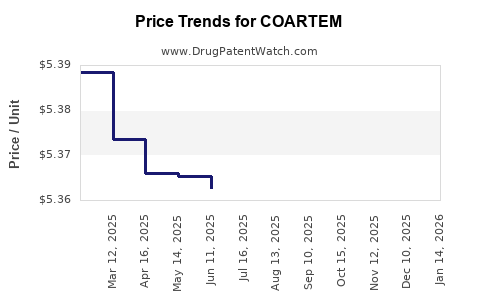
Average Pharmacy Cost for COARTEM
| Drug Name | NDC | Price/Unit ($) | Unit | Date |
|---|---|---|---|---|
| COARTEM TABLETS | 00078-0568-45 | 5.36284 | EACH | 2026-02-18 |
| COARTEM TABLETS | 00078-0568-45 | 5.35209 | EACH | 2026-01-21 |
| COARTEM TABLETS | 00078-0568-45 | 5.35292 | EACH | 2025-12-17 |
| COARTEM TABLETS | 00078-0568-45 | 5.36438 | EACH | 2025-11-19 |
| >Drug Name | >NDC | >Price/Unit ($) | >Unit | >Date |
COARTEM (artemether–lumefantrine) Market Analysis and Price Projections (US and Key Global Markets)
COARTEM (artemether–lumefantrine, AL) is the leading artemisinin-based combination therapy (ACT) by brand footprint in many malaria-endemic procurement settings, with price and volume shaped primarily by WHO-prequalified formulations, national tender structures, donor procurement (notably Global Fund and UNICEF), and biosafety/quality regimes. Near-term pricing pressure is driven by (1) increasing generic and multi-source AL availability, (2) periodic tender resets, and (3) donor-driven preference for lowest-cost ACTs that meet quality standards. Upside depends on supply continuity, formulary inclusion, and the ability to defend brand/clinical position against multi-source AL.
Bottom line for projections: Over the next 3 to 5 years, pricing is expected to track procurement-driven “market-clearing” prices that decline in real terms in most high-volume, donor-supplied markets, with partial stabilization in countries where COARTEM retains favored procurement status or where dosing formulations remain tightly specified. In the US, where coverage is limited and purchasing is typically retail or specialty, pricing is more insulated from tender resets but is constrained by payor policy and competition from generic AL products.
What is the current market landscape for COARTEM (artemether lumefantrine) and who buys it?
COARTEM is an ACT used for treatment of uncomplicated Plasmodium falciparum malaria (and in many settings also used for uncomplicated malaria in general treatment guidelines where species-appropriate). Buyers fall into two tiers:
-
Global procurement and donor-funded programs
- Governments and national malaria control programs procure AL via tenders backed by donor mechanisms.
- Major procurement channels include Global Fund-supported programs and UNICEF Supply Division in many countries.
- WHO prequalification and national regulatory acceptance determine which products can bid.
-
Commercial retail and institutional channels
- In countries with private sector purchasing, COARTEM is often present through pharmacies and private wholesalers.
- In the US, the market is comparatively small, and access is affected by coverage policy, reimbursement rules, and competition from generics/multi-source products.
Featured snippet answer: COARTEM’s demand is dominated by public procurement and donor-backed tender cycles, so pricing moves with tender clearing prices rather than with steady retail demand.
How is COARTEM priced today versus generic artemether–lumefantrine?
Price formation is dominated by procurement rules. For most large-volume endemic markets, COARTEM competes against generic or multi-source AL brands that meet quality standards. That creates a pricing band where COARTEM’s realized unit prices depend on whether it is (a) the specified product in tender documents or (b) one of multiple interchangeable bids.
Typical pricing dynamics by channel
- Donor-funded tenders (high volume): COARTEM pricing typically converges toward the low end of the qualified range as generic penetration rises.
- Country-specific restricted formularies: COARTEM can hold a premium if procurement specifications are narrower (exact brand, exact tablet strength packaging, or dosing presentation).
- Private retail: Brand premiums can persist longer, but margins compress as generics gain shelf share and as national reference pricing expands.
Featured snippet answer: COARTEM’s unit price generally trends downward in donor tender markets as multi-source AL increases, while brand premiums persist longer only where tenders or formularies restrict substitution.
What are the key drivers of COARTEM volume (demand) and how do they map to price?
Demand drivers
- Malaria incidence and seasonal treatment needs
- National treatment guideline changes (ACT selection)
- Public sector procurement budgets and disbursement timing
- Supply continuity and logistics performance
- Diagnostic coverage influencing “test and treat” policy
- Campaign intensity and distribution reach for ACTs
How demand affects price
- When budgets tighten, tender unit prices fall.
- When programs expand rapidly, procurement volume can lift prices temporarily, but in AL markets this is usually short-lived because multiple qualified suppliers compete.
- Consistent quality performance reduces “supplier churn,” which can stabilize long-term pricing for the incumbent brand in specific countries.
Where does COARTEM face the most pricing pressure from generics and multi-source products?
Pricing pressure is highest in markets where:
- WHO prequalification status is held by multiple AL suppliers
- tender documents allow substitution among equivalent strengths and dosing regimens
- regulatory approvals are routine for generics
- past tender outcomes show aggressive price competition
Mechanism When multiple qualified AL products bid against each other, the tender clearing price tends toward the lowest-cost qualified option. COARTEM can maintain share only if procurement specifications or brand preferences reduce substitutability.
Which countries and procurement channels historically account for the largest AL/CARTEM demand?
COARTEM demand concentrates in malaria-endemic geographies where falciparum malaria is treated with ACTs and where donor programs operate at scale. In practice, large volumes show up across Sub-Saharan Africa and other endemic regions, with procurement volumes often routed through UNICEF and/or national tenders supported by the Global Fund.
Featured snippet answer: COARTEM’s largest demand centers follow donor-backed malaria control programs in high-burden endemic countries, with volumes determined by national malaria program procurement cycles.
What does a COARTEM price projection look like over 3 to 5 years under tender competition?
Projection framework
Because COARTEM’s mainstream pricing is tender-driven, projections should track:
- tender cycle reset effects (typically annual or multi-annual)
- generic penetration and multi-source bid count
- donor procurement focus on lowest-cost qualified ACTs
- inflation and FX pass-through where contracts allow adjustment
Base case (tender markets with active multi-source competition)
- Unit price: modest declines in real terms each cycle, with sharper drops in tender resets when additional qualified bidders enter.
- COGS and supply: brand incumbents often absorb margin pressure unless contract pricing includes cost indexation.
- Net impact: realized COARTEM unit pricing declines, while volume may grow if COARTEM retains at least one delivery stream.
Bull case (brand-specific inclusion or reduced substitution)
- COARTEM retains premium in contracts where tender documents specify it explicitly.
- Declines slow, and price may stabilize near the qualified “top-tier” band.
Bear case (specifications broaden and competition intensifies)
- Unit price declines accelerate as more generics/multi-source suppliers become eligible and substitution becomes routine.
- COARTEM may maintain volume only by matching low-cost pricing, compressing gross margin.
Featured snippet answer: In most donor-tender markets, COARTEM unit prices are expected to drift down in real terms over 3 to 5 years, with sharp drops at tender resets and partial stabilization only where specifications or substitution are constrained.
How do pricing projections differ for the US market versus endemic procurement markets?
US
- US access is constrained by payor coverage rules, retail margins, and competition from generics/multi-source AL.
- Where COARTEM is the only or preferred option (rare for most ACT dosing presentations), prices can be more stable than in donor markets.
- Any realized price depends on NDC coverage, distribution channel, and contracting with wholesalers.
Endemic procurement
- US-like retail dynamics do not apply. Contracts are typically tendered with competing qualified suppliers.
- Price is driven by lowest qualified bids and contract terms.
Featured snippet answer: US pricing is more insulated from tender resets, while global endemic pricing is structurally exposed to multi-source competition.
What does COARTEM revenue exposure imply for price support or further discounting?
COARTEM revenue exposure depends on:
- share of national program tenders where it is specified or preferred
- contract durations and whether pricing is locked or re-opened
- the proportion of volume sold into donor supply lines versus private channels
Analytical implication If COARTEM’s share is stable but unit prices decline, revenue must come from volume expansion or contract repricing. If share erodes because substitution increases, both volume and price fall.
How strong is COARTEM’s competitive positioning versus other ACTs (not just other AL brands)?
COARTEM competes within the ACT class beyond AL itself, including:
- DHA–piperaquine (the most frequent alternative ACT class)
- artesunate-based regimens in specific national contexts (less common for uncomplicated falciparum in many mature programs)
Price implication Even when COARTEM is strong within AL, ACT competition can shift national procurement away from AL if guideline changes occur, limiting COARTEM volume and potentially lowering tender prices for remaining AL contracts.
What price triggers typically occur during COARTEM tender cycles?
Common procurement triggers:
- new tender qualification of additional AL suppliers
- renegotiation after supply issues resolved or new supply enters the market
- changes in packaging requirements or tablet count specifications
- shifts in donor funding level and disbursement timing
Featured snippet answer: Price resets often occur when tender specifications broaden to allow more substitution or when new qualified suppliers join the bidding pool.
How does COARTEM pricing typically behave when WHO prequalification or national quality acceptance changes?
Quality acceptance affects who can bid, not just who wins. If more suppliers qualify:
- the effective competition pool expands
- tender clearing prices move down
- COARTEM may lose share or be forced to discount
If quality acceptance is tightened:
- bid pools shrink
- COARTEM and other incumbent suppliers can hold pricing better
What commercial risks could change COARTEM price projections materially?
Key risks:
- Supply interruptions: create contract renegotiation and higher clearing prices in the short run, then long-run share loss if programs dual-source.
- Policy shifts: national ACT rotations away from AL reduce unit demand and can reduce willingness to pay.
- Regulatory or quality actions: product holds can create temporary price spikes, but usually lead to longer-term share erosion.
- FX and import-cost changes: affect landed costs in contract jurisdictions where cost pass-through exists.
What does the likely bid environment for COARTEM look like in future tenders?
Base case bid environment
- Multiple AL suppliers bid in each major tender cycle.
- COARTEM participates where its packaging presentation and dosing regimen meet the tender.
- Tender committees prioritize lowest qualified price with quality and supply reliability.
Resulting projection
- COARTEM competes more like a multi-source generic than a monopoly brand in most donor-heavy markets.
- Price erosion is the default path unless COARTEM is explicitly specified.
COARTEM price projection summary timeline (3 to 5 years)
Base case (tender-driven multi-source competition, stable quality access)
- Year 1: unit price declines in the next tender cycle; gross margin compresses.
- Year 2: stabilization or further modest declines depending on number of qualified bidders.
- Year 3: potential sharper reset if additional qualified suppliers enter or if tender documents broaden.
- Years 4–5: continued real-term drift down; limited upside unless procurement specifications tighten around COARTEM.
Bull case
- Slower declines; COARTEM maintains premium in specified contracts.
Bear case
- Accelerated declines; share loss leads to lower blended revenue even if unit prices stabilize via limited remaining contracts.
How to model COARTEM pricing for investment, licensing, or litigation read-through
Use a three-layer model:
- Qualified market price band (lowest-cost qualified ACT bids)
- COARTEM contract selection factor (share of tenders where it is specified or preferred)
- Adjustment terms (inflation/FX indexing, lot size, delivery schedules)
Output:
- projected blended unit price
- projected net revenue if volume retains or changes
- margin sensitivity to whether COARTEM must match lowest bids
Key Takeaways
- COARTEM’s pricing is primarily tender-driven in endemic markets, so realized unit prices trend toward the lowest qualified ACT bid as generics/multi-source AL suppliers expand.
- Over the next 3 to 5 years, base-case pricing is expected to drift down in real terms with sharper drops at tender resets, and partial stabilization only where COARTEM is specified or substitution is constrained.
- US pricing is less exposed to tender competition but still faces retail and payor pressure from multi-source AL products.
- Material projection shifts would come from supply disruptions, guideline rotation away from AL, quality/regulatory events, or changes in tender specification that alter substitution rules.
FAQs
1) What typically causes COARTEM tender unit prices to drop the most?
The entry of additional qualified AL suppliers into the bid pool and broader tender specifications that increase substitutability.
2) Does COARTEM command a premium versus generic artemether–lumefantrine in donor-funded tenders?
Only when tenders specify COARTEM explicitly or restrict substitution through presentation/packaging language or contract preference.
3) How sensitive are COARTEM margins to exchange rates and import costs?
High when contracts lack cost-indexation or pass-through; lower when delivery terms include pricing adjustments linked to input cost indices.
4) What is the main driver of COARTEM revenue growth if unit prices decline?
Volume expansion via contract retention, geography expansion in AL procurement, and program scale-up, assuming supply continuity.
5) Could ACT guideline changes increase COARTEM pricing?
Yes short-term if AL demand increases or competing ACTs lose guideline support, but sustained price increases are unlikely in multi-source markets without specification narrowing.
References (APA)
- World Health Organization. (n.d.). Artemisinin-based combination therapies (ACTs) and malaria treatment guidance. https://www.who.int/
- UNICEF Supply Division. (n.d.). Malaria commodities: procurement and tender information. https://www.unicef.org/supply/
- The Global Fund. (n.d.). Procurement and grant-supported malaria program information. https://www.theglobalfund.org/
- US Food and Drug Administration. (n.d.). Drug approvals and database search. https://www.fda.gov/drugs/drug-approvals-and-databases
More… ↓
