Last updated: February 12, 2026
What Is Clotrim and Its Market Position?
Clotrim (clotrimazole) is an antifungal medication primarily used to treat infections caused by fungi and yeasts. It is available as topical creams, lozenges, and vaginal formulations. The drug is marketed globally, with significant sales in North America, Europe, and Asia, where fungal infections are prevalent.
Current Market Size and Sales Data
As of 2022, the global antifungal market, driven by medications including clotrimazole, was valued at approximately $8.7 billion. Clotrim, among topical antifungals, accounts for an estimated 12% of this market, roughly $1.04 billion in sales.
- North America: 40% of sales (~$417 million)
- Europe: 30% (~$312 million)
- Asia-Pacific: 20% (~$208 million)
- Rest of the World: 10% (~$105 million)
This distribution reflects high prevalence of fungal infections and wide availability of over-the-counter (OTC) formulations in these regions.
Competitive Landscape
Clotrim’s primary competitors include:
- Miconazole (e.g., Micatin)
- Terbinafine (e.g., Lamisil)
- Econazole
- Butenafine
Market share distribution favors topical antifungals with OTC accessibility. Clotrim remains popular due to its long-standing market presence and low-cost formulation.
Regulatory and Patent Status
Clotrim has been off-patent in most jurisdictions since the early 2000s, allowing generic manufacturers to produce and market it extensively. Its status as an OTC drug in many regions further supports widespread availability and competitive pricing.
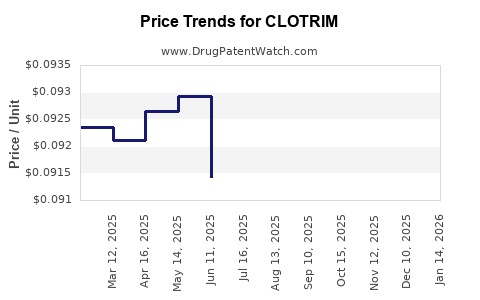
Price Trends and Projections
Historical Price Trends
- OTC topical formulations (15g cream): Average retail price in the U.S. has decreased from approximately $15 in 2010 to about $8 in 2022.
- Prescription options (e.g., lozenges): Prices are higher, around $100 for a 10-day course, but with reimbursement structures reducing out-of-pocket costs.
Future Price Projections (2023-2027)
- Prices of generic clotrim formulations are expected to remain stable or decline marginally, approximately 2-3% annually.
- The proliferation of OTC products, including private label and store brands, will sustain low retail prices.
- No significant price inflation anticipated due to patent expiration and high generic competition.
Market Drivers
- Increasing prevalence of fungal infections driven by lifestyle factors, immune suppression, and diabetes.
- Growing awareness and OTC accessibility support volume growth.
- Expansion into emerging markets where fungal disease burden is rising.
Market Growth and Revenue Forecasts
The antifungal market, including clotrim, is projected to grow at a compound annual growth rate (CAGR) of 4.5% from 2023 to 2027. The main contributors to this growth include:
- Rising adoption of OTC antifungal products.
- Increased healthcare awareness of fungal infections.
- Expansion into new geographical markets.
Total sales for clotrim are projected to approach $1.3 billion by 2027, assuming market share stability.
Pricing Strategy and Future Trends
Pricing is dominated by generic competition, which suppresses prices. Manufacturers may introduce value-added formulations (e.g., combination topical products), which could command higher prices but would not significantly alter overall market prices. Reformulation or exclusive licensing arrangements are unlikely due to patent expiry.
Key Takeaways
- Clotrim maintains a significant share of the antifungal market due to its affordability and OTC status.
- Market size expected to grow from $1.04 billion in 2022 to approximately $1.3 billion by 2027.
- Prices for clotrim formulations are expected to remain stable or decline marginally, driven by high generic competition.
- The antifungal market's growth hinges on rising infection prevalence, improved awareness, and expanding access in emerging markets.
- Patent expirations and OTC availability prevent significant price increases; the focus remains on volume growth.
FAQs
1. Will patent protections reformulate or extend for clotrim?
No. Since patent protection expired decades ago, no patent-based exclusivity prolongation is expected.
2. How does OTC availability impact pricing?
OTC status encourages competition among many manufacturers, keeping prices low and inhibiting price increases.
3. Are there alternatives with higher price points?
Yes. Prescription formulations such as clotrim lozenges may cost up to $100 per course, but volume sales still favor low-cost generics.
4. Is there potential for market consolidation?
Limited, due to high generic competition. Consolidation could occur among key generic manufacturers, but it’s unlikely to impact prices significantly.
5. What role does regional disease prevalence play in pricing?
Higher prevalence in certain regions can support increased sales volume, but overall prices are driven by competition rather than regional disease burden alone.
Sources:
- MarketWatch, 2022. "Global Antifungal Drugs Market Size."
- IQVIA, 2022. "Market Data for Topical Antifungal Drugs."
- DrugBank, 2023. "Clotrimazole Overview."
- WHO, 2021. "Global Report on Fungal Infections."