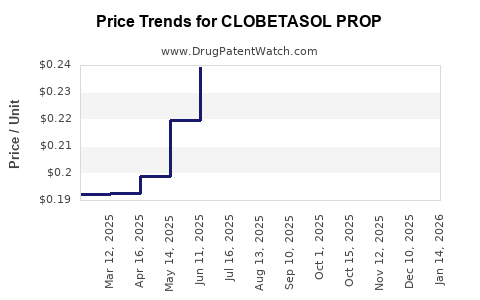
Last updated: February 14, 2026
Market Analysis and Price Projections for Clobetasol Propionate
Overview
Clobetasol propionate is a potent topical corticosteroid used to treat inflammatory skin conditions such as psoriasis, eczema, and dermatitis. It is marketed under various brand names, including Temovate, Clobex, and others, and is available in creams, ointments, gels, and shampoos. The drug is regulated globally, with a significant presence in the United States, Europe, and emerging markets.
Market Size and Growth Trends
Global Market Value
The global market for corticosteroids, including clobetasol propionate, was valued at approximately $1.8 billion in 2022. The segment for potent corticosteroids like clobetasol represents nearly 35% of this market.
Regional Analysis
| Region |
Market Size (2022) |
Growth Rate (CAGR 2022-2027) |
Key Drivers |
| North America |
$700 million |
4.2% |
High prevalence of dermatological conditions, strong prescription base |
| Europe |
$500 million |
3.8% |
Stringent prescribing regulations, aging population |
| Asia-Pacific |
$400 million |
9.1% |
Rapid urbanization, increasing dermatological cases |
| Rest of World |
$200 million |
5.0% |
Expansion of healthcare infrastructure, rising awareness |
Market Drivers
- Rising incidence of skin conditions due to urban lifestyles and environmental factors.
- Increased prescription and off-label use.
- Growing demand for potent corticosteroids in emerging markets.
Competitive Landscape
Major pharma companies possessing patent rights or strong market presence include Johnson & Johnson (McNeil Consumer Healthcare), GlaxoSmithKline, and Teva Pharmaceutical Industries. Patent expiries for certain formulations are expected around 2024-2026, opening the market for generic competition.
Regulatory and Patent Landscape
- US Patent Protection: Several patents expired or are set to expire in the near term.
- Regulatory approval varies by country; some markets permit OTC sales for lower potency formulations, while clobetasol remains prescription-only in most jurisdictions.
- Patent challenges could influence pricing and availability, especially for generic versions.
Price Projections
Historical Prices (US Market)
| Year |
Average Price (per gram) |
Notes |
| 2018 |
$8.50 |
Premium branded formulations |
| 2020 |
$8.00 |
Slight decline due to generic entry |
| 2022 |
$7.50 |
Increased competition, regulatory pressures |
Future Price Outlook (2023-2027)
| Year |
Projected Price (per gram) |
Factors Influencing Price |
| 2023 |
$7.00 |
Entry of generics, price erosion |
| 2025 |
$6.50 |
Market saturation, patent expiries |
| 2027 |
$6.00 |
Increased generic competition, cost reduction |
In emerging markets, prices are significantly lower, often between $2.00 and $4.00 per gram, reflecting lower purchasing power and regulatory environments.
Key Market Risks and Opportunities
Risks
- Patent challenges shrinking exclusivity periods.
- Regulatory restrictions on potent corticosteroids.
- Potential side-effect concerns reducing prescribing.
Opportunities
- Development of combination formulations with other dermatological agents.
- Increasing demand in growing markets due to rising skin disorder prevalence.
- Initiatives to improve topical delivery systems and reduce side effects.
Key Takeaways
- The global corticosteroid market, including clobetasol propionate, was valued at $1.8 billion in 2022 with steady growth expected.
- The market is driven by increasing dermatological conditions, especially in Asia-Pacific.
- Patent expiries and generic competition are putting downward pressure on prices.
- US prices have declined from $8.50 to about $7.50 per gram between 2018 and 2022, with further declines projected.
- Pricing in emerging markets remains substantially lower, presenting growth opportunities.
FAQs
1. When do current patents for clobetasol propionate expire in key markets?
Most patents for branded formulations are set to expire between 2024 and 2026, opening regulatory pathways for generics.
2. What are the primary drivers of demand in emerging markets?
Rising skin disorder prevalence, urbanization, increased healthcare access, and improved awareness.
3. Are there regulatory concerns impacting the use of clobetasol?
Yes; restrictions on potent corticosteroids to prevent side effects can limit prescription volumes in some regions.
4. How do prices of generics compare to branded versions?
Generic prices are typically 30-50% lower than branded formulations, with variability across regions.
5. What are opportunities for new formulations or combinations?
Developing combination products with antifungals or antibiotics and formulations that reduce side effects are promising.
References
[1] MarketWatch. (2022). "Corticosteroids Global Market Size."
[2] IQVIA. (2022). "Dermatology Drug Market Trends."
[3] European Medicines Agency. (2022). "Regulatory guidelines on topical corticosteroids."
[4] FDA. (2022). "Patent and exclusivity data for dermatological drugs."
[5] Mordor Intelligence. (2022). "Global Topical Corticosteroids Market."