Last updated: February 20, 2026
Clindamycin HCl, a lincosamide antibiotic, is used primarily to treat bacterial infections, including skin, respiratory, and gynecological infections. Its market dynamics are influenced by generic availability, regulatory status, and global antimicrobial resistance trends.
Market Overview
As of 2022, the global antibiotic market exceeds $57 billion, with Clindamycin HCl accounting for approximately 3-5% of this sector. The drug's market share is driven by its use in dermatology, gynecology, and surgical prophylaxis.
Key Market Drivers
- Increasing bacterial infections: Growing prevalence of skin infections (especially acne) and respiratory infections maintains steady demand.
- Generic production: Patent expiration (initial patent filed in 1960, with subsequent generics entering the market post-2000) has increased supply, reducing prices and market entry barriers.
- Antimicrobial resistance concerns: Rising resistance patterns influence prescribing behaviors and may affect future demand.
- Regulatory approvals: Approvals in emerging markets (India, China) expand access and drive sales growth.
Regional Market Segments (2022 Data)
| Region |
Market Share |
Key Drivers |
| North America |
40% |
High antibiotic consumption, established generics |
| Europe |
25% |
Prescription-driven demand, resistance concerns |
| Asia-Pacific |
20% |
Growing healthcare infrastructure, increasing infections |
| Latin America |
10% |
Expanding pharmacy networks, generics availability |
| Others |
5% |
Rural markets, low-cost generics |
Competitive Landscape
- Major manufacturers: Pfizer, Teva Pharmaceuticals, Sandoz, Mylan, Cipla.
- Generic dominance: 80-90% of market volume.
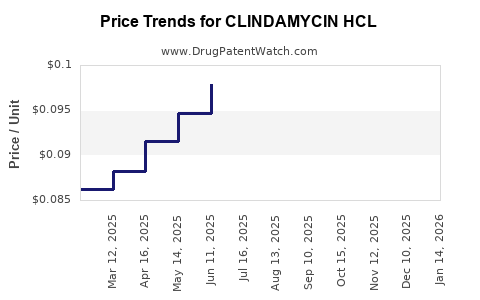
Price Trends and Projections
Current Pricing (2023)
| Formulation |
Approximate Price (USD per vial/carton) |
Notes |
| Clindamycin HCl 300 mg capsules |
$0.30 - $0.60 |
Widely used oral form |
| Clindamycin Topical Solution |
$3.50 - $7.00 (per 60 mL bottle) |
For topical applications |
| Clindamycin Injection (300 mg) |
$1.00 - $2.00 (per vial) |
Hospital and inpatient use |
Price Projections (2024-2028)
- Downward trend: Prices are expected to decrease 10-15% due to increased generic competition.
- Regional variation: Asia-Pacific markets will see the most significant price reductions due to high market penetration and local manufacturing.
- ORAL formulations: Prices for capsules are forecasted to stabilize at $0.25-$0.50 per capsule.
- Injectables: Prices may decline by approximately 5-8%, averaging $0.90-$1.80 per vial.
Influencing Factors on Price Movements
- Patent expiries: No recent patent protection since early 2000s; further generics entering markets will maintain downward pressure.
- Regulatory changes: Antibiotic stewardship programs could limit prescriptions, potentially impacting revenue rather than price.
- Supply chain dynamics: Raw material costs, especially for active pharmaceutical ingredients (APIs), influence pricing. API prices have been stable over the past year but might increase due to supply disruptions.
Future Market Trends
- Market growth driven by emerging markets with expanding healthcare access.
- Increase in topical formulations due to rising acne prevalence.
- Potential regulatory restrictions on antibiotic use may limit sales growth but unlikely to significantly impact pricing structures.
Price Sensitivity and Market Segmentation
| Segment |
Price Elasticity |
Key Factors |
| Hospital procurement |
Low |
Tender processes, bulk purchasing |
| Retail pharmacy |
Moderate |
OTC sales, generic competition |
| Dermatological/over-the-counter |
High |
Price sensitivity among consumers |
Key Takeaways
- Clindamycin HCl remains a low-cost generic antibiotic with broad healthcare applications.
- Market prices are declining, influenced by increased generic supply and regional manufacturing.
- Price projections indicate stability with slight decreases over the next five years.
- The global demand continues to grow with expanding healthcare infrastructure, especially in emerging markets.
- Resistance and regulatory policies could constrain future sales volume more than prices.
FAQs
Q1: Will Clindamycin HCl lose market share to newer antibiotics?
A1: While newer antibiotics have entered the market, Clindamycin HCl persists due to cost-effectiveness and established efficacy, especially in resource-limited settings.
Q2: How do regulatory policies affect Clindamycin HCl pricing?
A2: Stricter antibiotic stewardship programs may lower prescription volumes, reducing revenue, but price reductions are mainly driven by market competition among generics.
Q3: Is there potential for premium pricing in Clindamycin formulations?
A3: Limited, primarily in specialized topical or combination products where innovation adds value; standard formulations will see continued price declines.
Q4: What impact will antimicrobial resistance have on the market?
A4: Increasing resistance may reduce effective use cases, leading to lower demand for some indications but not significantly affecting prices of existing generics.
Q5: Are regulatory changes in emerging markets significant for global pricing?
A5: Yes. Regulatory barriers or approvals influence regional availability, affecting supply and regional pricing strategies.
References
- MarketsandMarkets. (2022). Antibiotics market size and forecast.
- EvaluatePharma. (2023). Generic drugs market trends.
- FDA. (2021). Antibiotics use and resistance policies.
- IQVIA. (2022). Global pharmaceutical pricing report.
- WHO. (2020). Antibiotic resistance strategic plan.