Share This Page
Drug Price Trends for CLINDAMYCIN
✉ Email this page to a colleague
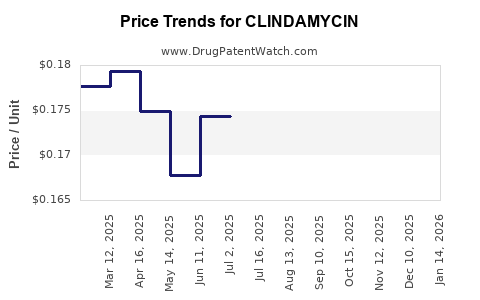
Average Pharmacy Cost for CLINDAMYCIN
| Drug Name | NDC | Price/Unit ($) | Unit | Date |
|---|---|---|---|---|
| CLINDAMYCIN PHOS 1% PLEDGET | 80005-0131-09 | 0.28146 | EACH | 2026-07-22 |
| CLINDAMYCIN PHOSPHATE 1% GEL | 73473-0302-75 | 3.63883 | ML | 2026-07-22 |
| CLINDAMYCIN PH 1% GEL | 73473-0300-60 | 0.12907 | GM | 2026-07-22 |
| >Drug Name | >NDC | >Price/Unit ($) | >Unit | >Date |
Best Wholesale Price for CLINDAMYCIN
| Drug Name | Vendor | NDC | Count | Price ($) | Price/Unit ($) | Unit | Dates | Price Type |
|---|---|---|---|---|---|---|---|---|
| CLINDAMYCIN PO4 1% GEL,TOP | Sandoz, Inc. | 00168-0202-30 | 30GM | 37.70 | 1.25667 | GM | 2023-08-15 - 2028-08-14 | FSS |
| CLINDAMYCIN PO4 1% GEL,TOP | Sandoz, Inc. | 00168-0202-60 | 60GM | 74.63 | 1.24383 | GM | 2023-08-15 - 2028-08-14 | FSS |
| CLINDAMYCIN PO4 1% LOTION,TOP | Sandoz, Inc. | 00168-0203-60 | 60GM | 89.77 | 1.49617 | GM | 2023-08-15 - 2028-08-14 | FSS |
| >Drug Name | >Vendor | >NDC | >Count | >Price ($) | >Price/Unit ($) | >Unit | >Dates | >Price Type |
Clindamycin Market Analysis and Price Projections
Clindamycin is a widely used lincosamide antibiotic sold in multiple formulations (oral capsules, topical gels/solutions, and injectable products). Pricing is dominated by generic competition, tender-driven procurement, and payer reimbursement dynamics across major markets. Near-term pricing is expected to remain constrained, with modest gains concentrated in branded, specialty, or supply-constrained segments rather than across the overall class.
What is the market structure for clindamycin?
Clindamycin’s market is split by formulation and channel:
- Oral (capsules/strips/generic equivalents): Highly generic, competitive pricing, frequent inventory-led purchasing.
- Topical (gel/solution/foam/cream variants by brand and strength): Competitive but with higher brand fragmentation by geography and product form.
- Injectable (vials/IV/IM products): Smaller unit volumes versus oral/topical, but pricing can move with supply continuity and hospital contracting.
From a patent standpoint, clindamycin is mature and largely off-patent in most jurisdictions. Commercial outcomes therefore track generic intensity, raw-material and manufacturing costs, and supply stability rather than exclusivity-driven pricing.
How is pricing set in major regions?
Pricing is shaped by each region’s reimbursement and procurement mechanics:
United States
- Generic-heavy market: Pricing typically follows the “race to the bottom” effect unless supply is constrained or product-specific contracts favor certain manufacturers.
- Hospital procurement: Injectable pricing can show short-cycle volatility due to formulary bidding and distributor behavior.
- Pharmacy channel: Oral and topical products tend to track lower net prices, with variability by package size and NDC availability.
Europe
- Tender and reimbursement controls: Competition drives down ex-manufacturer prices. Patient out-of-pocket and payer reimbursement influence net realization more than list pricing.
- Multi-source dynamics: Multiple suppliers for the same strength and dosage form compress pricing unless shortages occur.
Other markets (LATAM, MENA, parts of APAC)
- Import and distribution frictions: Pricing can be higher than US/EU due to procurement costs and supply variability.
- Local generics: Where domestic manufacturing exists, local brand leaders can hold prices longer, especially in topical segments.
What do historical pricing patterns imply for forward prices?
Clindamycin is not a new-entry molecule, and most demand is met by generics. In mature generic antibiotics, forward pricing usually follows this pattern:
- Stable-to-declining base: As more generic suppliers gain share, net prices fall or stay flat.
- Short, supply-led spikes: When manufacturing lines face outages or logistics tighten, wholesalers and hospitals can accept higher short-term prices.
- Contract resets: After tender cycles, prices drop again.
That means price projections should assume range-bound movement for mainstream formulations, with faster normalization to low net prices for oral and topical SKUs once additional competitors enter.
What is the expected price trajectory (2026-2028)?
Baseline scenario: “generic normalization”
Assumes no major sustained shortages, no major regulatory price interventions, and typical tender-driven contract resets.
- Oral generics (capsules): Flat to down modestly due to multi-source competition and incremental supplier intensity.
- Topical generics: Flat with occasional softness tied to competitor pricing in acne/dermatology.
- Injectables: Slightly higher volatility; modest declines where additional sources stabilize supply.
Upside scenario: “supply constraint pockets”
Assumes episodic shortages in specific pack sizes or manufacturers exiting production lines.
- Injectables: Short-cycle increases (weeks to a few quarters), then partial reversion.
- Topical branded or premium-generic SKUs: Better pricing than baseline due to formulary preferences in dermatology practices.
Downside scenario: “more competition and tender resets”
Assumes additional generics enter major tenders or price cuts by large wholesalers pressure net realizations.
- Oral and topical: Declines accelerate modestly in tendered markets.
- Injectables: Tender resets push net price down once supply expands.
Price projections by formulation (global directional ranges)
The table below expresses projections as percent change in net realized prices versus the prior-year baseline for each formulation segment. This is a directional market model for a mature generic drug and should be read as scenario ranges rather than point estimates.
| Formulation | 2026 vs 2025 | 2027 vs 2026 | 2028 vs 2027 | Main drivers |
|---|---|---|---|---|
| Oral (capsules/solids) | -1% to +1% | -2% to +1% | -1% to +1% | Generic intensity, tender resets, distributor pricing |
| Topical (gel/solution variants) | -1% to +2% | -2% to +1% | -1% to +1% | Acne/derm prescribing mix, brand fragmentation, competition |
| Injectable (IV/IM vials) | -1% to +5% | -2% to +3% | -1% to +2% | Supply continuity, hospital contracting, stocking behavior |
Where could price outperformance show up?
Outperformance usually concentrates in products with one or more of the following attributes:
- Tight supply or recent manufacturing disruptions in particular strengths or pack sizes.
- Formulary inertia where hospitals or dermatology clinics keep existing supplier options after a tender, creating short-cycle pricing power.
- Bundle effects when procurement decisions favor a distributor contract that includes clindamycin.
If you model price outcomes at the SKU level, the highest variance typically comes from injectables and from topical variants where fewer substitutes are stocked at the distributor or practice level.
What are the demand and utilization drivers?
Demand for clindamycin tracks antibiotic prescribing patterns and clinical guideline adherence:
- Clinical use is chronic at a stable baseline because clindamycin is used for skin/soft tissue and other indications where clinicians choose it based on susceptibility and patient-specific factors.
- Substitution pressure exists from other antibiotics and stewardship controls; this typically limits growth rather than driving sustained declines.
- Seasonality is modest for bacterial skin conditions, with local swings driven by dermatology and infection-management practice.
Net market growth tends to be volume-flat to modest in mature settings, while price contributes more to revenue stability than volume growth.
How do competitors and substitution affect price?
Clindamycin’s pricing is constrained by:
- Same-class and functionally substitutable antibiotics in many indications (other topical/oral antibiotics and alternative systemic agents).
- Multiple clindamycin generics that compete on price and availability.
- Therapeutic switching when local formulary preferences change.
In competitive markets, substitution mainly compresses price because suppliers must maintain share in tender and distributor networks.
What are the key risks to projections?
-
Regulatory or quality events
Antibiotic manufacturing is sensitive to quality compliance. Any recalls or manufacturing capacity closures can trigger localized pricing spikes. -
Supply chain shocks
API and packaging constraints can move net prices more than competitive dynamics for short intervals. -
Payer and hospital contracting shifts
New tender structures or formulary updates can reset prices down quickly once supply expands. -
Antibiotic stewardship and utilization changes
Any sustained downtrend in utilization reduces volume and can pressure suppliers to cut price to preserve market share.
Actionable implications for R&D and commercial planning
Even for a mature drug, business decisions still hinge on where pricing variance exists:
-
SKU strategy matters more than molecule strategy
Injectables and certain topical pack formats carry the highest short-cycle price volatility. -
Timing of supply contracts
Contracting prior to tender windows can lock in net prices; renegotiations later can track market compression. -
Channel focus
Pharmacy channel pricing compresses faster under multi-source competition; hospital contracting can create short-term deviations during procurement cycles. -
Portfolio positioning
If a company is marketing combinations or specialty forms that broaden patient access, pricing stability can be better than basic generics.
Key Takeaways
- Clindamycin pricing is structurally generic-driven, so baseline net prices are expected to be flat to modestly down in oral and topical, with higher volatility in injectables.
- The 2026-2028 outlook is range-bound: oral and topical around -2% to +2% annually in scenario terms, injectables around -2% to +5% depending on supply and contracting.
- The biggest levers are SKU-level supply, tender cycles, and formulary contracting, not patent exclusivity.
- Business value concentrates in managing procurement timing and availability strategy to capture short-cycle pricing during supply constraints.
FAQs
1) Is clindamycin expected to experience sustained price growth?
No. In major markets, clindamycin is generic-dominated, and pricing typically stays flat to modestly down absent sustained supply disruptions in specific SKUs.
2) Which clindamycin formulation is most price-volatile?
Injectable products, because hospital contracting and supply continuity can shift net prices faster than in pharmacy channels.
3) What drives the fastest price declines?
Tender resets and increased multi-source competition that force net price compression for oral and topical SKUs.
4) Where can prices outperform the baseline?
In periods of localized injectable or topical supply constraints, and in SKUs that maintain distributor and formulary placement despite competition.
5) How should investors model revenue for a mature clindamycin segment?
Use scenario-based net price ranges by formulation with conservative volume assumptions, and treat price movements as mostly contract and supply-cycle driven.
References
[1] FDA Orange Book: Approved Drug Products with Therapeutic Equivalence Evaluations. United States Food and Drug Administration. https://www.accessdata.fda.gov/scripts/cder/daf/index.cfm
[2] Drugs@FDA. United States Food and Drug Administration. https://www.accessdata.fda.gov/scripts/cder/daf/
[3] IQVIA Institute for Human Data Science. Global and regional pharmaceutical market trends and pricing dynamics (published reports). IQVIA. https://www.iqvia.com/insights/the-iqvia-institute/reports
More… ↓
