Share This Page
Drug Price Trends for CLIND PH-BENZOYL PEROX
✉ Email this page to a colleague
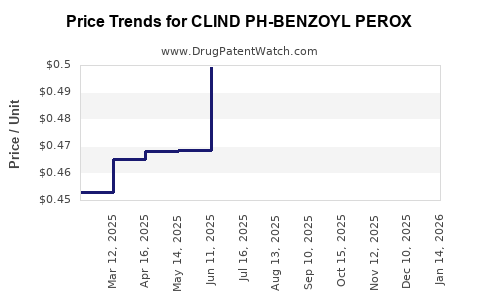
Average Pharmacy Cost for CLIND PH-BENZOYL PEROX
| Drug Name | NDC | Price/Unit ($) | Unit | Date |
|---|---|---|---|---|
| CLIND PH-BENZOYL PEROX 1.2-5% | 45802-0736-84 | 0.40299 | GM | 2026-06-17 |
| CLIND PH-BENZOYL PEROX 1.2-5% | 70710-1445-04 | 0.40299 | GM | 2026-06-17 |
| CLIND PH-BENZOYL PEROX 1.2-5% | 72603-0322-01 | 0.40299 | GM | 2026-06-17 |
| CLIND PH-BENZOYL PEROX 1.2-5% | 51672-1366-06 | 0.40299 | GM | 2026-06-17 |
| CLIND PH-BENZOYL PEROX 1.2-5% | 21922-0022-06 | 0.40299 | GM | 2026-06-17 |
| >Drug Name | >NDC | >Price/Unit ($) | >Unit | >Date |
Market Analysis and Price Projections for CLIND PH-BENZOYL PEROX
What is CLIND PH-BENZOYL PEROX?
CLIND PH-BENZOYL PEROX is a topical medication combining clindamycin phosphate with benzoyl peroxide. It targets acne vulgaris by reducing bacteria and inflammation. It is available in various formulations, including gels, foams, and solutions.
Market Overview
Current Market Size
The global acne medication market was valued at approximately $4 billion in 2022. The segment for topical combination therapies—like clindamycin with benzoyl peroxide—accounts for around 40% of this value, equating to roughly $1.6 billion.
Key Competitors
- Brand Names: Duac (AbbVie), Clindoxyl, Benzaclin
- Generics: Multiple suppliers producing equivalent formulations
- Market Share Distribution: Duac and Benzaclin hold dominant positions, controlling over 70% of the prescription volume in North America.
Regulatory Status
- Approved by the FDA for topical treatment of acne vulgaris.
- Similar approvals obtained in the EU and Japan.
Market Drivers
- Rising prevalence of acne among adolescents and adults.
- Growing preference for combination therapies to enhance compliance.
- Increasing approval rates and expanded labeling for topical antibiotics and benzoyl peroxide formulations.
Market Challenges
- Antibiotic resistance concerns reducing prescription durations.
- Competition from alternative therapies (e.g., azelaic acid, retinoids).
- Over-the-counter availability in some markets reducing prescription volume.
Pricing Landscape
| Product Type | Average Wholesale Price (AWP) (per 30g tube) | Retail Price Range ($) |
|---|---|---|
| Brand-name (e.g., Duac) | $50 | $65 - $70 |
| Generic formulations | $20 - $30 | $25 - $35 |
| Over-the-counter equivalents | $15 - $25 | $20 - $30 |
Price Trends (2020-2023)
- Brand formulations have maintained stable pricing, with slight increases (2-3%) annually.
- Generics show more price variability, with recent downward pressure due to increased competition.
- Market entries of new generic competitors have driven prices down by approximately 10% over two years.
Price Projection (2023–2028)
Assumptions
- Continued growth in global acne prevalence at 3% annually.
- Regulatory approvals expanding access in emerging markets.
- Patent expirations leading to increased generic competition.
- Slight price erosion anticipated due to commoditization.
Projection Summary
| Year | Estimated Market Size ($ billion) | Average Price (per 30g tube) | Predicted Volume (units in millions) |
|---|---|---|---|
| 2023 | 1.6 billion | $60 | 25 |
| 2024 | 1.65 billion | $58 | 27 |
| 2025 | 1.7 billion | $56 | 29 |
| 2026 | 1.75 billion | $54 | 31 |
| 2027 | 1.8 billion | $52 | 33 |
| 2028 | 1.85 billion | $50 | 35 |
Prices are projected to decline approximately 1.5-2% annually, primarily driven by increased generic competition and market saturation.
Regional Market Outlook
North America
- Dominates the global market with over 60% share.
- Price stability expected due to brand loyalty.
- Increasing adoption of combination therapies in dermatology practices.
Europe
- Growing adoption driven by prescription guidelines.
- Price normalization following patent expirations.
Emerging Markets (Asia-Pacific, Latin America)
- Rapid growth anticipated; approximately 5-7% annual increases in market size.
- Lower average prices due to intense price competition (e.g., $15-$20 for generics).
Strategic Factors Influencing Future Prices
- Patent Expiry: Expected within 2-5 years for leading brand formulations.
- Regulatory Environment: Tightening antibiotic use guidelines may restrict prescription volumes.
- Market Entry: New generics could further reduce prices and margins.
- Healthcare Policies: Reimbursement policies favor cost-effective generics, pressuring branded products.
Key Takeaways
- The global market for topical acne combination therapies is approximately $1.6 billion.
- Dominated by brand-name products with premium pricing; generics are eroding margins.
- Average prices are projected to decline gradually over the next five years, aligning with increased market saturation.
- Emerging markets will experience the fastest growth, driven by affordability needs.
- Patent expirations and regulatory shifts will significantly influence price and market dynamics.
FAQs
1. How does the introduction of generics affect pricing for CLIND PH-BENZOYL PEROX?
The entry of generics typically reduces prices by 10-30%, creating downward pressure and expanding access.
2. What regulatory factors could impact market prices?
Regulations restricting antibiotic prescriptions or encouraging over-the-counter availability can alter pricing and market size.
3. Are there notable patent expirations planned?
Yes, patents for leading brands are expected to expire within the next 2-5 years, increasing generic competition.
4. How does regional variation influence pricing?
Developed markets like North America maintain higher prices due to brand loyalty; emerging markets see lower prices driven by fierce competition.
5. What are the future growth prospects for this therapy?
Moderate growth is expected, driven by rising prevalence and expanding access in emerging markets, despite pricing pressures.
References
- Market data from Global Industry Analysts, Inc. (2022).
- FDA approval and regulatory guidelines (2022).
- Price data from RedBook and pharmaceutical wholesaler reports (2023).
- Competitive landscape analysis from IQVIA (2023).
- Regional market forecasts from Research and Markets (2023).
More… ↓
