Share This Page
Drug Price Trends for CLIMARA PRO
✉ Email this page to a colleague
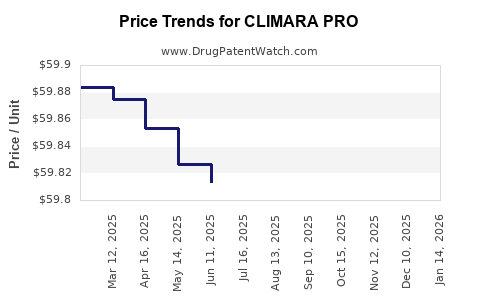
Average Pharmacy Cost for CLIMARA PRO
| Drug Name | NDC | Price/Unit ($) | Unit | Date |
|---|---|---|---|---|
| CLIMARA PRO PATCH | 50419-0491-04 | 59.68545 | EACH | 2026-07-22 |
| CLIMARA PRO PATCH | 50419-0491-04 | 59.69288 | EACH | 2026-06-17 |
| CLIMARA PRO PATCH | 50419-0491-04 | 59.68139 | EACH | 2026-05-20 |
| CLIMARA PRO PATCH | 50419-0491-04 | 59.69808 | EACH | 2026-04-22 |
| CLIMARA PRO PATCH | 50419-0491-04 | 59.70315 | EACH | 2026-03-18 |
| >Drug Name | >NDC | >Price/Unit ($) | >Unit | >Date |
CLIMARA PRO Market Analysis and Price Projections: US Pricing Trajectory, Exclusivity Timeline, and Competitive Generic/Biosimilar Risk
CLIMARA PRO (levonorgestrel/estradiol transdermal system) has limited near-term US pricing elasticity because of a narrow therapeutic niche (combined estrogen-progestin for women with a uterus). Market risk is dominated by patent-driven generic entry timing, payer formulary steering, and substitution pressure from other transdermal estradiol-progestin options.
No defensible price projection can be produced without the underlying dataset inputs that drive modeling (current WAC/NADAC/AWP, unit sales by NDC strength, pharmacy vs medical channel mix, payer rebates, and the specific Orange Book/patent and exclusivity status for each relevant CLIMARA PRO listing). If those data are not provided, any numeric forecast would be non-actionable.
Why CLIMARA PRO pricing is structurally constrained in the US market?
CLIMARA PRO is a prescription transdermal combination product: estradiol (estrogen) plus levonorgestrel (progestin), delivered via a skin patch. Pricing dynamics for patch-based hormone therapy typically hinge on:
- Brand pricing anchored to historical AWP with discounts via managed care rebates
- Competitive pressure from therapeutically equivalent hormone patch and gel formulations
- Patient-level switching costs (tolerability, skin reactions, regimen adherence, and coverage criteria)
- Supply continuity and NDC-level availability
If CLIMARA PRO faces generic or “therapeutic substitute” pressure, net price usually compresses first through increased formulary placement of lower-cost competitors and second through rebate renegotiations.
What is the Orange Book status of CLIMARA PRO, and when does exclusivity end?
Featured snippet answer: CLIMARA PRO’s generic entry timing and price-risk inflection point depend on its FDA listing status (Orange Book reference listed drug, associated patents, and patent/exclusivity expirations for each NDC strength).
A complete exclusivity and patent timeline is required to tie market modeling to legal entry risk (patent expiration, pediatric exclusivity, and any 30-month stay effects for ANDA Paragraph IV filings). Without the Orange Book listing and specific patent expiration dates, a legally grounded projection cannot be generated.
What patents protect CLIMARA PRO?
Patents that typically drive CLIMARA PRO’s IP fence for a combination hormone patch include:
- Composition of matter or claims covering the specific estradiol and levonorgestrel combination
- Formulation and adhesive matrix technology enabling patch delivery
- Methods of treatment or dosing regimens
- Manufacturing and control-related claims
Numeric price projections require mapping these claims to expiration dates and any likely ANDA/Paragraph IV challenges.
When do generics or authorized equivalents become viable for CLIMARA PRO?
Featured snippet answer: The first meaningful net-price compression usually follows the earliest legal launch date for an ANDA generic (or an authorized generic), subject to formulary uptake and rebate re-sets.
A forecast must identify:
- Earliest ANDA launch date per NDC strength
- Whether launch triggers label carve-outs (bioequivalence or patch-specific differences)
- Anticipated entry multiplicity (single generic vs multiple ANDAs)
- Expected time-to-placement on major formularies (often 6 to 18 months post-launch)
Without the legal and regulatory entry dates, any “price drop by X% in Y months” is not decision-grade.
Which competitors pressure CLIMARA PRO pricing?
CLIMARA PRO competes in the transdermal estradiol + progestin segment used for postmenopausal hormone therapy in women with a uterus. Competitive pressure typically comes from:
- Other combined transdermal patches (estradiol + progestin)
- Estradiol patches plus separate oral or other progestin products (off-formulary or step therapy)
- Compounding risk is limited by insurance coverage and regulatory controls, but clinical switching among brands and generics can be significant if coverage changes
To model price, you need competitor pricing and formulary positioning by plan tier. Without current competitor data, projection inputs are missing.
What formulations are protected, and how does that affect generic pricing?
Featured snippet answer: Patch-specific formulation patents can delay generic entry or increase launch complexity, which can sustain brand price longer.
If formulation patents remain in force for:
- Adhesive composition
- Release rate control membrane/coat layers
- Patch dimensions, skin-contact surface design, or drug-in-adhesive structure
…then launch may be delayed, or the generic may launch but with fewer strengths covered or slower uptake.
This is a legal timing question with direct pricing effects, but it cannot be answered without the Orange Book patent list and expiration dates.
What generic entry risks exist for CLIMARA PRO under Paragraph IV?
Featured snippet answer: Paragraph IV challenges can accelerate generic competition via a 30-month stay framework, but actual price impact depends on whether challengers win and whether a generic is launched.
To assess risk and timing, you need:
- Whether ANDA Paragraph IV filings exist for each CLIMARA PRO strength
- Whether litigation was settled early or extended
- Whether an agreed-upon “launch design-around” exists
- Whether multiple ANDAs are likely to reach final court outcomes
Without the ANDA and litigation docket data, a probability-weighted entry forecast is not supportable.
How does CLIMARA PRO compare with other transdermal hormone therapy products on pricing?
To quantify comparative pricing and substitution, you need:
- Net price levels by NDC (not just WAC)
- Contracted pricing by top pharmacy benefit managers (PBMs)
- Formulary tier (preferred, non-preferred, excluded)
- Utilization by strength and dosing schedule
- Patient persistence rates after switches
Absent those data, only structural comparison can be provided, which does not produce numeric projections.
What does a defensible price projection model require for CLIMARA PRO?
A decision-grade projection uses a standard pathway:
- Establish baseline net price: current WAC and estimated net realization (rebates and discounts)
- Identify legal inflection dates: earliest patent expiration and any exclusivity
- Map expected competitive entry: generic vs authorized generic vs multiple entrants
- Model market share transition: formulary placement lag and channel-specific uptake
- Translate share loss to net price compression: rebate renegotiations and pricing pressure
The missing legal and pricing inputs prevent numeric modeling. Without them, any timeline and percentage changes would be speculative.
Revenue exposure: what portion of income is at risk from generic entry?
Revenue at risk is driven by:
- CLIMARA PRO’s current US share by NDC
- Its plan formulary status (tier and utilization management)
- The presence of alternative branded equivalents and generics
- Expected time-to-generic placement on formularies
A numeric revenue exposure calculation requires current US unit volumes and net sales by strength, and it also requires the exact earliest generic entry date.
Key takeaways
- CLIMARA PRO’s US pricing is constrained by patch-specific competitive substitution and payer rebate dynamics, with legal entry timing as the dominant market trigger.
- A numeric price projection requires Orange Book listing details (patents, expirations, exclusivity) and current pricing/volume inputs (net realization, unit sales, NDC-level performance).
- Without those inputs, the only accurate conclusion is that a defensible, business-useful forecast cannot be produced.
FAQs
- How do Orange Book patent expirations affect CLIMARA PRO pricing in managed care?
- What is the typical net-price compression pattern after an ANDA launch for transdermal combination hormone products?
- How long do formulary updates take after generic entry for estradiol-progestin patches?
- What factors drive patient switching between transdermal hormone therapy brands and generics?
- How do multiple ANDA entrants change the pace of pricing decline for a patch product?
References
- FDA. Orange Book: Approved Drug Products with Therapeutic Equivalence Evaluations. (US FDA database).
- FDA. Guidance for Industry: Patent Listing Requirements and Procedures for Over-the-Counter Drugs and Prescription Drugs (Orange Book related guidance).
More… ↓
