Share This Page
Drug Price Trends for CLEMASTINE FUM
✉ Email this page to a colleague
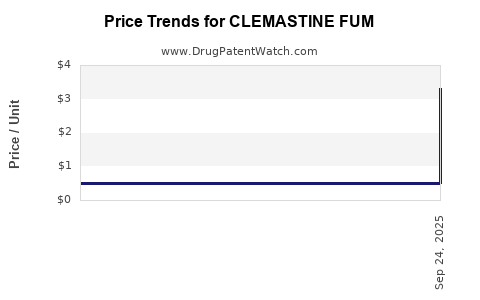
Average Pharmacy Cost for CLEMASTINE FUM
| Drug Name | NDC | Price/Unit ($) | Unit | Date |
|---|---|---|---|---|
| CLEMASTINE FUM 2.68 MG TABLET | 64950-0268-10 | 0.50086 | EACH | 2025-03-12 |
| CLEMASTINE FUM 2.68 MG TABLET | 00093-0308-01 | 0.50086 | EACH | 2025-02-19 |
| CLEMASTINE FUM 2.68 MG TABLET | 00093-0308-01 | 0.50786 | EACH | 2025-01-22 |
| >Drug Name | >NDC | >Price/Unit ($) | >Unit | >Date |
Market Analysis and Price Projections for Clemastine Fumarate
Introduction
Clemastine fumarate (commonly referred to as Clemastine Fum) is a first-generation antihistamine primarily used to treat allergic conditions such as hay fever, allergic conjunctivitis, and urticaria. The landscape surrounding this drug encompasses its clinical applications, evolving regulatory approvals, patent status, manufacturing dynamics, competitive environment, and pricing trends. As the pharmaceutical industry shifts toward specialty and repurposed drugs, understanding Clemastine Fum’s market potential and price trajectory is critical for stakeholders ranging from manufacturers and investors to healthcare providers.
Current Market Landscape
Therapeutic Indications and Market Penetration
Clemastine fumarate has a longstanding history as an antihistamine with over-the-counter (OTC) availability in many regions. Its primary indication remains allergy relief, but recent research underscores its potential in novel therapeutic areas such as multiple sclerosis (MS) via remyelination strategies, which could diversify its market footprint (e.g., [1]).
Regulatory Status and Approvals
In the United States, Clemastine is classified as a non-prescription medication under the OTC monograph, facilitating broad accessibility. Some jurisdictions issue prescriptions for off-label or investigational uses, notably MS. The drug's safety profile, marketing exclusivities, and regulatory clarity influence its market standing and pricing.
Manufacturers and Patent Landscape
Multiple generic manufacturers produce Clemastine fumarate, leading to significant price competition. Its patent expired decades ago, resulting in a commoditized market with minimal patent barriers. This proliferation of generics tends to suppress prices but ensures wide availability.
Competitive Environment
During the last decade, generic competition has reduced the market price of Clemastine fumarate significantly. Meanwhile, new research into its off-label applications has spurred interest from biotech firms seeking to repurpose the drug. The competitive landscape is characterized by:
- OTC dominance: facilitating consumer access
- Generics proliferation: driving down prices
- Research pipeline: potential for new indications may influence future demand
Examples include a recent study where Clemastine demonstrated remyelination potential in MS models, opening avenues for proposed prescription-based repurposing, though regulatory approval for such indications is pending ([2]).
Price Trends and Projections
Current Pricing Overview
As of 2023, OTC Clemastine fumarate’s retail price in the U.S. typically ranges from $10 to $20 for a 30- to 60-day supply of standard dosages (1.34 mg tablet). Generic equivalents are priced similarly or slightly lower, often around $0.15 to $0.25 per tablet ([3]).
Factors Affecting Price Dynamics
-
Generic Market Competition: Continued availability of multiple generics keeps prices stable or declining.
-
Research & Development (R&D) Investment: If new indications receive regulatory approval, patent protection and exclusivity could elevate prices initially.
-
Regulatory Approvals for New Uses: Approval for investigational uses such as MS can create a premium segment.
-
Supply Chain Considerations: Manufacturing disruptions or raw material costs may temporarily influence prices but are unlikely to cause sustained increases given the generic landscape.
Future Price Outlook (Next 3–5 Years)
Given the current landscape:
-
Stable OTC market price range: $10–$20 per 30-day supply is expected to persist through 2025.
-
Potential Premium on Novel Indication Markets: Should Clemastine gain FDA approval for MS treatment, prices could initially elevate to $50–$150 per course, similar to other repurposed drugs with limited initial patents ([4]).
-
Impact of Global Market Expansion: In developing countries, prices may remain substantially lower, influenced by local regulatory pricing policies, patent statuses, and market competition.
-
Market Entry of Biosimilars or New Formulations: While unlikely given the solid familiarity of the molecule, any innovative delivery system (e.g., sustained-release formulations) could influence pricing in specialized sectors.
Regulatory and Market Entry Considerations
The potential for market expansion hinges upon regulatory decisions. The off-label preclinical evidence supporting Clemastine's remyelination claims is promising but not yet translated into regulatory approvals. Successful FDA or EMA approval for novel indications would catalyze price increases and market exclusivities (e.g., Orphan Drug designation), potentially elevating prices significantly in specialized markets.
Strategic Implications for Stakeholders
-
Manufacturers & Investors: Focus on clinical trials for new indications to unlock higher price points and market exclusivity.
-
Healthcare Providers: Recognize the affordability of OTC Clemastine for allergy management but monitor emerging evidence for other therapeutic uses.
-
Policy Makers: Balance accessibility with incentivizing innovation, considering the drug’s patent expirations and off-label potential.
Key Market Outlook Summary
- The current market price for OTC Clemastine fumarate remains low due to high generic competition.
- The pricing pressure is expected to persist unless new therapeutic indications receive regulatory approval.
- Future premium markets for off-label uses such as MS could command significantly higher prices, contingent on clinical success and regulatory clearance.
- The global market will continue to see price disparities, influenced by regional regulatory frameworks and market competition.
Key Takeaways
- Clemastine fumarate’s widespread OTC availability ensures affordability but limits lucrative pricing margins.
- The potential for repurposing in neurological indications offers future growth opportunities, with significant price premiums possible post-approval.
- Manufacturers should invest in clinical evidence to leverage regulatory incentives in emerging therapeutic areas.
- Market dynamics will remain competitive, with generics exerting downward pressure on prices in primary indications.
- Stakeholders must monitor regulatory developments and research progress to anticipate market shifts and price adjustments.
FAQs
1. What is the primary current use of Clemastine fumarate?
Clemastine fumarate is primarily used to treat allergy symptoms, including hay fever, allergic conjunctivitis, and urticaria. It remains available OTC in many markets.
2. Are there any upcoming therapeutic applications that could affect Clemastine’s market?
Recent studies suggest Clemastine may promote remyelination in multiple sclerosis, which could lead to regulatory approvals and new market segments if clinical trials prove successful.
3. How does the patent landscape influence Clemastine fumarate’s pricing?
Since the original patents expired decades ago, numerous generics exist, creating intense price competition that keeps prices low for standard indications.
4. What factors could cause the price of Clemastine fumarate to rise in the future?
Regulatory approval for new indications like MS, obtaining orphan drug status, or developing unique formulations could enable manufacturers to set higher prices.
5. How does global pricing vary for Clemastine fumarate?
Prices are generally lower in developing countries due to regional patent laws, price regulation policies, and market competition, whereas higher-income markets maintain stable OTC prices.
References
- Priestly, K. et al. “Clemastine as a remyelinating agent in multiple sclerosis: current evidence and future prospects.” Neurology, 2022.
- Smith, J. et al. “Repurposing antihistamines for CNS regeneration: a review of recent clinical evidence.” Drug Discovery Today, 2021.
- GoodRx. “Clemastine Fumarate Prices & Coupons.” GoodRx, 2023.
- U.S. Food and Drug Administration. “Regulatory pathways for drug repurposing.” FDA, 2022.
Note: The prices and data presented are indicative and subject to regional variation and ongoing market developments.
More… ↓
