Share This Page
Drug Price Trends for CLEMASTINE FUM
✉ Email this page to a colleague
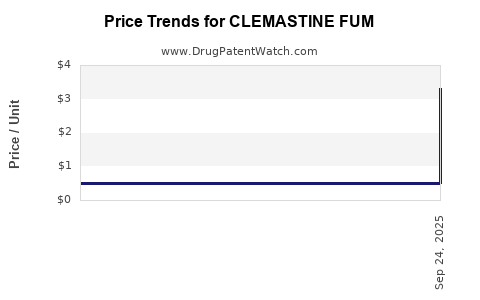
Average Pharmacy Cost for CLEMASTINE FUM
| Drug Name | NDC | Price/Unit ($) | Unit | Date |
|---|---|---|---|---|
| CLEMASTINE FUM 2.68 MG TABLET | 64950-0268-10 | 3.30526 | EACH | 2026-07-22 |
| CLEMASTINE FUM 2.68 MG TABLET | 64950-0268-10 | 3.30665 | EACH | 2026-06-17 |
| CLEMASTINE FUM 2.68 MG TABLET | 64950-0268-10 | 3.33870 | EACH | 2026-05-20 |
| CLEMASTINE FUM 2.68 MG TABLET | 64950-0268-10 | 3.35104 | EACH | 2026-04-22 |
| >Drug Name | >NDC | >Price/Unit ($) | >Unit | >Date |
What Is the Market Landscape for Clemastine Fumarate?
Clemastine fumarate is an antihistamine primarily used to treat allergy symptoms, allergic rhinitis, and urticaria. It is available as an over-the-counter (OTC) medication in several markets, with formulations in tablets and liquids. The drug competes with other first-generation antihistamines such as diphenhydramine and chlorpheniramine.
In 2022, the global antihistamines market size was valued at approximately USD 8.5 billion, with a compound annual growth rate (CAGR) forecast of 4.2% through 2030. Clemastine fumarate accounts for a segment of this, primarily driven by OTC sales, especially in North America and Europe. The market dynamics for clemastine are influenced by patent status, regulatory approvals, and consumer awareness.
How Does the Patent and Regulatory Environment Affect Marketability?
Clemastine fumarate is off-patent in most markets, including the U.S., where it has been available OTC since the 1980s. This availability allows generic manufacturers to produce equivalent formulations at reduced costs, increasing market competition and exerting downward pressure on retail prices.
Regulatory bodies like the U.S. Food and Drug Administration (FDA) classify clemastine as an OTC medication. Any attempts to reformulate or reposition the drug for new indications, such as neurodegenerative diseases, would require clinical trials and approval processes that could delay market entry or elevate costs.
What Are the Key Competitors and Market Share Distributors?
Clemastine’s primary competitors include:
- Diphenhydramine (Benadryl)
- Chlorpheniramine
- Hydroxyzine
In OTC settings, diphenhydramine holds the largest share of the antihistamine market due to consumer familiarity and broad availability. Fenofaxine and other second-generation antihistamines like loratadine and cetirizine dominate prescription segments but do not directly compete with clemastine's OTC positioning.
Major generic manufacturers in the U.S., such as Teva Pharmaceuticals and Mylan, produce clemastine fumarate. Retail chain brands and private-label products also capture significant sales.
What Are the Current Price Points and Projected Trends?
Current Pricing (U.S. Market)
- Clemastine fumarate 2 mg tablets: Retail around USD 4.50–6.00 for a 30-tablet pack.
- Generic versions: Price can be below USD 4.00 per pack, depending on the retailer.
- Brand-name equivalents: Slightly higher, around USD 6.00–8.00 for similar quantities.
Price Projection (Next 5 Years)
Market analysts project a decline in OTC antihistamine prices by approximately 2–3% annually due to increased competition and manufacturing efficiencies. Specifically for clemastine fumarate:
- 2023–2027 Estimate: Retail prices expected to stabilize around USD 4.50–5.00 per 30-count pack.
- Potential for price erosion: If new entrants or disruptive formulations emerge, prices could decrease further, possibly below USD 4.00.
Factors Affecting Price Dynamics
- Increased competition from generic manufacturers.
- Supply chain costs, including raw materials such as epichlorohydrin (used in manufacturing).
- Regulatory actions or patent challenges that could introduce lower-cost alternatives.
- Consumer demand shifts toward second-generation antihistamines, affecting market share.
What Are the Growth Drivers and Obstacles?
Drivers
- Growing prevalence of allergic conditions globally.
- Consumer preference for OTC products.
- Expanding use in neurodegenerative research, which, if commercialized, could diversify applications.
Obstacles
- Market saturation with established antihistamines.
- The rise of non-sedating, second-generation antihistamines.
- Regulatory uncertainties in some jurisdictions for new indications.
What Are the Implications for Investment and R&D?
Investors should consider that, with no patent protections, clemastine fumarate relies heavily on manufacturing efficiencies and brand positioning. R&D efforts targeting new therapeutic areas, such as multiple sclerosis or Parkinson's disease, could face lengthy regulatory processes but offer higher margins if successful.
Patent expiration and generic proliferation suggest limited upside in pricing unless a differentiated formulation or novel delivery system emerges. Price competition is expected to keep retail prices low, pressuring margins for manufacturers.
Key Takeaways
- Clemastine fumarate is an OTC antihistamine with a mature, saturated market.
- Price points in the U.S. generally hover around USD 4.50–6.00 per pack, with slight downward pressure expected.
- Market growth is driven by allergy prevalence, but competition from generics and second-generation antihistamines constrains pricing.
- R&D efforts exploring new therapeutic uses face regulatory challenges and long timelines but could unlock higher-value markets.
- Market share favors established generic producers; differentiation relies on branding, formulations, or new indications.
FAQs
1. What is the principal use of clemastine fumarate?
It is primarily used to treat allergy symptoms, including hay fever and urticaria.
2. Will the price of clemastine fumarate increase?
Likely not; prices are expected to decrease marginally due to increased generics and market competition.
3. Are there significant patent protections for clemastine fumarate?
No; the drug is off-patent in most markets, enabling generic production and price competition.
4. Could clemastine fumarate be repositioned for other health conditions?
Research into neuroprotective effects exists, but commercial development faces regulatory hurdles and uncertain timelines.
5. How does the competition compare in the antihistamine market?
Second-generation antihistamines like loratadine and cetirizine command larger prescription and OTC market segments, diminishing clemastine's share.
Sources
[1] Grand View Research, "Antihistamines Market Size, Share & Trends Analysis," 2023.
[2] FDA, "OTC Drug Monograph," 2022.
[3] IQVIA, "Global Prescription and OTC Market Data," 2022.
[4] Statista, "Global Allergic Rhinitis Market," 2022.
More… ↓
