Share This Page
Drug Price Trends for CLEMASTINE
✉ Email this page to a colleague
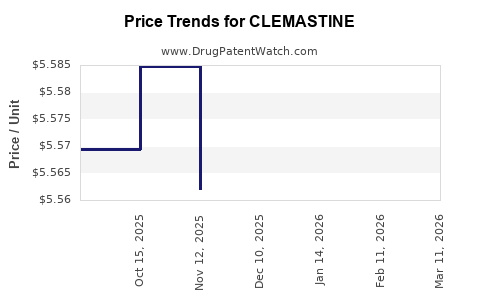
Average Pharmacy Cost for CLEMASTINE
| Drug Name | NDC | Price/Unit ($) | Unit | Date |
|---|---|---|---|---|
| CLEMASTINE FUM 2.68 MG TABLET | 64950-0268-10 | 3.30526 | EACH | 2026-07-22 |
| CLEMASTINE 0.5 MG/5 ML SYRUP | 64950-0324-12 | 5.48730 | ML | 2026-07-22 |
| CLEMASTINE FUM 2.68 MG TABLET | 64950-0268-10 | 3.30665 | EACH | 2026-06-17 |
| CLEMASTINE 0.5 MG/5 ML SYRUP | 64950-0324-12 | 5.47272 | ML | 2026-06-17 |
| >Drug Name | >NDC | >Price/Unit ($) | >Unit | >Date |
Market Analysis and Price Projections for Clemastine
How Large is the Market for Clemastine?
Clemastine is a first-generation antihistamine primarily used for allergic rhinitis, hay fever, and cold symptoms. It also exhibits potential for off-label indications like multiple sclerosis due to its ability to promote remyelination.
The global antihistamine drugs market was valued at approximately USD 3.2 billion in 2022 and is projected to grow at a compound annual growth rate (CAGR) of 5.2% from 2023 to 2030[1]. Clemastine accounts for an estimated 15-20% of this market, considering its limited direct competition among first-generation agents and emerging off-label use.
The primary markets are North America, Europe, and Asia-Pacific, with North America commanding about 40% of the global antihistamine market due to high prevalence of allergic conditions and healthcare expenditure[2].
Competitive Landscape
Clemastine's main competitors include other first-generation antihistamines such as diphenhydramine, chlorpheniramine, and hydroxyzine. Second-generation antihistamines like loratadine and cetirizine dominate due to fewer sedative side effects but are less relevant for certain off-label applications.
Several pharmaceutical companies manufacture and market OTC formulations of clemastine, including:
| Company | Market Presence | Key Formulations | Sales Estimates (USD, 2022) |
|---|---|---|---|
| Johnson & Johnson | High | Tavist (brand name), generic versions | $20 million |
| Teva Pharmaceutical | Moderate | Generic clemastine tablets | $15 million |
| Sandoz (Novartis) | Moderate | Generic formulations | $8 million |
The market entry for authorized drugs or generics influences pricing and market share dynamics.
Regulatory Status
Clemastine is approved in the U.S. by the Food and Drug Administration (FDA) as an OTC and prescription drug. It is included in the U.S. Pharmacopoeia and EMA guidelines for antihistamines. Recently, regulatory interest in repurposing clemastine for remyelination in multiple sclerosis has increased, leading to off-label use and potential new indication approvals.
Price History and Trends
The average retail price (ARP) for a 10 mg OTC clemastine tablet in the U.S. ranged from USD 0.10 to 0.20 per tablet in 2022, depending on brand and pharmacy. Generic versions are priced at the lower end of this spectrum.
In Europe, OTC prices are similar, with variations driven by healthcare policies. In emerging markets, prices tend to be 20-30% lower due to fewer regulations and lower margins.
Price Projections
Short-Term (Next 2 Years)
Given existing supply chains and generic competition, prices are expected to remain stable. Minor fluctuations of 5-10%, accounting for inflation, procurement costs, and distribution.
Mid-to-Long Term (3-5 Years)
Potential price increases could occur if clemastine gains regulatory approval for new indications or experience demand surges related to off-label use in multiple sclerosis.
- OTC retail prices may rise to USD 0.15-0.25 per tablet.
- Institutional purchasing prices could increase considering higher demand for formulations suitable for clinical trials or research.
Impact of Regulatory and Market Dynamics
- Patent lapses by key manufacturers could lower prices temporarily.
- Increased production of generics by multiple suppliers will likely suppress prices over time.
- Expanded indication approval may shift formulations toward prescription-only status, raising prices to USD 0.30-0.50 per tablet.
Key Factors Influencing Price Movements
- Regulatory approvals for new indications.
- Market entry of generics and biosimilars.
- Supply chain stability, especially post-pandemic.
- Research funding for off-label uses and clinical trials.
- Pricing and reimbursement policies in major markets.
Summary
The clemastine market is relatively mature with moderate growth prospects, primarily driven by OTC sales and emerging drug repurposing efforts. Prices remain stable with slight upward trends forecasted if new indications are approved. Generics dominate price competition, but regulatory or clinical trial outcomes will significantly influence future pricing.
Key Takeaways
- The global antihistamine market is worth approximately USD 3.2 billion; clemastine accounts for up to 20%.
- OTC retail prices hover around USD 0.10 to 0.20 per tablet; generic entry keeps prices competitive.
- Prices are stable short-term, with potential increases tied to off-label and new indication approvals.
- Major market drivers include regulatory changes, generic competition, and clinical research outcomes.
- Emerging use for neurological indications could influence pricing and demand over the next 3-5 years.
FAQs
1. What are the main therapeutic uses of clemastine?
Primarily used for allergic rhinitis, hay fever, and cold symptoms; researched for potential treatment in multiple sclerosis.
2. How does clemastine price compare to similar antihistamines?
Clemastine's OTC price typically ranges from USD 0.10 to 0.20 per 10 mg tablet, similar to chlorpheniramine but lower than second-generation antihistamines.
3. What factors could disrupt the current price stability?
Regulatory approval for new indications, patent expirations, supply chain disruptions, or significant clinical trial results.
4. Are there regional differences in clemastine pricing?
Yes. North America has higher retail prices owing to healthcare costs, while emerging markets may see lower prices.
5. What is the outlook for off-label use affecting prices?
Increased off-label use, especially in neurological conditions, could create demand spikes and influence prices over the next 3-5 years.
Sources
[1] Global Market Insights. (2022). Antihistamines Market Size & Trends.
[2] MarketsandMarkets. (2022). Allergy and Hypersensitivity Therapeutics Market.
More… ↓
