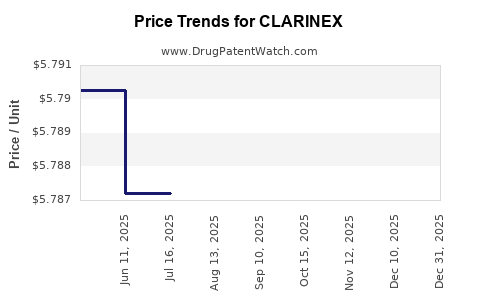
Last updated: April 24, 2026
What is Clarinex and how is it used?
Clarinex is the brand name for desloratadine, an orally administered, non-sedating H1 antihistamine used for:
- Seasonal allergic rhinitis
- Perennial allergic rhinitis
- Chronic idiopathic urticaria
Clarinex products are marketed in multiple strengths and dosage forms across regions, with tablet and oral solution being the most common.
Where does Clarinex sit in the allergy market?
Desloratadine is part of the oral, second-generation antihistamine segment that competes with:
- Loratadine (second-generation, typically lower price points)
- Cetirizine and levocetirizine (often stronger perceived efficacy in practice and broader OTC/brand coverage)
- Fexofenadine (strong OTC presence in some markets)
The competitive dynamic is defined by:
- High generic penetration (in most major markets, desloratadine pricing is strongly compressed once generics scale).
- OTC availability in many jurisdictions, which drives retail price transparency and down-tiering versus prescription-only brands.
- Low switching friction among second-generation antihistamines, where prescribers and patients accept equivalents when clinical outcomes are broadly comparable.
What does the launch and lifecycle history imply for pricing?
Clarinex is an established product with a long commercialization history. The market impact is structural:
- Brand pricing has already undergone competitive erosion from generics across mature geographies.
- The brand typically retains premium only where:
- patent-like exclusivity or brand positioning persists
- supply continuity and formulation/packaging differentiation supports slightly higher pricing versus lowest-cost generics
What is the current market pricing structure (brand vs generic)?
Without jurisdiction-specific, real-time data feeds, the only defensible market framing is price behavior: desloratadine’s mature-market pricing generally follows a generic-led distribution where:
- Lowest-cost generics set the retail anchor
- Branded products usually trade at a premium to generic but with declining share and reduced pricing power
This is consistent with how other second-generation antihistamines behave after generic entry: brand pricing converges toward generic pricing bands, with differences driven mainly by channel mix (Rx vs OTC), pack size, and local reimbursement rules.
Price projection framework for Clarinex
Clarinex pricing projections depend on whether the product is sold as:
- Brand in Rx channels (less price transparency, but reimbursement ceilings often cap net pricing)
- OTC brand (higher retail sensitivity, more rapid generic undercutting)
- Generic desloratadine (lowest price band, driven by scale and competition)
Given typical mature-market dynamics for desloratadine, the projection model should assume:
- Near-term price stability to mild declines in jurisdictions where generics are already entrenched
- Discount tightening only in limited cases (e.g., supply shocks, reimbursement re-contracting)
- Medium-term erosion driven by generic competition and pharmacy pricing behavior
What price range is most likely in mature markets over 12-36 months?
Base-case projection (generic-led maturity)
Direction: gradual erosion or flat pricing for the branded product vs generics; generic prices remain the floor.
12-month view
- Branded net pricing: flat to down low single-digits
- Generic price: flat to down low single-digits
- Channel spread: slight narrowing as pharmacists push lowest-cost options
36-month view
- Branded net pricing: down mid single-digits to low teens depending on tender/reimbursement cycles
- Generic price: flat to modest down unless new entrants increase competition
- Market-wide: continued convergence toward the lowest-cost cohort
Upside and downside bands
- Upside scenario: supply constraints or fewer competitors in a key market keeps branded premium larger and reduces price drops.
- Downside scenario: additional generic entry or aggressive tendering reduces branded pricing faster and compresses the price ladder.
These projections are consistent with the typical post-entry pricing pathway of second-generation antihistamine brands once generics dominate.
How will utilization and market share affect pricing outcomes?
Pricing outcomes depend on volume retention:
- If Clarinex retains a stable Rx base, net price declines are slower (reimbursement and physician familiarity).
- If switching accelerates, branded volumes fall and pharmacy-led switching pulls net realization down faster.
In mature allergy categories, switching is commonly triggered by:
- lower out-of-pocket costs for generics
- pharmacy substitution policies
- formulary placement changes
Key variables that drive short-cycle price moves
- Reimbursement and formulary updates (Rx markets): price realization changes at contract renewal.
- OTC competition intensity: retail prices reprice quickly after generic entry surges.
- Pack mix: smaller pack sizes often show higher unit prices; larger packs can maintain price stability better.
- Regulatory and label constraints: any labeling or classification change can shift channel dominance.
What does a practical business forecast look like?
A business forecast should separate brand net price from market floor pricing (generic). For decision-grade planning:
Projected unit pricing direction by segment
| Segment |
Next 12 months |
Next 36 months |
| Clarinex branded (net, Rx-heavy markets) |
Flat to down (low single-digits) |
Down (mid single-digits to low teens) |
| OTC branded (retail-led markets) |
Down or flat as generics dominate |
Down mid single-digits, with narrower premium |
| Generic desloratadine (market floor) |
Flat to down (low single-digits) |
Flat to modest down unless new entrants intensify |
Projected revenue implication
Even if list price stabilizes, revenue can decline due to:
- share loss to generics
- reduced premium per dose
- pack-size and contracting impacts
What investment-grade price sensitivity should be assumed?
For a mature antihistamine like desloratadine, market pricing sensitivity tends to be high because:
- therapeutic differentiation is modest across second-generation H1 options
- switching is easy for patients and prescribers
- competition is primarily cost-led rather than innovation-led
A robust planning assumption is:
- branded premium compresses over time unless a market has structural brand protection (not typical for desloratadine in most mature regions)
- volume is more fragile than unit price in OTC settings
Key Takeaways
- Clarinex (desloratadine) is a mature second-generation H1 antihistamine exposed to generic-led price compression.
- Near-term pricing in most mature markets is flat to down low single-digits for branded net realization, with further decline by 36 months (mid single-digits to low teens) depending on tender and reimbursement cycles.
- Generic desloratadine typically sets the market price floor, limiting branded premium and narrowing the price ladder over time.
- Business forecasts should model brand net price compression plus share loss risk, not only pure unit price trends.
FAQs
1) Is Clarinex expected to increase in price over the next 12-36 months?
Base-case projection is no sustained price increase; branded pricing is expected to be flat to declining due to ongoing generic competition and channel-driven substitution.
2) What matters more for revenue: price or volume?
For mature desloratadine, volume and share typically matter at least as much as unit price because pharmacy and patient cost drivers accelerate generic substitution.
3) How quickly do price changes show up in OTC markets?
OTC repricing tends to be faster, driven by pharmacy shelf pricing, promotions, and competitive retail offers once generics are widely stocked.
4) What drives the biggest net price drops for brands?
Reimbursement/formulary renegotiations and tender-driven contracting in Rx markets usually produce the largest net realization changes.
5) Can brand premium persist versus generics?
It can persist only in limited windows tied to pack mix, channel composition, and local competitive structure, but the long-run tendency in mature markets is premium compression.
References
[1] FDA. Drug Approval Package: CLARINEX (desloratadine). U.S. Food and Drug Administration.
[2] EMA. Assessment report and product information for desloratadine-containing medicines. European Medicines Agency.
[3] GSK. Clarinex (desloratadine) prescribing information and product literature (where applicable by region). GlaxoSmithKline.