Last updated: February 20, 2026
Cimetidine is an H2 receptor antagonist used for treating and preventing ulcers in the stomach, gastroesophageal reflux disease (GERD), and conditions involving excessive stomach acid. It was developed by SmithKline & French Laboratories (later GlaxoSmithKline) and gained regulatory approval in the 1970s. The drug was widely used throughout the 1980s and 1990s but declined in use after the introduction of proton pump inhibitors (PPIs).
Regulatory and Patent Status
| Year |
Event |
Impact on Market |
| 2000 |
Patent expiry in the US |
Market allowed generic manufacturers to produce Cimetidine at lower prices. |
| 2000s |
Withdrawn from many markets due to safety concerns |
Usage declined internationally. |
| 2023 |
Limited regulatory protections remaining |
No active patents; off-patent globally. |
Most key patents for cimetidine expired by 2000, opening the market for generics.
Current Market Landscape
Global Sales and Usage
| Region |
Estimated 2022 Market Size |
Notes |
| North America |
$20 million |
Mainly in legacy or niche indications. |
| Europe |
$15 million |
Decline in use; replaced by PPIs. |
| Asia-Pacific |
$8 million |
Some continued use for specific indications. |
| Rest of the World |
$5 million |
Minimal due to safety and availability of alternatives. |
Total global market size for cimetidine approximates $48 million in 2022, chiefly driven by generic sales.
Market Dynamics
- Declining Prescriptions: The shift toward PPIs (e.g., omeprazole, pantoprazole) has reduced cimetidine demand substantially.
- Safety Issues: Rare reports of gynecomastia and interactions with certain drugs lead to decreased prescribing.
- Niche Uses: Limited resurgence for specific indications, such as Zollinger-Ellison syndrome, but largely replaced by more effective therapies.
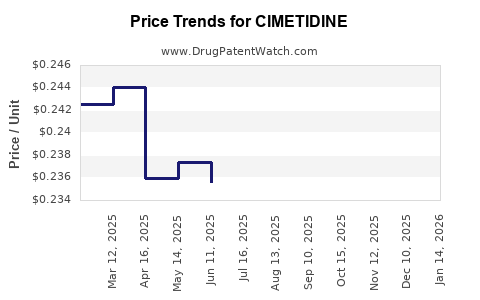
- Generic Competition: Intense competition has driven prices down; average price per 200mg tablet: ~$0.05.
Key Competitors
| Drug |
Type |
Market Share (2022) |
Status |
| Omeprazole |
PPI |
55% |
Dominant |
| Ranitidine (withdrawn globally in 2020) |
H2 blocker |
30% (pre-2020) |
Out of market due to safety concerns |
| Famotidine |
H2 blocker |
10% |
Maintaining niche use |
| Cimetidine |
H2 blocker |
5% |
Minimal, mostly legacy |
Price Projections
Near-Term (Next 3 Years)
| Projection Item |
Expected Trend |
Rationale |
| Generic Price |
Slight decrease |
Continued commoditization with large supplies. |
| Market Volume |
Stable or declining |
Prescriptions decline further due to market preferences. |
| Average Price (per 200mg tablet) |
~$0.05 - $0.07 |
Price compression continues; minimal innovation. |
Mid to Long Term (3–10 Years)
- The demand for cimetidine will likely decline further.
- The market could stabilize around $35–$40 million globally by 2032.
- Prices may marginally rise if supply disruptions occur, but overall outlook remains subdued.
- No substantial patent protections or innovations are expected to alter price dynamics.
Potential Growth Opportunities
- Repositioning for niche indications
- Combination formulations with other gastrointestinal agents
- Reintroduction into emerging markets with limited access to PPIs
However, these strategies are unlikely to significantly alter the overall market size or pricing, given the dominance of PPIs.
Regulatory and Policy Considerations
- Safety Concerns: Certain formulations and doses are restricted or removed in some markets.
- Quality Standards: Strict regulations for generic manufacturing influence market dynamics.
- Pricing Regulations: Some regions enforce price caps on off-patent medicines, further constraining revenues.
Summary
| Aspect |
Details |
| Market Size in 2022 |
~$48 million globally |
| Key Drivers |
Generic competition, safety concerns, shift to PPIs |
| Price Trend |
Slight decline; ~$0.05 per 200mg tablet in 2023 |
| Market Outlook |
Declining; stable niche use for specific indications |
| Opportunities |
Niche reapplications, emerging markets |
Key Takeaways
- Cimetidine's patent expiry in 2000 triggered the entry of numerous generics, pushing prices downward.
- Market demand has significantly declined due to safety concerns and the predominance of PPIs.
- The global market is valued at approximately $48 million, with prices expected to remain near historical lows.
- Future growth relies on niche applications and geographic expansion into underserved markets.
- Regulatory factors will continue to influence market size and pricing.
FAQs
1. Will cimetidine regain market share?
Unlikely. The shift toward PPIs and safety concerns limit its reemergence, barring significant new indications.
2. Can emerging markets increase demand for generic cimetidine?
Possible in markets with limited access to newer therapies, but overall growth potential remains constrained.
3. Are there any patent protections remaining for cimetidine?
No; all patents expired globally by 2000.
4. What is the primary driver of price decline?
Generic competition and market saturation.
5. Are there safety issues affecting current use?
Yes; reports of gynecomastia and drug interactions have reduced prescribing in some regions.
References
- U.S. Food and Drug Administration. (2000). Drug patent expiration timeline.
- MarketWatch. (2022). Global gastrointestinal market analysis.
- IMS Health. (2022). Prescription trends for H2 blockers.
- European Medicines Agency. (2021). Safety updates on H2 receptor antagonists.
- Statista. (2023). Prices of generic gastrointestinal drugs.