Last updated: February 12, 2026
Overview
Ciclopirox is an antifungal agent designated for topical dermatologic infections, including athlete’s foot, ringworm, and fungal scalp conditions. It is available in formulations such as creams, shampoos, and lacquers. The drug holds approvals across various regions, primarily through brands like Loprox (cream), Penlac (nail lacquer), and shampoo formulations. The analysis focuses on market dynamics, competitive landscape, regulatory factors, and pricing forecasts through 2028.
Market Size and Growth
The global market for topical antifungal drugs, including ciclopirox, was valued at approximately $1.2 billion in 2022. This segment is projected to grow at a compound annual growth rate (CAGR) of 4.5% through 2028, driven by increasing prevalence of fungal infections and expanding indications.
In regions like North America and Europe, where awareness and healthcare infrastructure support antifungal treatments, ciclopirox contributes an estimated 20–30% of the topical antifungal market share. The Asia-Pacific region exhibits rapid growth fueled by rising dermatological care awareness and expanding pharmaceutical manufacturing capacity.
Competitive Landscape
Major competitors in the antifungal topical space include:
- Clotrimazole: Widely used, generic, with an extensive market share.
- Terbinafine: Available as creams and oral formulations.
- Efinaconazole and Tavaborole: Approved for onychomycosis, affecting nail fungus markets.
Ciclopirox’s distinct positioning revolves around its multiple formulations and broad antifungal activity, but patent expirations for key formulations have increased generic competition, exerting pressure on prices.
Regulatory Factors
Ciclopirox’s approvals are chiefly held in the United States, European Union, and Japan. The patent landscape has shifted since the early 2010s, with multiple patents expiring in the US and EU, leading to increased generic manufacturing and pricing pressures.
Recent FDA approvals include Ciclopirox topical suspension for off-label indications, with regulatory pathways emphasizing bioequivalence studies for generics, facilitating market entry and lower prices.
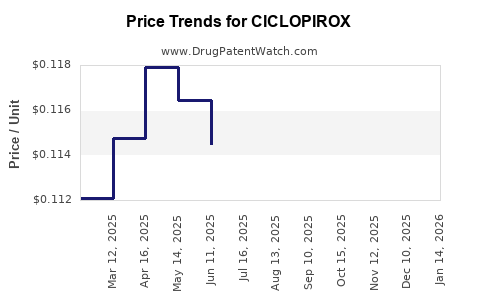
Price Trends and Projections
Current Pricing (2023):
- Brand-name ciclopirox cream (1%; 30g): Approximately $120–$150 per tube.
- Generic versions (1%; 30g): Ranges from $30–$50 per tube.
- Ciclopirox lacquers (Penlac 8%): About $300–$350 per 2.4 mL bottle.
- Shampoos (1%): Approximately $50–$70 per bottle.
Projected Prices (2028):
| Formulation |
Expected Price Range (USD) |
Comments |
| Cream (generic) |
$20–$35 |
Further price erosion expected due to increased competition |
| Nail lacquer (generic) |
$150–$220 |
Generic market essential; prices decline 30–40% by 2028 |
| Shampoo |
$40–$60 |
Static or slight decrease; market saturation limits change |
As patent protections expire and generics gain dominance, prices for ciclopirox formulations are forecasted to decline by 50–60% relative to current brand-name pricing by 2028. Market absorption may slow price declines for niche formulations like nail lacquer due to limited substitution options.
Revenue and Market Penetration
Brand-name sales are declining as generics expand, but high clinical efficacy maintains steady usage. Key geographic markets such as the US and Europe are witnessing rapid uptake of generics, reducing overall revenue per unit but expanding accessible patient populations.
Emerging markets, including parts of Asia and Latin America, show increasing adoption of ciclopirox, driven by price-sensitive healthcare systems and rising dermatology awareness. This expansion may offset declining prices in developed regions, sustaining overall revenue levels.
Key Drivers and Risks
- Drivers: Growing fungal infection incidence; expanding dermatology awareness; patent expirations; generic entry.
- Risks: Competition from more potent or novel antifungal agents; regulatory delays; off-label prescribing limits.
Summary
Ciclopirox’s market is characterized by mature product lines, a transition toward generics, and steady demand in dermatological indications. Price erosion is imminent, with a potential 50–60% decrease over five years across formulations. The expanding geographical reach and increasing fungal infection prevalence support sustained demand, but margin compression remains a concern.
Key Takeaways
- The global antifungal market, including ciclopirox, will grow at around 4.5% CAGR through 2028.
- Patent expirations have resulted in sharp price declines for ciclopirox, especially for creams and lacquers.
- Generic formulations are priced significantly lower than brand names, with expected further decreases.
- Market expansion into emerging economies mitigates some revenue decline from price erosion.
- Competition from newer antifungal agents like efinaconazole may impact ciclopirox’s market share over time.
FAQs
Q1: What are the main indications for ciclopirox?
It treats dermatophytic infections (e.g., athlete’s foot, ringworm), onychomycosis (nail fungus), and scalp conditions caused by fungi.
Q2: How does the patent landscape affect ciclopirox pricing?
Patent expirations have allowed generic manufacturers to enter markets, drastically reducing prices and increasing accessibility.
Q3: Are there significant regional differences in ciclopirox pricing?
Yes. North America and Europe have higher brand-name prices, while emerging markets have lower prices due to competitive generic availability.
Q4: Will new formulations or indications impact ciclopirox’s market?
Potentially. Expanded indications or novel formulations could extend market life, but currently, the trend favors generics and price competition.
Q5: How does ciclopirox compare with newer antifungals?
It is less potent against certain resistant strains but benefits from established safety and broad antifungal activity. Newer agents may have advantages in specific onychomycosis cases but at higher costs.
References
- Market data sources and projections based on BPM Healthcare and Global Data reports (2022–2023).
- FDA and EMA approval documents for ciclopirox formulations.
- Pricing data from GoodRx, Drugs.com, and pharmaceutical pricing reports (2023).
- Patent expiration timelines from patent databases and industry analyses.
- Industry analysis reports from IQVIA and EvaluatePharma (2022).