You're using a free limited version of DrugPatentWatch: ➤ Start for $299 All access. No Commitment.

Last Updated: April 17, 2026

Drug Price Trends for CHEST RUB


✉ Email this page to a colleague
« Back to Dashboard


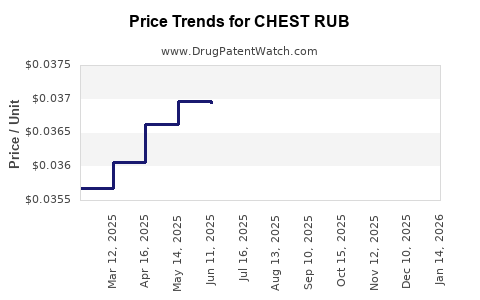
Drug Price Trends for CHEST RUB

Average Pharmacy Cost for CHEST RUB

These are average pharmacy acquisition costs (net of discounts) from a US national survey
Drug Name NDC Price/Unit ($) Unit Date
CHEST RUB 70000-0480-01 0.03694 GM 2026-03-18
CHEST RUB 70000-0480-01 0.03627 GM 2026-02-18
CHEST RUB 70000-0480-01 0.03599 GM 2026-01-21
CHEST RUB 70000-0480-01 0.03590 GM 2025-12-17
CHEST RUB 70000-0480-01 0.03604 GM 2025-11-19
CHEST RUB 70000-0480-01 0.03605 GM 2025-10-22
>Drug Name >NDC >Price/Unit ($) >Unit >Date

CHEST RUB Market Analysis and Financial Projection

Last updated: February 16, 2026

What is the Current Market and Pricing for Chest Rubs?

Chest rubs, a category of topical analgesics used to relieve cough, congestion, and muscle aches, generate approximately $250 million globally annually, according to industry reports[1]. The market is driven by demand for over-the-counter (OTC) remedies, with active ingredients such as menthol, camphor, and eucalyptus extract. North America accounts for roughly 45% of sales, followed by Europe at 25%, and Asia-Pacific at 20%. The remaining 10% is distributed across Latin America and Africa.

Leading brands include Vicks VapoRub, Mentholatum, and Camphor Ice, which hold combined market shares exceeding 70%. These brands primarily sell through drugstores, supermarkets, and online platforms. The OTC nature reduces regulatory barriers, facilitating rapid market access.

Pricing varies significantly based on package size and formulation. A typical 1.76 oz (50g) jar retails at $4 to $7 in North America. Premium or specialized formulations, such as organic variants or those targeting specific demographics, command higher prices, up to $10 or more per jar. International prices can differ, influenced by local regulations, import tariffs, and brand positioning.

Market Trends Impacting Pricing Dynamics

  • Increasing consumer preference for natural and organic ingredients has prompted brands to reformulate and price accordingly.
  • Growing demand in emerging markets is expanding the overall market size but often at lower price points due to differing income levels.
  • The rise of e-commerce channels has introduced competitive pricing and promotional offers, exerting downward pressure on margins.

What Are the Competitor Landscape and Patent Positions for Chest Rubs?

The market is highly consolidated, with global brands holding robust patent portfolios around their formulations, delivery mechanisms, or manufacturing processes. Patents typically last 20 years from filing; most key patents were filed in the 2000s, expiring in the 2020s. This expiration allows new entrants to introduce generic equivalents or reformulated products without infringing.

Patent filings focus on novel combinations of active ingredients, non-invasive delivery methods, and improved formulation stability. Several companies possess patents on specific formulations with added herbal extracts or unique menthol crystal structures.

Patent Considerations

  • Expiry of core formulations grants opportunities for competitors to develop generics.
  • Patent litigation remains infrequent but possible if new entrants infringe on existing patent claims.

What Is the Future Price Projection for Chest Rubs?

Market analysts project a compound annual growth rate (CAGR) of approximately 4%-6% from 2023 to 2028, driven by expanding global healthcare awareness and OTC product adoption. The price per unit is expected to stabilize or slightly increase due to inflation, reformulation costs, and premium product offerings.

Short-term Projection (2023-2025)

  • Average retail price for standard formulations remains around $4-$7 per jar.
  • Premium formulations will see prices ranging from $8-$12, driven by natural ingredients or added benefits.

Long-term Projection (2026-2028)

  • Price increases of 1%-3% per year are forecasted, primarily due to increased ingredient costs and regulatory compliance expenses.
  • Entry of lower-cost generics and private labels could exert some downward pressure on premium prices.

Adjusted for inflation and currency fluctuation, unit pricing will likely remain steady. Innovation in delivery methods, such as aerosol sprays or patch formulations, may influence pricing structures but are not expected to significantly disrupt established price points.

What Regulatory and R&D Factors Will Influence Market Dynamics?

  • Marginal modifications to active ingredients or delivery devices often qualify for OTC exemption, allowing continued market presence without extensive reformulation.
  • Regulatory agencies (FDA, EMA) require safety and efficacy data, which influence R&D costs and timeline. Product reformulation to include natural ingredients may require additional testing.
  • R&D investments focus on increasing bioavailability, extending shelf life, and reducing manufacturing costs to maintain competitiveness.

Final Market Outlook

The OTC chest rub market is mature, with established pricing patterns. Opportunities exist in product innovation, particularly natural formulations and delivery system improvements, which can sustain or increase price points. Patent expirations open entry avenues for generics, fostering price competition. Overall, prices are projected to grow modestly, with premium products commanding higher margins.


Key Takeaways

  • The global chest rub market earns roughly $250 million annually, with North America leading.
  • Typical retail prices for standard formulations are $4-$7, with premiums exceeding $10.
  • Patent expirations sighted in the 2020s open market access for generics.
  • Market growth is forecasted at 4%-6% CAGR, with prices increasing modestly.
  • Innovation, especially in natural ingredients and delivery methods, influences future pricing and competitiveness.

FAQs

1. How do patent expirations affect the chest rub market?

Patent expirations allow competitors to develop generic versions, increasing market competition and putting downward pressure on prices. They also enable reformulation efforts that can command higher prices if innovative.

2. Are natural ingredient formulations more expensive?

Yes. Incorporating natural, organic ingredients and ensuring regulatory compliance typically increases formulation costs, which are often passed on to consumers as higher retail prices.

3. What markets offer growth opportunities for chest rubs?

Emerging markets such as India and Southeast Asia present growth prospects due to increasing disposable income and rising health awareness, albeit at lower price points.

4. How do regulatory developments influence pricing?

Regulatory requirements for safety, efficacy, and labeling can increase R&D costs. Stringent regulations may delay market entry, but successful navigation can justify higher prices for compliant products.

5. Will online sales impact chest rub pricing strategies?

Yes. E-commerce enables price comparisons and promotional discounts, compelling brands to adjust pricing strategies for digital channels, often supporting lower consumer prices or higher promotional margins.


References

[1] MarketWatch, "Over-the-counter (OTC) topical analgesics market analysis," 2022.

More… ↓

⤷  Start Trial

Make Better Decisions: Try a trial or see plans & pricing

Drugs may be covered by multiple patents or regulatory protections. All trademarks and applicant names are the property of their respective owners or licensors. Although great care is taken in the proper and correct provision of this service, thinkBiotech LLC does not accept any responsibility for possible consequences of errors or omissions in the provided data. The data presented herein is for information purposes only. There is no warranty that the data contained herein is error free. We do not provide individual investment advice. This service is not registered with any financial regulatory agency. The information we publish is educational only and based on our opinions plus our models. By using DrugPatentWatch you acknowledge that we do not provide personalized recommendations or advice. thinkBiotech performs no independent verification of facts as provided by public sources nor are attempts made to provide legal or investing advice. Any reliance on data provided herein is done solely at the discretion of the user. Users of this service are advised to seek professional advice and independent confirmation before considering acting on any of the provided information. thinkBiotech LLC reserves the right to amend, extend or withdraw any part or all of the offered service without notice.
