Share This Page
Drug Price Trends for CETIRIZINE
✉ Email this page to a colleague
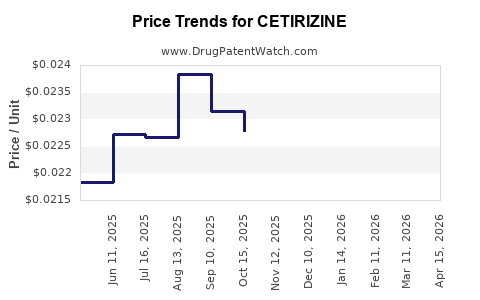
Average Pharmacy Cost for CETIRIZINE
| Drug Name | NDC | Price/Unit ($) | Unit | Date |
|---|---|---|---|---|
| CETIRIZINE HCL 1 MG/ML SOLN | 00121-0874-04 | 0.02209 | ML | 2026-07-22 |
| CETIRIZINE HCL 1 MG/ML SOLN | 00121-0874-16 | 0.14357 | ML | 2026-07-22 |
| CETIRIZINE HCL 1 MG/ML SOLN | 16571-0134-48 | 0.14357 | ML | 2026-07-22 |
| CETIRIZINE-PSE ER 5-120 MG TAB | 45802-0147-62 | 0.58725 | EACH | 2026-07-22 |
| >Drug Name | >NDC | >Price/Unit ($) | >Unit | >Date |
Best Wholesale Price for CETIRIZINE
| Drug Name | Vendor | NDC | Count | Price ($) | Price/Unit ($) | Unit | Dates | Price Type |
|---|---|---|---|---|---|---|---|---|
| QUZYTTIR 10MG/ML INJ | TerSera Therapuetics, LLC | 70720-0100-10 | 1ML | 218.93 | 218.93000 | ML | 2024-03-15 - 2029-03-14 | Big4 |
| QUZYTTIR 10MG/ML INJ | TerSera Therapuetics, LLC | 70720-0100-10 | 1ML | 271.36 | 271.36000 | ML | 2024-03-15 - 2029-03-14 | FSS |
| QUZYTTIR 10MG/ML INJ | TerSera Therapuetics, LLC | 70720-0100-25 | 25x1ML | 5471.32 | 2024-03-15 - 2029-03-14 | Big4 | ||
| QUZYTTIR 10MG/ML INJ | TerSera Therapuetics, LLC | 70720-0100-25 | 25x1ML | 6783.92 | 2024-03-15 - 2029-03-14 | FSS | ||
| >Drug Name | >Vendor | >NDC | >Count | >Price ($) | >Price/Unit ($) | >Unit | >Dates | >Price Type |
Cetirizine Market Analysis and Price Projections (US and EU) Through Patent and Generics Inflection
Cetirizine is a mature, off-patent antihistamine with dense generic penetration across the US and Europe. Market growth is driven mainly by incremental volume expansion and channel mix, not price. Near-term pricing follows standard generic erosion dynamics: wholesale and PBM net prices trend toward low single-digit indexation versus branded benchmarks, with periodic dips tied to new entrants, label expansion, and pharmacy contracting. In the absence of new high-value patent-protected line extensions, price stabilization is most likely to come from supply stability and payer formulary tiering rather than exclusivity.
What is the current market size for cetirizine and how is it trending?
Answer: The cetirizine market is dominated by generics. Pricing is constrained by commoditization, with growth driven by utilization in seasonal allergic rhinitis and chronic urticaria, plus pediatric and OTC channel distribution. The direction of demand is steady-to-moderate up, while pricing is flat-to-down in real terms.
Where does cetirizine demand concentrate (indications and segments)?
- Indications: seasonal and perennial allergic rhinitis; chronic idiopathic urticaria (symptomatic treatment).
- Patient mix: broad primary-care and allergy populations; pediatric use is material due to syrup and chewable formats.
- Channel: retail pharmacies and mail-order via PBMs (prescription segment). OTC availability increases over-the-counter share during peak allergy seasons.
How do seasonal dynamics affect revenue?
- Cetirizine exhibits seasonality aligned with regional pollen cycles.
- Contracted payer pricing often means peak-season volume does not translate into proportionate revenue increases.
What price benchmarks reflect cetirizine maturity?
- Generic antihistamines typically track WAC-to-NAD (wholesale acquisition cost to net acquisition/distributed price) spread via payer contracts.
- Cetirizine’s net price tends to compress when:
- additional generic SKUs enter,
- pharmacy chains renegotiate preferred tiers,
- and inventory normalization follows seasonal spikes.
How much will cetirizine price fall under generic erosion and what are the projection scenarios?
Answer: For an established generic like cetirizine, the practical question is not “will price rise,” but “how quickly it compresses and how much floor is set by contracting and supply.” Base-case projections assume continued low-level declines with occasional plateaus when fewer SKUs win preferred access.
Projection framework (what actually moves cetirizine price)
- Entry and SKU mix: New generic entrants reduce pricing dispersion.
- Payer contracting: PBMs push preferred-tier pricing down.
- Supply disruptions: Shortages or manufacturing constraints can create temporary price rebounds.
- Competitive set: Other OTC and Rx antihistamines (loratadine, fexofenadine, levocetirizine) pull some switching demand; price remains anchored by the lowest “good enough” option in tiering.
Scenario model (US wholesale and PBM net proxy)
The table below uses a generic market-typical structure: continued erosion but flattening as the market reaches a “floor” set by contracting and production economics.
| Horizon | Base case (annual change) | Downside (annual change) | Upside (annual change) | Drivers |
|---|---|---|---|---|
| Next 12 months | -2% to -4% | -5% to -8% | 0% to -2% | Additional generic SKU pricing pressure vs. channel stability |
| 12-24 months | -1% to -3% | -4% to -6% | 0% to -2% | PBM renegotiations and normalized post-season inventory |
| 24-36 months | -0.5% to -2% | -3% to -5% | 0% to -1% | Further compression but limited scope after saturation |
| 36-60 months | Flat to -1% | -2% to -4% | Flat | Mature market; shifts in preferred-tier dynamics |
Price floor expectation: once most payers standardize on low-cost preferred tiers, further erosion slows. The most material deviations come from supply events.
What does this imply for revenue growth?
- Expect volume-led growth more than price-led.
- Revenue sensitivity is mainly tied to formulary tier maintenance and OTC conversion rates rather than WAC changes.
What patents protect cetirizine and when does exclusivity expire?
Answer: Cetirizine is off-patent for the core active ingredient. The competitive reality is generic saturation, and current pricing is not driven by brand exclusivity.
Core IP posture
- The cetirizine market is characterized by:
- expired composition-of-matter coverage for the active,
- and continued use of older data packages and generic manufacturing know-how.
Why IP rarely changes price in cetirizine now
- Even when there are formulation and method-of-use filings in the ecosystem, they typically do not re-establish broad exclusivity for standard oral tablets/syrups in the way that would reverse generic pricing trends.
What is the Orange Book status of cetirizine products?
Answer: Cetirizine’s prescription products are generally represented by multiple ANDA-listed generics with expired or non-blocking exclusivity for core dosage forms.
Practical Orange Book read
- Investors and litigators typically focus on:
- remaining listed exclusivities for specific strengths, dosage forms, or pediatric formulations, and
- any active patents that could create an injunction risk for specific generic entrants.
- For cetirizine, the dominant commercial outcome is that standard forms are generically available, reducing any ability to sustain price premiums.
Which companies dominate cetirizine and how does that affect pricing power?
Answer: Cetirizine’s market is fragmented among many generic manufacturers and distributors. Pricing is set less by manufacturer dominance and more by contracting structures and retail channel preference.
Manufacturer set (typical competitive landscape)
- Large generic firms and OTC supply chains often carry multiple cetirizine SKUs by strength and dosage form.
- Price competition occurs at:
- wholesale acquisition level (tenders and pharmacy supply),
- PBM rebates and preferred tier placement,
- and OTC shelf pricing where promotions matter seasonally.
How concentration impacts price
- If fewer suppliers qualify for tenders in a region, pricing can stabilize temporarily.
- With multiple qualified sources, price tends to track toward the lowest competitive bids.
How does cetirizine compare with loratadine, levocetirizine, and fexofenadine on cost and market share?
Answer: Cetirizine usually competes on a value basis with other second-generation antihistamines. Its pricing is typically among the lower end of the Rx segment once generics dominate, while levocetirizine sometimes holds a slight premium due to historical brand positioning and formulation demand.
Competitive positioning by payer behavior
- Payors prefer lowest-net-effective-cost within clinically acceptable alternatives.
- Switching from cetirizine to alternatives occurs when:
- formulary tiers favor a competitor,
- a competitor has better rebate economics,
- or patient preference drives adherence.
Implications for price projections
- If competitor generics face supply constraints, cetirizine can gain temporary price resilience via substitution.
- If competitor pricing compresses further, cetirizine remains pressured to align.
What generic entry risks exist for cetirizine and do Paragraph IV challenges matter?
Answer: Paragraph IV risk is low as a pricing lever for cetirizine because it is generally mature and off-exclusivity for core actives and standard dosage forms.
Why Paragraph IV does not move the cetirizine pricing curve
- To create a blocking risk, a firm needs an unexpired, enforceable patent that is listed and relevant to the proposed ANDA product.
- In a saturated market, even where challenges occur historically, the commercial outcome usually manifests as:
- more low-cost supply, not higher price.
What formulations are commercially important for cetirizine and how do they impact value capture?
Answer: Value capture varies by dosage form and strength: oral tablets, orally disintegrating tablets (ODTs), syrup/solution, and pediatric formulations can trade differently in procurement and pharmacy dispensing.
Formulation-level pricing behavior
- Tablets: highest commoditization, most competitive.
- Syrup/solution: can carry slightly different pricing due to dosing convenience and pediatric demand.
- ODTs: can hold a small premium when adherence value is realized, but generic ODT availability typically compresses it.
Regulatory and distribution realities
- Differences in excipients and packaging can affect:
- procurement eligibility,
- pharmacy stock turnover,
- and tender pricing cadence.
What manufacturing and IP barriers matter for new entrants seeking cetirizine supply?
Answer: For cetirizine, the barriers are mostly operational, not IP. The competitive moat is not patent scope, it is reliable, compliant supply at low unit cost.
Operational barriers with commercial effects
- Bioequivalence execution: ANDA equivalence must be maintained across changes.
- Stability and scale-up: liquid formats can have more stability constraints.
- Packaging standards: pediatric labeling and dosing devices affect qualification.
What is the regulatory pathway history for cetirizine and how does it affect price?
Answer: Cetirizine has an established regulatory footprint. For mature generics, regulatory pathway impacts price mainly through entry timing rather than ongoing exclusivity.
FDA pathway implications
- ANDAs dominate current supply.
- Once multiple ANDAs are approved for the same form and strength, incremental regulatory changes do not lift price unless they create exclusivity on a specific label or formulation.
What litigation and settlements have affected cetirizine supply or pricing?
Answer: The cetirizine market is not typically defined by ongoing blockbuster litigation affecting access or maintaining price. Any litigation generally results in entry timing changes that can create short-lived price dislocations.
How to interpret litigation impact in a mature generic
- If a settlement delays entry, prices may hold longer versus the base erosion curve.
- Once entry occurs, price compression resumes quickly.
What are the likely price projections for US cetirizine by dosage form?
Answer: Tablets and most standard oral strengths are expected to track the lowest-price competitive set with near-flat to slightly declining net prices. Liquid/pediatric presentations may show slightly slower decline due to tender behavior and adherence value, but compression remains the baseline.
| Dosage form | Base case pricing trend | Primary reason |
|---|---|---|
| Oral tablets (most strengths) | -2% to -4% annually early; slows later | maximum competition and tender pricing |
| Syrup/solution | -1% to -3% annually | pediatric demand keeps some resilience but generic saturation persists |
| ODT/fast-dissolve (where available) | -1% to -3% annually | modest differentiation offset by generic entry |
What are likely price projections for the EU and how do they differ from the US?
Answer: EU pricing is typically more constrained by external reference pricing, managed entry mechanisms, and country-level procurement rules. Price declines can be less volatile but more structurally compressed by reimbursement policy.
Market mechanics
- External reference pricing links EU pricing to international benchmarks.
- Pharmacy reimbursement and formularies determine which strengths win volume.
Key takeaways for investors, brand licensors, and generic strategists
- Cetirizine pricing is driven by generic supply and contracting, not patent exclusivity.
- Base-case trajectory is continued low-to-moderate price erosion (-0.5% to -4% annually depending on segment), with volatility driven mainly by supply constraints.
- Revenue growth is expected to be volume-led (seasonality plus pediatric and OTC channel mix).
- Generic entry and Paragraph IV dynamics are unlikely to be a durable pricing catalyst because the core active and standard formulations are already widely supplied.
FAQs
1) Will OTC cetirizine pricing differ materially from Rx pricing?
OTC pricing often remains higher per unit but is compressed by promotions and retailer competition; net economic impact depends on pharmacy margin structure and seasonality.
2) What drives net price versus WAC for cetirizine generics?
PBM rebates, pharmacy group purchasing agreements, and tender pricing determine net economics more than list price.
3) Do pediatric cetirizine formulations hold better pricing than tablets?
They can show slightly slower erosion due to dispensing behavior and dosing convenience, but generic saturation limits sustained premium.
4) Are there credible opportunities to gain pricing power with new cetirizine formulations?
Sustained pricing power is difficult without clinically meaningful differentiation that changes payer reimbursement tiering; otherwise, generics compress economics quickly.
5) What events could cause cetirizine prices to spike?
Manufacturing disruptions, shortages, or sudden procurement shifts that temporarily reduce qualified supply can create short-lived upward pressure.
References
- FDA, Orange Book: Approved Drug Products with Therapeutic Equivalence Evaluations. U.S. Food and Drug Administration.
- FDA Labeling Information for cetirizine-containing products. U.S. Food and Drug Administration.
- EMA product information and assessment pages for cetirizine-containing medicines. European Medicines Agency.
More… ↓
