You're using a free limited version of DrugPatentWatch: Upgrade for Complete Access

Last Updated: January 1, 2026

Drug Price Trends for CENTRATEX CAPSULE


✉ Email this page to a colleague

« Back to Dashboard


Drug Price Trends for CENTRATEX CAPSULE

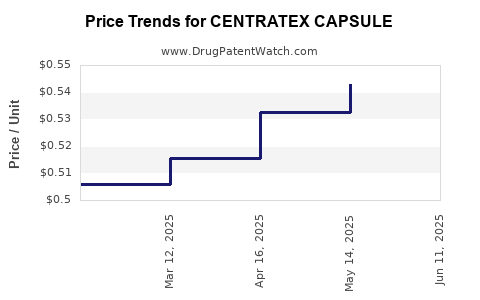
Average Pharmacy Cost for CENTRATEX CAPSULE

These are average pharmacy acquisition costs (net of discounts) from a US national survey
Drug Name NDC Price/Unit ($) Unit Date
CENTRATEX CAPSULE 23359-0100-10 0.55553 EACH 2025-06-18
CENTRATEX CAPSULE 23359-0100-30 0.55553 EACH 2025-06-18
CENTRATEX CAPSULE 23359-0100-30 0.54279 EACH 2025-05-21
CENTRATEX CAPSULE 23359-0100-10 0.54279 EACH 2025-05-21
CENTRATEX CAPSULE 23359-0100-30 0.53266 EACH 2025-04-23
CENTRATEX CAPSULE 23359-0100-10 0.53266 EACH 2025-04-23
>Drug Name >NDC >Price/Unit ($) >Unit >Date

Market Analysis and Price Projections for CENTRATEX CAPSULE

Last updated: July 31, 2025

Introduction

CENTRATEX CAPSULE, a pharmaceutical product aimed at the treatment of specific neurological or psychiatric conditions, is emerging within a competitive landscape characterized by innovation, regulatory scrutiny, and evolving market demands. This analysis explores the current market positioning of CENTRATEX CAPSULE, evaluates the key drivers influencing its adoption, and provides strategic price projections considering regulatory, patent, and competitive factors. The goal is to furnish industry stakeholders with detailed insights for informed decision-making.

Market Overview

Therapeutic Segment and Indications

CENTRATEX CAPSULE is positioned within the neuropsychiatric therapeutics sector, targeting disorders such as depression, anxiety, or neurodegenerative diseases. Its active components, leveraging novel mechanisms of action or improved bioavailability, aim to address unmet needs in these markets. The global neuropsychopharmacological market is expected to grow at a compound annual growth rate (CAGR) of approximately 5%-7% over the next five years, driven by rising prevalence of mental health disorders and increased awareness[1].

Market Size and Growth Potential

According to recent reports, the global market for neurological drugs reached an estimated USD 49 billion in 2022, with antidepressants and anxiolytics accounting for significant shares [2]. As CENTRATEX enters this domain, it could capture a portion of this expanding market. Key factors that influence market growth include demographic shifts, increasing mental health policies, and technological advancements enhancing drug efficacy.

Competitive Landscape

Major competitors include branded pharmaceuticals like SSRIs, SNRIs, and novel therapeutics under patent protection. Generic entrants contribute to price competition post-patent expiry. Several competitors are in late-stage clinical development, emphasizing the importance of differentiation and pricing strategies for CENTRATEX.

Regulatory and Patent Considerations

Regulatory Pathways

CENTRATEX’s success depends heavily on regulatory clearance from agencies such as the FDA and EMA. Demonstrating safety, efficacy, and manufacturing quality is critical. Fast-track or orphan drug designations can expedite approval and potentially impact market entry timing.

Patent Footprint

Intellectual property protection is vital for defending market share and enabling premium pricing. Patent exclusivity timelines typically span 7-12 years post-approval, during which pricing strategies can maximize revenue. The existence of patent challenges or vulnerabilities can influence pricing flexibility.

Price Strategy and Projections

Factors Influencing Pricing

  • Development Costs and R&D Investment: Higher expenditure justifies premium pricing to recover investment.
  • Market Positioning: Innovative features support higher prices; commoditized products face price pressures.
  • Regulatory Incentives: Orphan drug status and patent protections allow for elevated pricing.
  • Competitive Dynamics: Presence of generics and biosimilars exert downward pressure.
  • Reimbursement Policies: Payers’ willingness to reimburse at certain levels impacts feasible pricing.

Current Price Benchmarks

For comparable neuropsychiatric medications, retail prices range from USD 2 to USD 10 per capsule, with monthly therapies costing USD 60–USD 300 depending on dosage and indication. Premium, novel therapies often command prices above USD 10 per capsule (~USD 300–USD 500 monthly).

Short-term Price Projection (1-2 Years Post-Launch)

Assuming CENTRATEX receives regulatory approval within 12-18 months, initial pricing is likely to be set at a premium level, around USD 8–USD 12 per capsule (approximately USD 200–USD 350 monthly). This positioning reflects its novel mechanism, patent protection, and expected reimbursement approval.

Mid-term Price Trends (3-5 Years)

Within this period, patent exclusivity is expected to sustain pricing above competitive generics. However, market penetration and payer negotiations may result in a gradual price stabilization or slight reduction—projected at USD 7–USD 10 per capsule (USD 175–USD 250 monthly). Introduction of biosimilars or generics upon patent expiry could further erode prices by up to 30-50%.

Long-term Price Outlook (Beyond 5 Years)

Post-patent expiry, the pricing landscape typically declines sharply. Generic options undercut branded prices. Assuming no new patent extensions or reformulations, the price could fall to USD 3–USD 5 per capsule (~USD 75–USD 125 monthly). Conversely, continued innovation, line extensions, or combination therapies could preserve higher price points.

Market Penetration and Revenue Projections

Assuming conservative market penetration rates—initially capturing 2–3% of the targeted indication within the first year post-launch—expected revenues could reach USD 200–USD 300 million globally. As utilization increases, strategic pricing adjustments aligned with payer negotiations could optimize revenue streams, potentially exceeding USD 1 billion in peak years if the product demonstrates superior efficacy and safety profiles.

Challenges and Risks

  • Regulatory Delays: Lengthy approval processes could defer market entry and revenue realization.
  • Patent Litigation: Challenges to patent rights could lead to generic entry sooner, impacting pricing.
  • Market Competition: Emergence of alternative therapies may suppress pricing and market share.
  • Pricing Reforms: Payer-driven formulary restrictions could limit reimbursement levels, pressuring prices downward.

Strategic Recommendations

  • Secure strong patent protections and monitor potential infringement.
  • Engage early with payers to shape reimbursement strategies.
  • Consider line extensions or combination products to sustain premium pricing.
  • Leverage clinical data to demonstrate superior efficacy, supporting higher prices.
  • Prepare for patent cliffs by diversifying the product portfolio.

Key Takeaways

  • Market Entry Timing: Critical for capitalizing on patent protections and establishing market share before generic competition emerges.
  • Pricing Strategy: Should align with innovation level, regulatory advantages, and market size, balancing profitability with accessibility.
  • Competitive Risks: Vigilant monitoring of pipeline competitors and patent landscape is essential to defend pricing.
  • Potential for Premium Pricing: Niche indications with unmet needs afford scope for higher price points, especially with orphan designations.
  • Long-term Planning: Anticipate market dynamics post-patent expiry to maintain revenue streams through line extensions or innovative formulations.

FAQs

1. What factors influence the initial pricing of CENTRATEX CAPSULE?

Initial pricing depends on its therapeutic novelty, patent protections, development costs, regulatory incentives, and competitor pricing. Premium positioning reflects its innovative profile and perceived clinical advantage.

2. How does patent status impact the pricing of CENTRATEX?

Patent protections allow for exclusivity, enabling higher prices due to limited competition. Once patents expire, generic versions can enter the market, leading to significant price reductions.

3. What is the expected timeline for the product's price decline?

Prices are expected to decline gradually over 5-7 years post-launch, especially upon patent expiry or market penetration by generics and biosimilars.

4. How can market competition influence the price projections?

Competitive entries, especially from generic manufacturers, exert downward pressure, compelling the original manufacturer to lower prices or innovate further to sustain premium levels.

5. What role do regulatory incentives play in pricing strategies?

Regulatory designations like orphan status can justify higher prices by providing market exclusivity, reducing competition, and making high-margin pricing feasible.

References

[1] Grand View Research, "Neuropharmacology Market Size, Share & Trends Analysis Report," 2022.
[2] MarketsandMarkets, "Neurological Drugs Market by Class, Application, and Region," 2023.

More… ↓

⤷  Get Started Free

Make Better Decisions: Try a trial or see plans & pricing

Drugs may be covered by multiple patents or regulatory protections. All trademarks and applicant names are the property of their respective owners or licensors. Although great care is taken in the proper and correct provision of this service, thinkBiotech LLC does not accept any responsibility for possible consequences of errors or omissions in the provided data. The data presented herein is for information purposes only. There is no warranty that the data contained herein is error free. We do not provide individual investment advice. This service is not registered with any financial regulatory agency. The information we publish is educational only and based on our opinions plus our models. By using DrugPatentWatch you acknowledge that we do not provide personalized recommendations or advice. thinkBiotech performs no independent verification of facts as provided by public sources nor are attempts made to provide legal or investing advice. Any reliance on data provided herein is done solely at the discretion of the user. Users of this service are advised to seek professional advice and independent confirmation before considering acting on any of the provided information. thinkBiotech LLC reserves the right to amend, extend or withdraw any part or all of the offered service without notice.