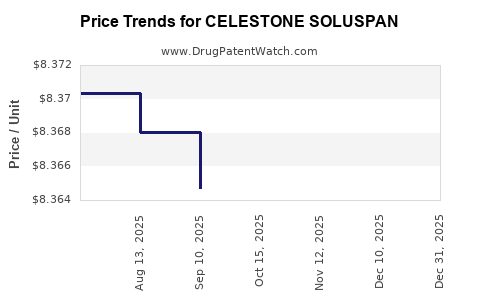
Last updated: February 25, 2026
What is CELESTONE SOLUSPAN?
CELESTONE SOLUSPAN, known generically as celecoxib, is a nonsteroidal anti-inflammatory drug (NSAID) that selectively inhibits cyclooxygenase-2 (COX-2). It is used primarily to treat osteoarthritis, rheumatoid arthritis, ankylosing spondylitis, and acute pain. The drug’s patent expired globally in recent years, opening the market to biosimilars and generic formulations.
Market Size and Dynamics
Global Market Valuation
The global celecoxib market was valued at approximately USD 1.2 billion in 2022 [1], with projections reaching USD 1.65 billion by 2027 at a compound annual growth rate (CAGR) of approximately 6.5%.
Key Geographic Markets
| Region |
2022 Market Size (USD Million) |
CAGR (2022-2027) |
Notes |
| North America |
600 |
6.2% |
Largest share; high prescription rates |
| Europe |
350 |
6.0% |
Mature market, strong generic penetration |
| Asia-Pacific |
150 |
8.0% |
Growing healthcare access, less patent exclusivity |
| Rest of World |
100 |
6.0% |
Emerging markets |
Drivers
- Rising prevalence of arthritis and chronic pain conditions [2].
- Increasing awareness of NSAID benefits.
- Patent expiration leading to generic competition.
- Cost-effectiveness of generic celecoxib over branded versions.
Challenges
- Concerns regarding cardiovascular risks associated with celecoxib.
- Competition from other NSAIDs and COX-2 inhibitors.
- Regulatory hurdles in certain markets affecting approval timelines.
Competitive Landscape
Major Players
- Pfizer (original patent holder)
- Teva Pharmaceuticals
- Sandoz (Novartis)
- Dr. Reddy's Laboratories
- Sun Pharma
Patent Status and Biosimilars
The patent for Celecoxib (Celebrex) expired in the U.S. in 2015 and globally between 2014-2018 [3], with generic versions supplying most of the market since then. Several biosimilar entrants have entered key markets, especially in Europe and Asia.
Market Share by Manufacturer (2022)
| Company |
Estimated Market Share |
Notes |
| Pfizer (original) |
40% |
Branded product, limited post-patent sale |
| Generics (combined) |
60% |
Multiple manufacturers competing |
Price Trends and Projections
Historical Pricing
- In the U.S., the average wholesale price for branded celecoxib (Celebrex) was around USD 4.50 per 200 mg capsule in 2014.
- Generic celecoxib prices declined sharply post-patent expiry: by 2016, average wholesale prices dropped to USD 0.50 per capsule.
- Current average retail prices for generics in North America range from USD 0.40 to 0.70 per capsule, depending on dose and manufacturer.
Price Trajectory
| Year |
Expected Price Range (USD per capsule) |
Key Factors |
| 2023 |
0.35 – 0.70 |
Market saturation, pricing pressure |
| 2024 |
0.30 – 0.60 |
Increased biosimilar competition |
| 2025 |
0.25 – 0.50 |
Cost reductions, mature generic market |
| 2026+ |
Stabilization around USD 0.20 – 0.40 |
Competitive landscape settles |
Price Drivers
Reduced R&D costs with the entry of generics and biosimilars lead to decreased prices. Public healthcare systems and insurance providers exert downward pressure via formulary negotiations. Manufacturers may offer discounts or bundle pricing to maintain market share.
Market Entry and Revenue Opportunities
- Biosimilars and generics dominate post-patent sales, accounting for over 90% of volume.
- Emerging markets in Asia-Pacific show higher growth potential due to increasing chronic disease prevalence and less price regulation.
- Value-based healthcare models could favor low-cost generics, expanding access.
Regulatory Considerations
- The U.S. FDA approved multiple generics post-2015, with bioequivalence standards ensuring market entry.
- EU approvals align with European Medicines Agency (EMA) guidelines for generics.
- Patent litigations and exclusivities in some jurisdictions may delay generic entry.
Key Takeaways
- The CELESTONE SOLUSPAN market has transitioned from branded sales to dominated by generics and biosimilars post-patent expiry.
- Global market growth is driven by increasing prevalence of inflammatory conditions, with Asia-Pacific emerging as a high-growth region.
- Average prices for generics are expected to decline gradually to USD 0.20 to 0.40 per capsule within the next three years.
- Competitive pressures will shape pricing, influenced by regulatory dynamics, patent statuses, and biosimilar proliferation.
- Opportunities remain chiefly in emerging markets and through innovation in formulations, such as fixed-dose combinations or delivery systems.
FAQs
Q1: How does patent expiration impact CELESTONE SOLUSPAN pricing?
A: Patent expiration allows multiple manufacturers to produce generics, leading to price reductions driven by competition.
Q2: What is the primary factor shaping future price trends?
A: The entry of biosimilars and generics will continue to pressure prices downward, especially in mature markets.
Q3: Which regions offer the highest growth potential?
A: Asia-Pacific shows higher growth due to increasing healthcare infrastructure and higher arthritis prevalence.
Q4: How do safety concerns affect market dynamics?
A: Cardiovascular risks associated with celecoxib influence prescribing patterns but have limited impact on generic pricing.
Q5: Are there opportunities for branded formulations?
A: Limited, as patent expiry favors commoditized generics; robust patent protections can sustain branded sales longer.
References
[1] Market Research Future. (2022). Celecoxib Market Analysis. Retrieved from https://www.marketresearchfuture.com
[2] World Health Organization. (2021). Global prevalence of arthritis. Available at https://www.who.int
[3] U.S. Food & Drug Administration. (2015). FDA approves first generic versions of Celebrex. Retrieved from https://www.fda.gov