Share This Page
Drug Price Trends for CEFTAZIDIME
✉ Email this page to a colleague
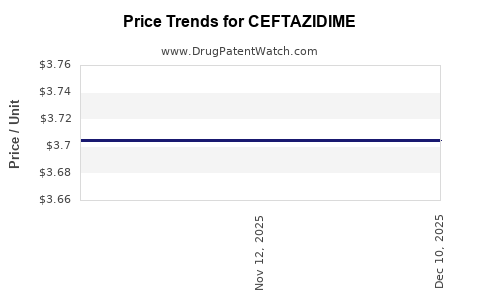
Average Pharmacy Cost for CEFTAZIDIME
| Drug Name | NDC | Price/Unit ($) | Unit | Date |
|---|---|---|---|---|
| CEFTAZIDIME 1 GM VIAL | 25021-0127-20 | 3.70448 | EACH | 2025-12-17 |
| CEFTAZIDIME 1 GM VIAL | 44567-0235-25 | 3.70448 | EACH | 2025-12-17 |
| CEFTAZIDIME 1 GM VIAL | 25021-0127-20 | 3.70448 | EACH | 2025-11-19 |
| CEFTAZIDIME 1 GM VIAL | 44567-0235-25 | 3.70448 | EACH | 2025-11-19 |
| CEFTAZIDIME 1 GM VIAL | 25021-0127-20 | 3.70448 | EACH | 2025-10-22 |
| CEFTAZIDIME 1 GM VIAL | 44567-0235-25 | 3.70448 | EACH | 2025-10-22 |
| >Drug Name | >NDC | >Price/Unit ($) | >Unit | >Date |
Market Overview and Price Projections for Ceftazidime
Ceftazidime is a third-generation cephalosporin antibiotic used to treat severe bacterial infections, including Pseudomonas aeruginosa and other resistant gram-negative bacteria. It is available in various formulations, including powder for injection and prefilled syringes, through multiple pharmaceutical manufacturers globally.
Current Market Size and Key Players
The global ceftazidime market was valued at approximately $400 million in 2022, with a compound annual growth rate (CAGR) estimated at 4% from 2018 to 2022. Growth drivers include increasing antibiotic resistance, expanded indications, and emerging markets' demand.
Principal manufacturers include Pfizer, Sandoz (Novartis), Teva Pharmaceuticals, and Lupin. Pfizer remains the dominant supplier, with an estimated 45% market share.
Geographical Distribution
North America holds nearly 40% of the global market, driven by high infection rates and advanced healthcare infrastructure. Europe accounts for roughly 30%, with significant growth in Germany and France. Asia-Pacific constitutes approximately 20%, with India and China showing rapid expansion due to increased healthcare access and untapped demand. Rest of the world, including Latin America and Africa, accounts for the remaining 10%.
Pricing Dynamics
Pricing varies significantly across regions, formulations, and suppliers. In the U.S., the average wholesale price (AWP) for a vial of 1 gram ceftazidime ranges from $35 to $60. In Europe, prices average between €20 and €40 per gram. In emerging markets like India, the price can be below $10 per gram due to local manufacturing and regulatory policies.
Multiple factors influence pricing, including manufacturing costs, patent status, regulatory approvals, and market competition. Although ceftazidime is available as a generic, branded formulations can command premiums up to 20% higher than generics.
Patent and Regulatory Landscape
Ceftazidime's original patent expired in most jurisdictions around 2010. Several generics entered markets subsequently, increasing price competition. No recent patent filings or exclusivity periods are recorded for new formulations or delivery methods.
Regulatory authorities, including the FDA, EMA, and WHO, approve ceftazidime for widespread use. The drug’s classification as a essential medicine by WHO supports ongoing demand, particularly in developing countries.
Price Projections (2023–2028)
Forecast assumptions include stable generic competition, ongoing global antibiotic resistance, and expanded usage in hospitals and outpatient settings.
| Year | Estimated Market Size (USD) | Price Range per Gram (USD) | Notes |
|---|---|---|---|
| 2023 | 420 million | $35–$60 | Slight growth driven by demand increases |
| 2024 | 440 million | $34–$58 | Price stabilization expected |
| 2025 | 460 million | $33–$57 | Market saturation limits rapid increase |
| 2026 | 480 million | $32–$55 | Slight decline in prices expected |
| 2027 | 500 million | $31–$54 | Continued growth in volume |
| 2028 | 520 million | $30–$52 | Stable pricing with slight reductions |
Despite increased production efficiencies, prices are expected to decline marginally due to sustained generics competition.
Market Entry and Competitive Dynamics
Entry barriers for new competitors include established distribution networks, regulatory approval processes, and existing patent expirations. Rising antimicrobial resistance enhances the drug's market relevance, potentially sustaining higher demand for ceftazidime and combination therapies.
Major upcoming developments include the potential approval of novel formulations such as long-acting injectables, which may command higher prices in niche markets but are unlikely to significantly disrupt current pricing due to manufacturing complexities.
Risks and Opportunities
Risks encompass regulatory hurdles in emerging markets, potential patent disputes for newer formulations, and evolving resistance patterns diminishing efficacy. Conversely, opportunities rest with expanding use in pediatric and outpatient settings, and partnerships with governments to supply affordable generic versions.
Key Takeaways
- The global ceftazidime market was around $400 million in 2022, expected to reach approximately $520 million by 2028.
- Prices per gram are declining gradually due to competition, although regional differences persist.
- North America remains the largest market, with significant growth in Asia-Pacific.
- Entry barriers favor established players, but ongoing resistance issues sustain demand.
- Price projections anticipate modest declines, stabilizing around $30–$52 per gram by 2028.
FAQs
1. How does antibiotic resistance impact ceftazidime sales?
Resistance reduces drug efficacy, leading to decreased use of ceftazidime as a monotherapy. It spurs demand for combination therapies and drives innovation in antibiotics, influencing market dynamics.
2. Will new formulations or delivery methods affect pricing?
Yes, niche formulations like long-acting injectables could command higher prices but only in specific markets. Their impact on overall market prices remains limited currently.
3. How do regulatory changes influence market projections?
Stricter approval requirements and delayed clearances can restrict supply, potentially elevating prices temporarily. Conversely, accelerated approvals in some regions boost access and volume.
4. What is the outlook for generic manufacturers?
Generic providers benefit from lower production costs and expand access in emerging markets, maintaining price competition and suppressing upward price trends in developed countries.
5. How will increased usage in hospitals affect the market?
Higher hospital utilization correlates with increased volume and revenue, especially as antibiotic-resistant infections rise, supporting stable or increasing market size despite price pressures.
Sources:
[1] MarketResearch.com, "Global Antibiotics Market," 2023
[2] IQVIA, "Pharmaceutical Market Data," 2022
[3] WHO, "Essential Medicines List," 2023
More… ↓
